

By the beginning of 1913, Lovis Corinth had essentially overcome the consequences of his stroke in late 1911. His painting style had moved on, although not because of any residual physical limitations, and he and his family were starting to build a new lifestyle that would hopefully preserve his health better. Key to that was getting away more from Berlin.

By 1913, in his Self-portrait with Tyrolean Hat, he appears to be on holiday in the South Tyrol, marked by his headgear and the inscription at the right. However, his face has become more gaunt and worried. Although he appears to be holding his brush in his right hand, it’s actually clasping several brushes and his palette, indicating that he was painting with his left hand. If painted from a mirror image, of course, the handedness could be reversed. There doesn’t appear to have been any significant change in his brushwork.

Corinth dons his suit of armour again for his 1914 Self-portrait in Armour, holding a pole in his left hand, assuming the image isn’t mirrored. This is an excellent comparator against his 1911 portrait: there has been little if any change in facture, but his face has changed, and there is still worry in his expression. His chin is no longer raised in pride, but he stares straight ahead with determination.
Painted at the start of the First World War, his armour here is probably a response to that, and to the universal call to arms. Corinth had a great admiration for Otto von Bismarck.

Self-portrait in the Studio (1914) is the last in this series of self-portraits, and shows him painting with the brush held in his left hand, although this would be reversed if the image was mirrored. He appears older, more anxious, perhaps even stressed, as he looks directly at the viewer. Again, there’s little apparent change in his brushwork from 1911.

At some stage, perhaps during the winter of 1912-13, Corinth and his wife stayed in the French resort of Menton (1913), where he painted this excellent and detailed view. Although clearly dated, his verticals are once again leaning towards the left, as they had been soon after his stroke.

His flattening of perspective is well illustrated in Skittle Alley (1913). This shows an outdoor skittle alley close to a building that is presumably behind the viewer. In the foreground is a table laid up for a meal, to the left of which is a chair. A man, his back to the viewer, is just about to bowl at the skittles shown at the far end of a level alley, cut through the wood.
With its high vanishing point, the alley seems shallow and much higher at its far end, and could easily be seen as rising at an angle of over 45 degrees. The distant landscape seen through the gap at the end of the alley has no aerial perspective, providing no clues as to its distance. Corinth has depicted this as if everything from the alley beyond is on a flat plane, like a theatrical scenery painting, parallel to the picture plane, and only slightly deeper than the table and chair.
This is believed to have been painted when Corinth had been invited to the property of Carl von Glantz, a friend of one of his students, at Mecklembourg. It’s reminiscent of Dutch paintings of the seventeenth century showing similar games taking place outdoors.

He continued to paint still lifes, such as this Cat’s Breakfast (1913); some of these became so loose as to show only the most basic forms of the objects.

Contrary to claims that this change in style was driven by the results of his stroke, Corinth still painted more detailed figurative works, such as this Bacchante (1913), using tempera rather than oils. Its brushwork and finish is surprisingly close to his earlier figurative paintings from Berlin, although once again the strokes in the background are slanted as if made using his right hand.

Corinth was also quick to return to major mythical paintings, some of which were undertaken as wall decoration for the Villa Katzenbogen, including his grand Odysseus in the Battle with the Suitors (1913). This shows the conclusion of the Odyssey, in which its hero slaughters all his wife Penelope’s suitors, on his return home to Ithaca.
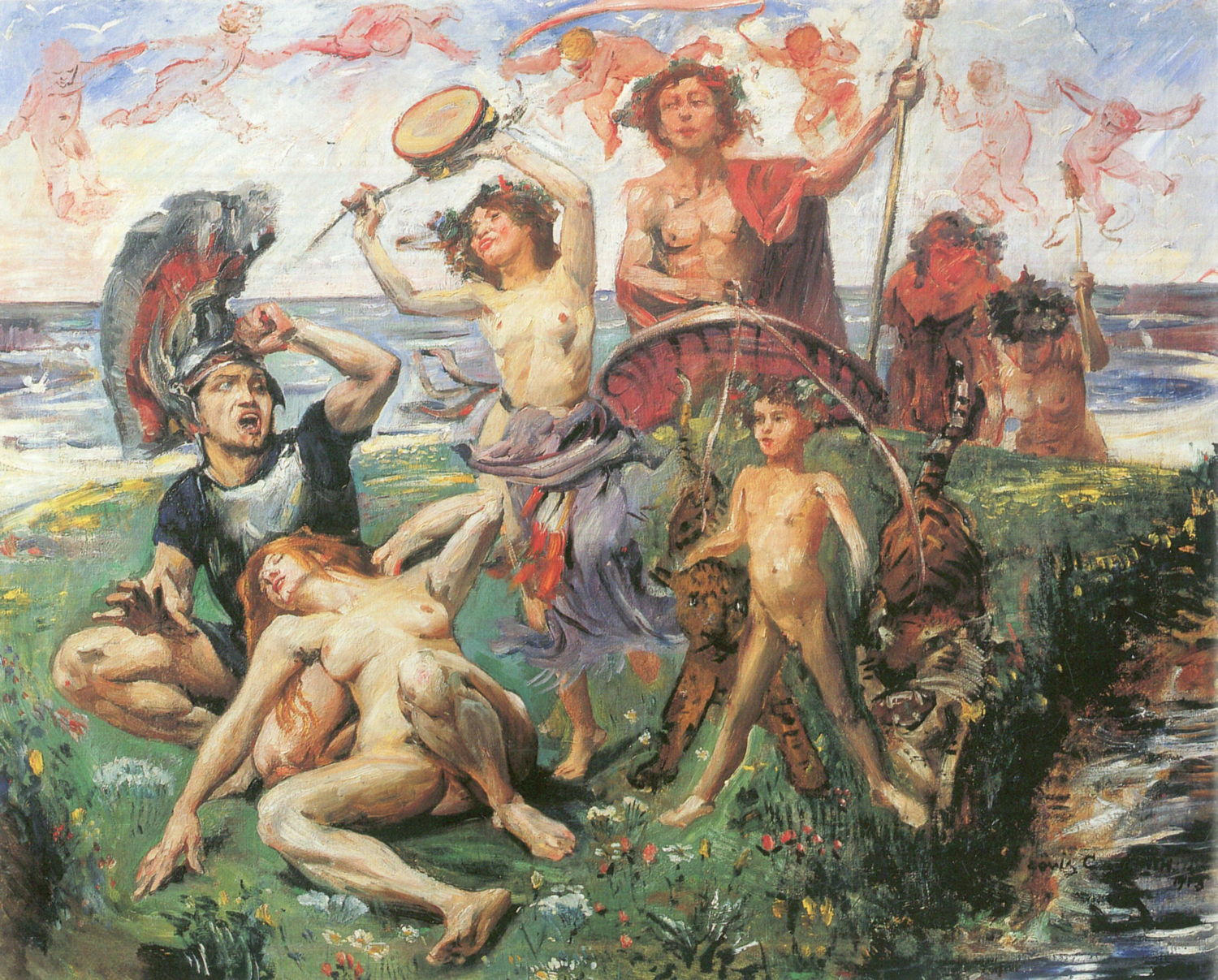
Ariadne on Naxos is one of Corinth’s most sophisticated mythical paintings, and was inspired by the first version of Richard Strauss’s opera Ariadne auf Naxos. This was first performed in Stuttgart in October 1912, and Corinth probably attended its Munich premiere on 30 January 1913. Wikipedia’s masterly single-sentence summary of the opera reads: “The opera’s unusual combination of elements of low commedia dell’arte with those of high opera seria points up one of the work’s principal themes: the competition between high and low art for the public’s attention.”
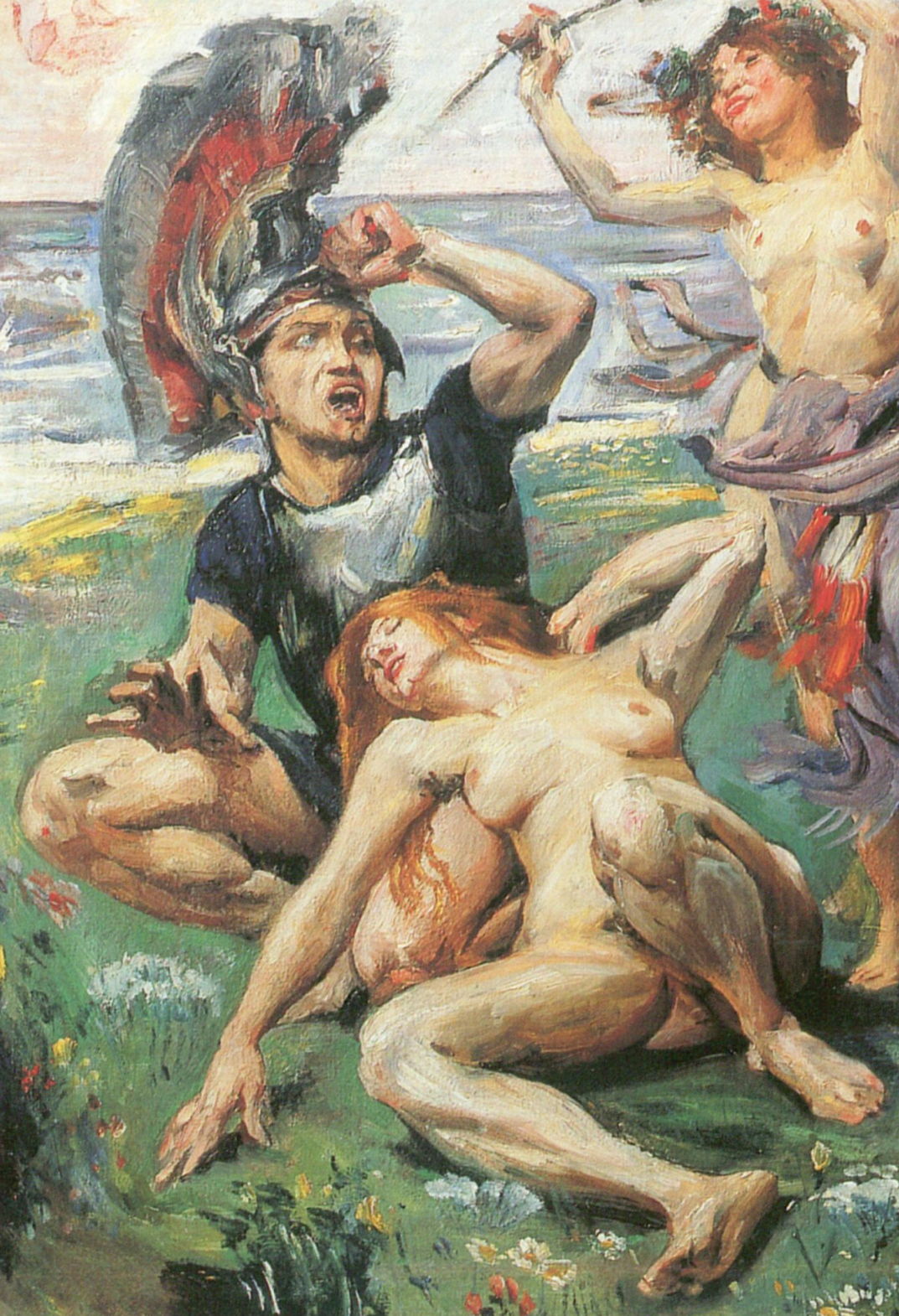
At the left and in the foreground, Ariadne lies in erotic langour on Theseus’ left thigh. He wears an exuberant helmet, and appears to be shouting angrily and anxiously towards the other figures to the right.
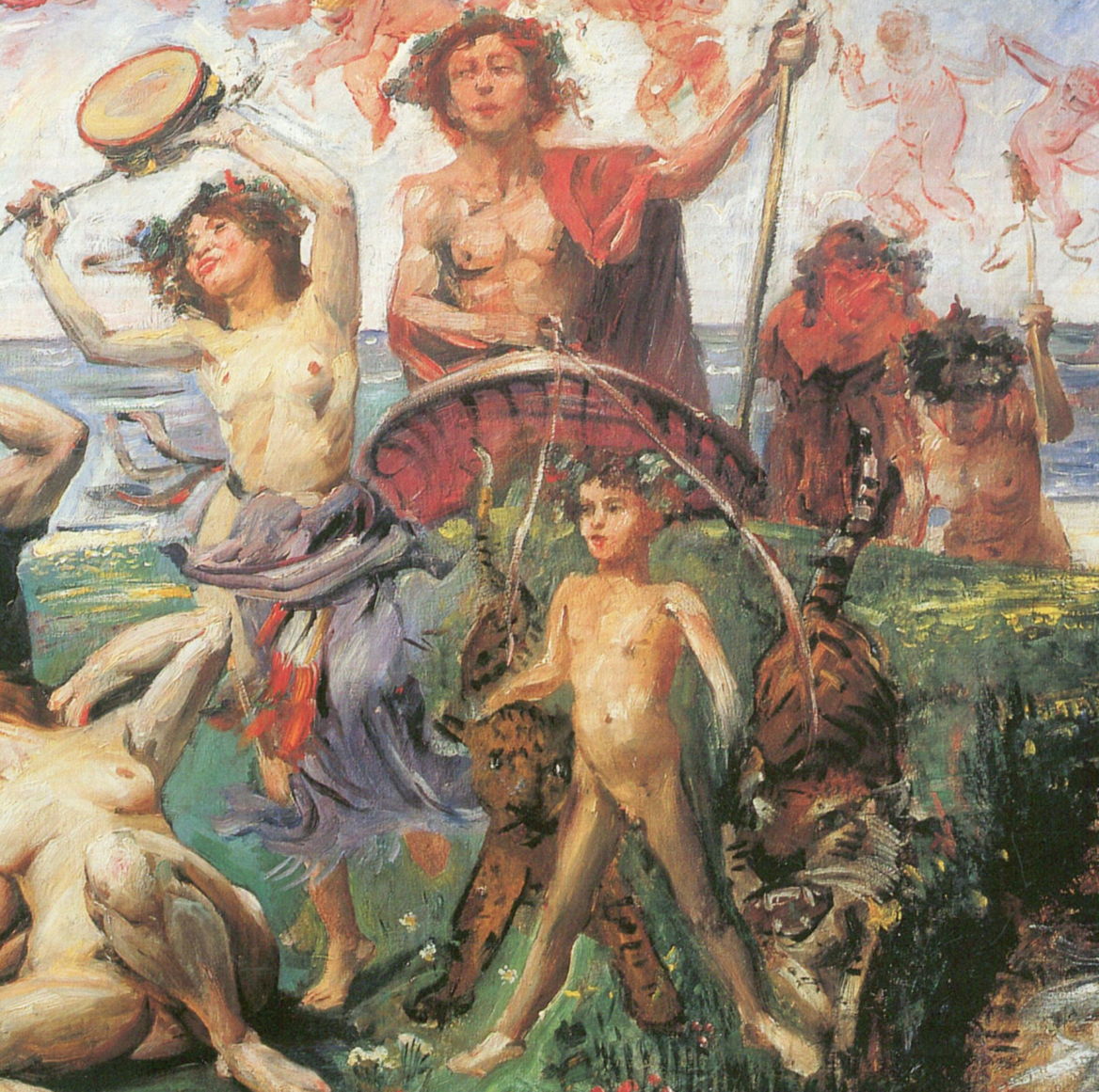
The group in the middle and right is centred on Dionysus, who clutches his characteristic staff in his left hand, and with his right hand holds the reins to the leopard and tiger drawing his chariot. Leading those animals is a small boy, and to the left of the chariot is a young bacchante. Behind them is an older couple of rather worn-out bacchantes. Crossing the sky in an arc are many putti, their hands linked together.
Corinth has combined two separate events in the story into a single image: Ariadne’s eventually broken relationship with Theseus, and her subsequently successful affair with Dionysus. This is multiplex narrative, more typical of narrative paintings of the early Renaissance, and exceptionally unusual for the early twentieth century.

On Christmas Eve at the end of 1913, he painted this delightful scene of their two young children enjoying their Christmas Decorations. Charlotte, the artist’s wife, is seen at the left edge disguised as Father Christmas. Their son Thomas stands with his back to the viewer in front of a nativity scene close to his mother. Daughter Wilhelmine is at the right edge, inspecting one of the presents. Corinth uses high chroma traditionally associated with Christmas to enrich the scene.

The following year, Corinth returned to the Mediterranean coast, this time to Liguria in northern Italy, where he painted the Sea at La Spezia (1914). Not as dramatic as his earlier painting at Bordighera, his waves are still rough strokes, and the sea rich in its colours.

Resorts along the French and Italian Rivieras were enjoying a wave of popularity and rapid growth captured in New Buildings in Monte Carlo (1914).

One of his few religious paintings of this time is his second version of Joseph and Potiphar’s Wife, from 1914. Its story is drawn from the book of Genesis, during the period in which Joseph was in Egypt after he had been sold into slavery by his brothers. Rising to become the head of Potiphar’s household, Potiphar’s wife takes a fancy to him, but Joseph resists her attempts at seduction. She then falsely accuses him of attempting to rape her, resulting in Joseph being thrown into prison.
Corinth shows the most popular scene depicted in paintings, in which Potiphar’s wife is trying to seduce Joseph.
Having survived his stroke and moved his style on, Corinth was now moving into the next phase of his career when, on 28 July 1914, the Austro-Hungarian Empire declared war on Serbia. Germany invaded Belgium and Luxembourg, and the First World War had begun.
References
Lemoine S et al. (2008) Lovis Corinth, Musée d’Orsay & RMN. ISBN 978 2 711 85400 4. (In French.)
Czymmek G et al. (2010) German Impressionist Landscape Painting, Liebermann-Corinth-Slevogt, Arnoldsche. ISBN 978 3 89790 321 0.
 The Eclectic Light Company