
The island of Zealand (Sjælland) lies between Germany and Scania (Skåne) in southern Sweden, on the south-western edge of the Baltic Sea, and is the most populous of the Danish islands. The capital Copenhagen (København) is on its eastern coast, looking across Øresund, the strait separating it from Malmö in Sweden.
Like most European cities, Copenhagen grew rapidly during the nineteenth century, from a population of just over 100,000 to four times that in 1901. Many of those migrated from the surrounding countryside, where they had farmed the land. This weekend I show paintings of the Zealand countryside from the early nineteenth century up to the 1930s.

Although JC Dahl had been born in Norway, he painted for much of his early career in Copenhagen, and later returned to the Zealand countryside. In 1829, he painted this Winter Landscape at Vordingborg, showing barren trees and snowy fields near the town of Vordingborg, in the south of Zealand. Plenty of sinister crows in the air and on the ground help build the sense of grim foreboding.

In Dahl’s Copenhagen Harbour by Moonlight (1846), he shows many ‘fully-rigged’ sailing ships in this major port at the south-western end of the Baltic Sea.

Painted in 1856, his Burning Windmill at Stege is an unusual brandje (a painting of fire) following a traditional sub-genre of the Dutch Golden Age. Although completed well before Impressionism, Dahl echoes the red of the flames in the field and trees to the left of the windmill, and even in his signature. Stege is a small town on an island in the south of the Zealand archipelago.

Laurits Andersen adopted his surname Ring from the village where he was born in the south of Zealand. His Young Girl Looking out of a Roof Window (1885) eloquently expresses the feelings of a migrant from the countryside when trapped in a garret amid the grey urban roofscape of Copenhagen.

His painting of Harvest shows his brother cutting what’s most probably rye rather than wheat, as a “monument to the Danish peasant”. He painted this during the summer of 1885, when his brother was working on his farm near Fakse on Zealand.

Erik Henningsen’s painted record of Farmers in the Capital from 1887 is one of the few contemporary accounts of migrants from the country. This family group consists of an older man, the head of household, two younger women, and a young boy. Everyone else is wearing smart leather shoes or boots, but these four are still wearing filthy wooden clogs, with tattered and patched clothing. The two men are carrying a large chest containing the family’s worldly goods, and beside them is their farm dog. The father is speaking to a mounted policeman, presumably asking him for directions to their lodgings. The large brick building in the background is the second version of Copenhagen’s main railway station, opened in 1864, and replaced by the modern station in 1911.

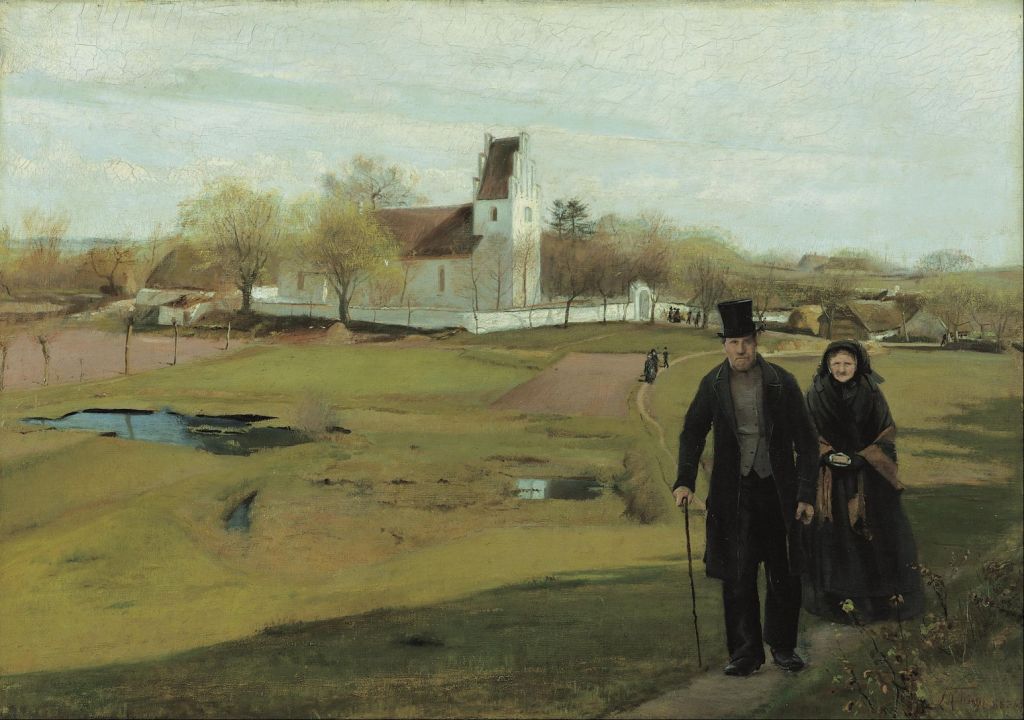
LA Ring’s Mogenstrup Church (1888-89) shows an elderly couple in their tattered Sunday best clothing, slowly making their way home after attending this church near his home village of Ring. The man’s shoes are still polished and his top hat also shiny, but like many country couples these two were no strangers to hunger or deprivation.

In 1891, Ring visited Herman Kähler’s ceramics factory in Næstved in the south of Zealand, and in the adjacent village painted this rural genre work, Conversation in the Countryside, Lille Næstved. It shows a mother with her two young children talking to an older boy, who sits on a doorstep staring at the viewer. Although the mother and family appear clean and fairly well-dressed, the boy’s clothing is worn out and tattered. Running behind them is the small stream that functioned as the dirt road’s main drain. Most of the cottages are small, and thatched, with the chimney of Kähler’s factory in the background.

The bog at Carlsminde in Søllerød, Zealand from 1906 is one of LA Ring’s finest landscapes, although perhaps more appropriate for pre-Impressionist painting in the middle of the nineteenth century. It shows a lake in the grounds of a Baroque mansion in Søllerød, to the north of Copenhagen. This estate had been bought by Isak Glückstadt in 1903, who expanded it and had it landscaped around this lake, with its stock of pike and tench. Glückstadt seems to have been eccentric, at one time keeping two Indian elephants here.
 The Eclectic Light Company