
By 1890, Lovis Corinth was financially independent, had his own studio in Königsberg, the city near his home village, and was starting to become a successful artist. His Pietà from 1889, which was sadly destroyed in 1945, received an honourable mention at the Paris Salon of 1890; encouraged by that and the greater prospects of working in what was then the arts capital of Germany, he moved to Munich in 1891.

Corinth set up his studio in what was at the time the most bohemian and artistic district of Munich, and painted this quick sketch of the View from the Studio, Schwabing (1891). He realised that his progressive style of painting was at variance with both the Munich Academy and the critics, and in 1892 he took part in the foundation of the Munich Secession to bring change. The following year he co-founded the Free Association (Freie Vereinigung). He also expanded his skills, started etching in 1891, and lithography in 1894.
Much of his painting during his nine years in Munich was experimental, although modern critics accuse him of spending more time drinking copious quantities of red wine and champagne.

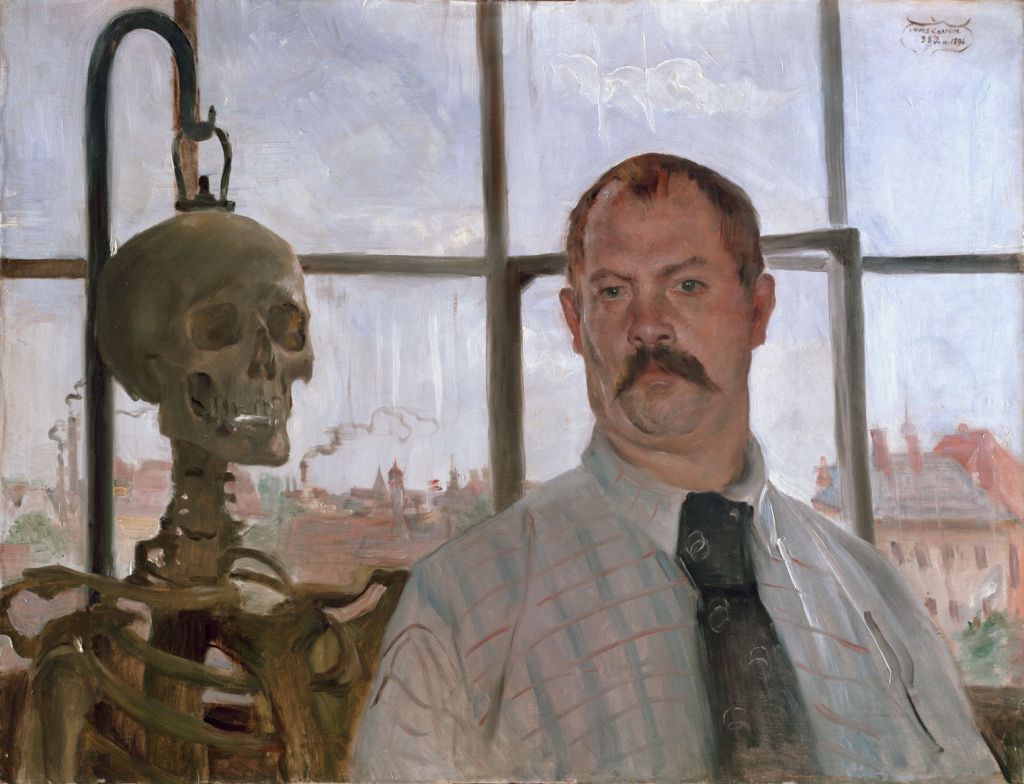
He painted this Self-portrait with Skeleton in his Munich studio in 1896, and shows in his face the effects of his high life in Munich.

In the 1890s he started to take landscape painting more seriously, including this Landscape with a Large Raven painted in the late autumn of 1893. As in Vincent van Gogh’s late landscapes, ravens, crows, and other similar black birds are taken as harbingers of death. In this otherwise deserted countryside, with the winter drawing close, this painting could be read as indicating Corinth’s bleak melancholy. Although he certainly suffered feelings of mortality and had episodes of depression, those aren’t part of the received image of his social life, nor of many of his paintings.

This shows the beautiful fishermen’s Cemetery in Nidden (1893) on the Kurische Nehrung, a long sand spit near the southern border of Lithuania, on the shore of the Baltic not far from Königsberg. During the 1890s, Corinth travelled from Munich to visit his home village, and went as far afield as Italy.

Like some of the Masters before him, most notably Rembrandt, he painted a series of studies In the Slaughterhouse (1893). As the son of a tanner, Corinth was familiar with such scenes.

The Deposition (Descent from the Cross) (1895) was one of his major paintings from this time in Munich, and won a gold medal when exhibited in the Glaspalast in Munich that year. It shows the traditional station of the cross commemorating the lowering of the dead body of Christ from the cross, attended by Joseph of Arimathea and Mary Magdalene.
This work is a thoroughly modern approach to its traditional theme, in its framing, composition, and faces. Its close-in cropped view suggests the influence of photography, and the faces shown appear contemporary and not in the least historic. These combine to give it the immediacy of a current event, rather than something that happened almost two millennia ago. Corinth returned to the subject of the Deposition, and the theme of the Crucifixion, in many of his later paintings.

Autumn Flowers (1895) is a delightful full-figure portrait of a girl, her dress held out in front of her to carry her collection of flowers, which also decorate her hair and the background.

A Forest. Flooding on Lake Starnberg (1896) was one of the landscapes that he painted in the countryside near Dachau, and shows a flooded stand of birch trees at the edge of the lake, probably in the spring.

Bacchanale (1896) is the first of his series of paintings of the wild and licentious antics of worshippers of Bacchus. These provided the opportunity for him to compose some of his many studies of nudes into grander paintings, although this one is non-narrative.

He returned to the theme of meat and animal carcasses in his Butchers in Schäftlarn on the Isar (1897), painted in this Bavarian town not far from Munich.

He painted this portrait of Fräulein Heck (in a Boat on the Starnberger See) (1897) on this picturesque lake near Dachau. This form of portrait, of a woman carrying a parasol in a boat, was popular at the time.

Corinth continued to paint figure studies, such as his Nude Woman (1897), for their value in his more substantial figurative works.

The Temptation of Saint Anthony (1897) visits another traditional religious theme, well-known for encouraging inventive and sometimes highly imaginative paintings. As with his earlier Deposition, Corinth shows the saint surrounded by modern temptations, in a real style. There’s a wealth of detail here, from the bright eyes of the owl in the top left corner, down to the sinister flick of the snake’s tongue at the lower right, demonstrating the history painter’s eye for detail and Corinth’s own Symbolist leanings in narrative.

The Witches (1897) is more subtle than it looks, as this isn’t a depiction of sensuous rites taking place in a coven. Instead, the women are preparing a younger woman to attend a masked ball. Their subject has just got out of the wooden tub in the foreground, has been dried off, and is about to don the fine clothes laid over the chair at the left, including the black mask.
Although Corinth undoubtedly drank more than his fair share of red wine and champagne while painting in Munich, his technique and style were maturing fast. The best of his paintings from this period are the equal of better-known works from later in his career. The stage was set for his first truly momentous painting.
References
Lemoine S et al. (2008) Lovis Corinth, Musée d’Orsay & RMN. ISBN 978 2 711 85400 4. (In French.)
Czymmek G et al. (2010) German Impressionist Landscape Painting, Liebermann-Corinth-Slevogt, Arnoldsche. ISBN 978 3 89790 321 0.

