
In 1891, plein air painting, particularly in oils, was a relatively new technique in the US, and growing rapidly in popularity. It was Janet Hoyt who first invited William Merritt Chase (1849–1916) to come to the new art village in western Southampton (or South Hampton), Long Island, to teach the hundreds of students attending her new plein air art school.

This tourist map from 1868 shows Long Island stretching from Brooklyn at the lower left to its north-eastern tip. Shinnecock and its bay are outlined in red, to the west of South Hampton, in what was then sparsely populated country, as shown in the detail below.

By the following summer, Chase’s friend Stanford White had designed and built the Chase family a summer house at Shinnecock, with an integral studio. They moved out of New York at the start of the summer, and while father was busy teaching the hundreds of students, his wife and children enjoyed the surrounding almost untouched countryside, the beaches, and a different pace of life.
Chase continued to teach for twelve consecutive summers at Shinnecock, his skills and experience being shared with thousands of aspiring painters. In later years, when he was drawn back to Europe, and Florence in particular, his family continued to grow up in the sunny Long Island summers.
His Impressionist style was at its strongest when sketching outdoors in oils at Shinnecock. There’s no point in trying to elaborate or explain his paintings in words: they show the skies, rough scrub, the Chase house, beaches, old tracks, and of course his wife and children. I have arranged them in approximate chronological order, but otherwise I’ll leave it to his paintings to show you his favourite Shinnecock.

Summer at Shinnecock Hills in 1891, painted during his first summer visit, before his house was built.

Shinnecock Hills (A View of Shinnecock), another oil sketch from that first visit in 1891.

A Sunny Day at Shinnecock Bay painted looking west along the bay, showing his family during their second summer in 1892, the year they occupied their new house there.

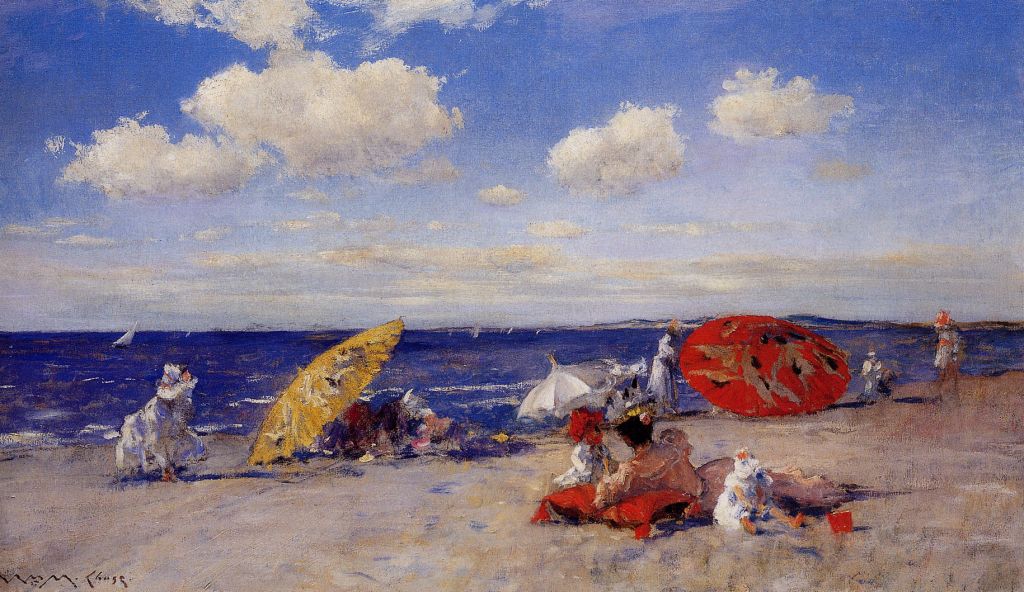
At The Seaside painted in about 1892, showing his family on the beach of Shinnecock Bay, seeking shade under parasols, one of which is influenced by Japonisme.

Shell Beach at Shinnecock, probably from the same summer in about 1892, also on the beach of Shinnecock Bay.
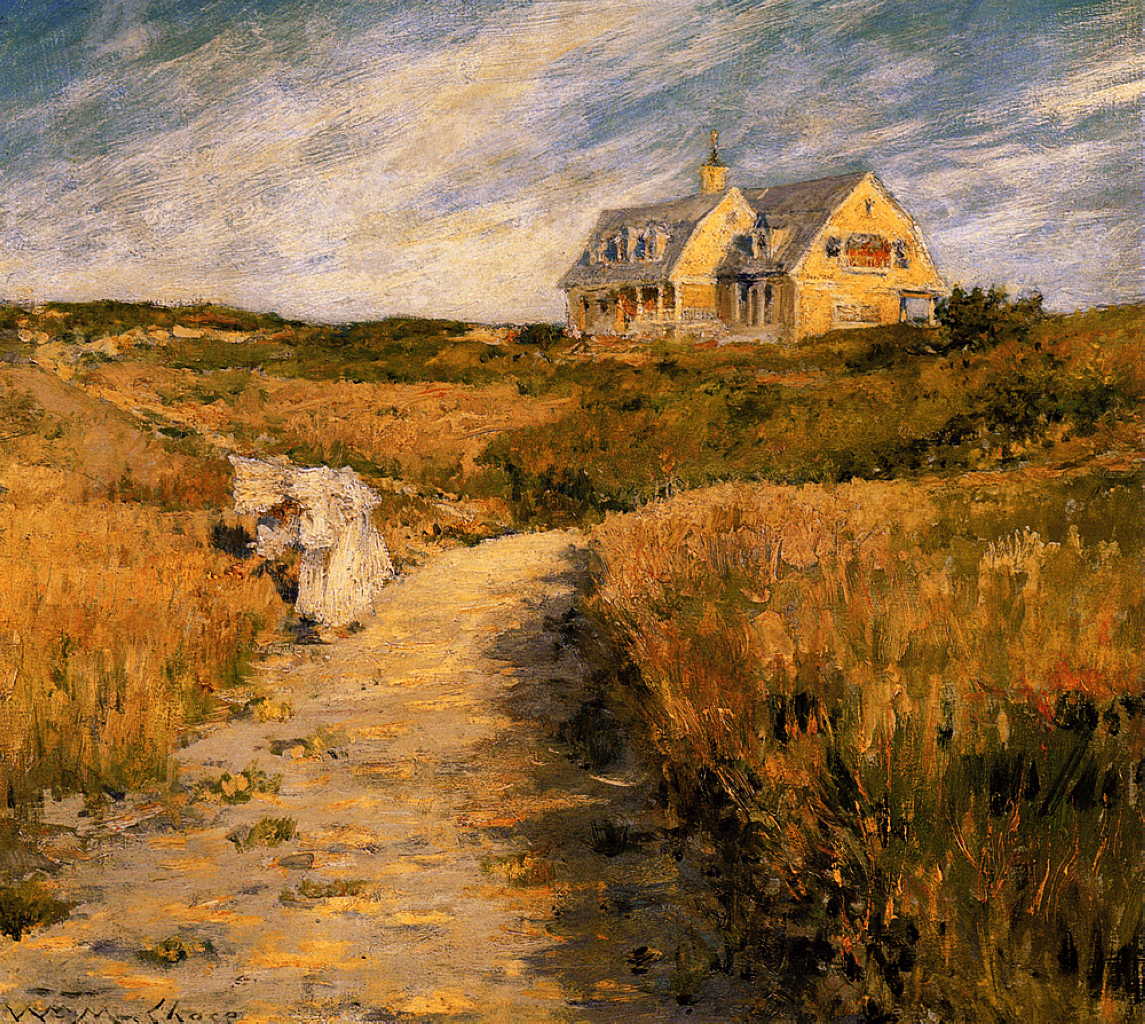
One of his first oil sketches showing The Chase Homestead, Shinnecock, in about 1893.

The Old Road to the Sea looking in the other direction, from their house down to Shinnecock Bay, in 1893.

October probably from the fall of 1893, looking inland from near their house.

Idle Hours shows Chase’s family growing up, and back in Shinnecock Bay in 1894.

The Old Sand Road is another of the rough tracks running near to their house, seen in 1894. Note the distant houses on the skyline to the right.

Gathering Autumn Flowers shows the Chase family outdoors in the early fall of 1894 or 1895

The Big Bayberry Bush from another fine summer day in about 1895, with the Chase family home in the background. The bayberry is a fragrant native shrub whose leaves are used as insect repellent.
References
Hirshler EE (2016) William Merritt Chase, Museum of Fine Arts Boston. ISBN 978 0 87846 839 3.
Longwell AG (2014) William Merritt Chase, A Life in Art, Parrish Art Museum and D Giles. ISBN 978 1 907804 43 4.
Smithgall E et al. (2016) William Merritt Chase, A Modern Master, The Phillips Collection and Yale UP. ISBN 978 0 300 20626 5.

