

Two centuries ago today, on 11 May 1824, the great narrative and realist painter, sculptor and teacher Jean-Léon Gérôme was born in Vesoul, in eastern France. Over a series of six articles (links at the end) I have looked at some of his more significant paintings. This article brings together a small selection of those to consider his career-long quest for visual truth.

Perhaps his first tentative exploration of this theme came in his small and simple painting of Michelangelo in 1849. The great sculptor is seen in his dotage, when he was blind and needed assistance. A young boy is helping his master place his hands on the Belvedere Torso, a huge fragment of marble statuary so loved by the sculptor that it was nicknamed the School of Michelangelo. In his blindness, Michelangelo can only feel what we can see, and thus has to rely on his sense of touch to ascertain truth.

A decade later, in Ave Caesar, Morituri Te Salutant (1859), Gérôme’s first spectacularly successful depiction of gladiatorial combat, the viewer joins the Vestal Virgins in enjoying a depraved spectacle. As in so many of his paintings, the viewer is not only looking at the spectacle, but also at those looking at the spectacle, ultimately at themselves.
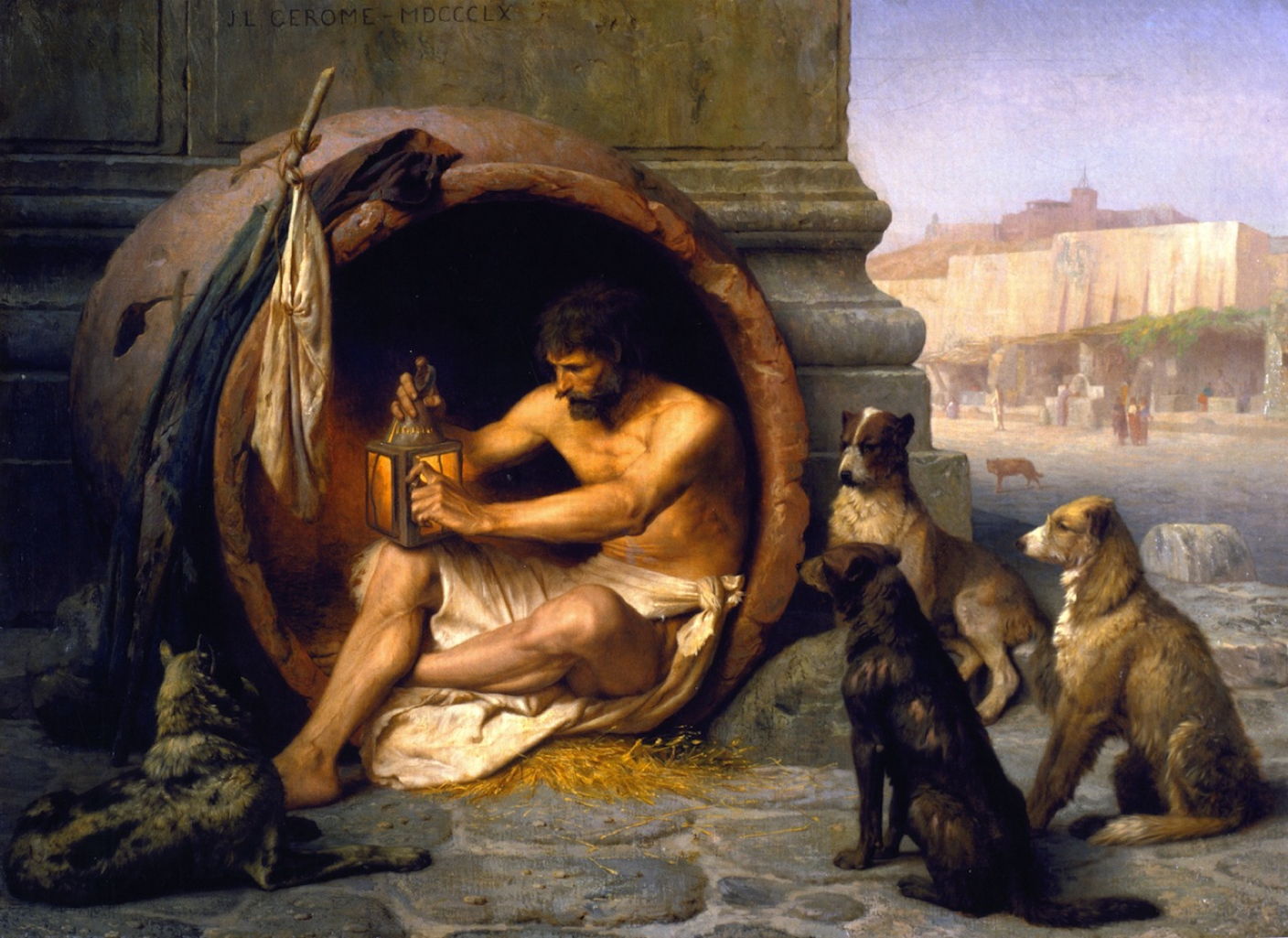
The following year, Gérôme painted this contrasting portrait of Diogenes (1860), the Cynic who is reputed to have lived in a large storage jar or possibly a barrel as he attacked the conventional view. I suspect the artist saw himself as a cynic in matters concerning visual art and visual truth.
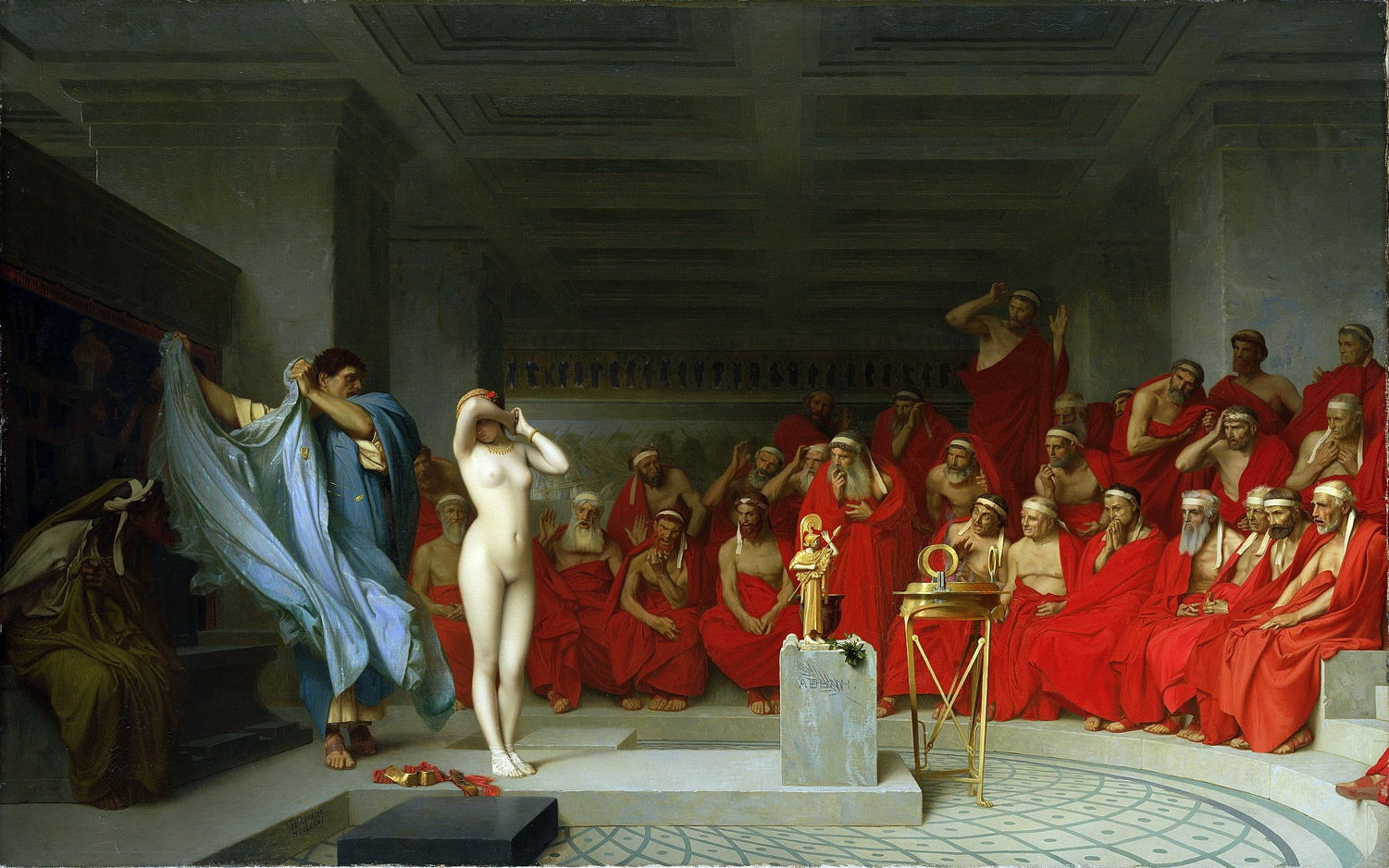
Another year passed, and this time it’s the legendary courtesan Phryne who tells us about looking and veracity. As she shields her eyes from the judges of the Areopagus, they can’t take their eyes off her naked body. This ploy worked perfectly, and she was acquitted of charges of impiety, and returned to her highly successful career as a courtesan.
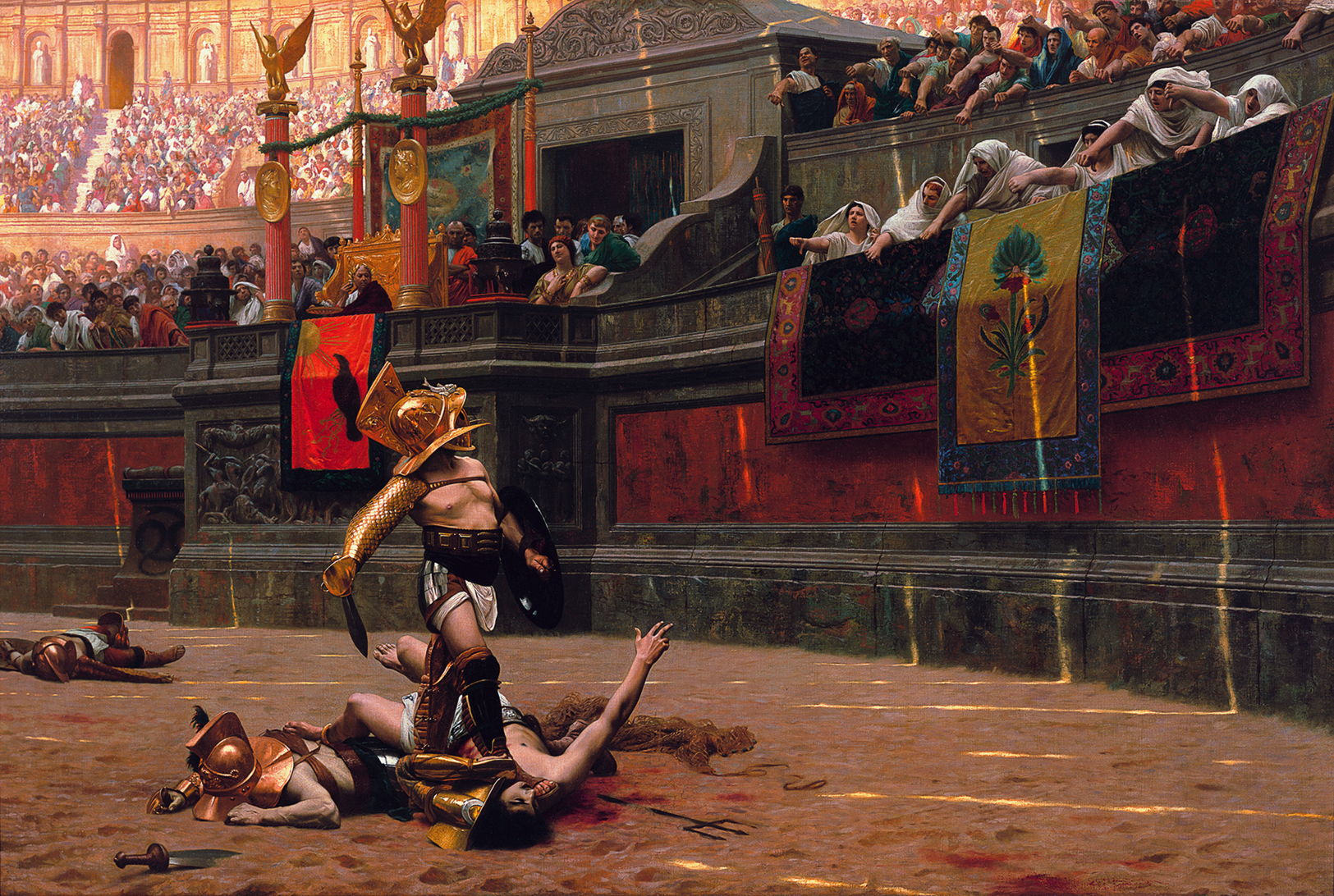
In his next hugely successful visit to the Roman arena, Pollice Verso in 1872, Gérôme looks at the power of expression, here a small gesture of the hand, and develops the theme of spectators and their complicity. This painting also makes clear the amount of attention that the artist paid to getting every smallest detail as right as he could, rather than just making it all look convincing.

In The Artist’s Model (1895), Gérôme attempts the ultimate introspection: he painted himself making a sculpture he had previously painted in a painting as a sculpture. Visual references in the props, paintings seen within the painting, and polychrome sculpture provide a visual summary of his professional career.

His last painting of the personification of Truth, completed in 1896 as his reputation was fast vanishing, is his manifesto not only for his art, but for the new art of photography. He saw visual truth, as demonstrated in his meticulous realism, as the objective for painting. In that, he differed fundamentally from Impressionism, which he viewed as misrepresentation of the way that we see the world, thus visual untruth, unlike photography.
I wonder what Gérôme would have made of image editing and generative AI.
Articles in this series
1, 1846-55
2, 1857-60
3, 1861-70
4, 1872-77
5, 1882-95
6, 1895-1902
References
Ackerman GM (2000) Jean-Léon Gérôme, Monographie révisée, Catalogue Raisonné Mis à Jour, (in French) ACR Édition. ISBN 978 2 867 70137 5.
Scott Allan and Mary Morton, eds. (2010) Reconsidering Gérôme, Getty. ISBN 978 1 6060 6038 4.
Gülru Çakmak (2017) Jean-Léon Gérôme and the Crisis of History Painting in the 1850s, Liverpool UP. ISBN 978 1 78694 067 4.
de Cars L et al. (2010) The Spectacular Art of Jean-Léon Gérôme (1824-1904), Skira. ISBN 978 8 85 720702 5.
 The Eclectic Light Company