

Although in modern secular Western societies, Christmas has become the most celebrated feast, for those of Christian faith the focus remains more on Easter, in particular today, Good Friday for Western churches. It’s a strange occasion, a mixture of deep even austere solemnity and spiritual celebration. To mark it this year, I’ve selected a few of the most memorable of the many thousands of depictions of the Crucifixion itself.

During the Northern Renaissance, the younger of the van Eyck brothers Jan established himself as a master painter of small religious works. This is the left panel of his Diptych of The Crucifixion and The Last Judgment from about 1420-25, and is impressive in its complexity, with the crowd scene in the foreground, all three crosses, and an elaborate background. It’s unusual for squeezing all three crucifixions into such a small panel, and for the rich and varied collection of figures standing at the foot of the crosses.
At about the same time in northern Italy, Masaccio was painting one of the most elaborate polyptychs of the day.

In February 1426, Masaccio was commissioned to paint a large and complex altarpiece for a chapel in the church of Santa Maria del Carmine in Pisa, and spent much of that year working on it. It appears to have been completed by the end of 1426, but in the 1700s it was dismantled and its individual panels dispersed. Its design was centred on The Virgin and Child with Four Angels, and this reconstruction shows how the eleven panels so far identified were probably placed. It’s thought to have originally consisted of a total of twenty panels.
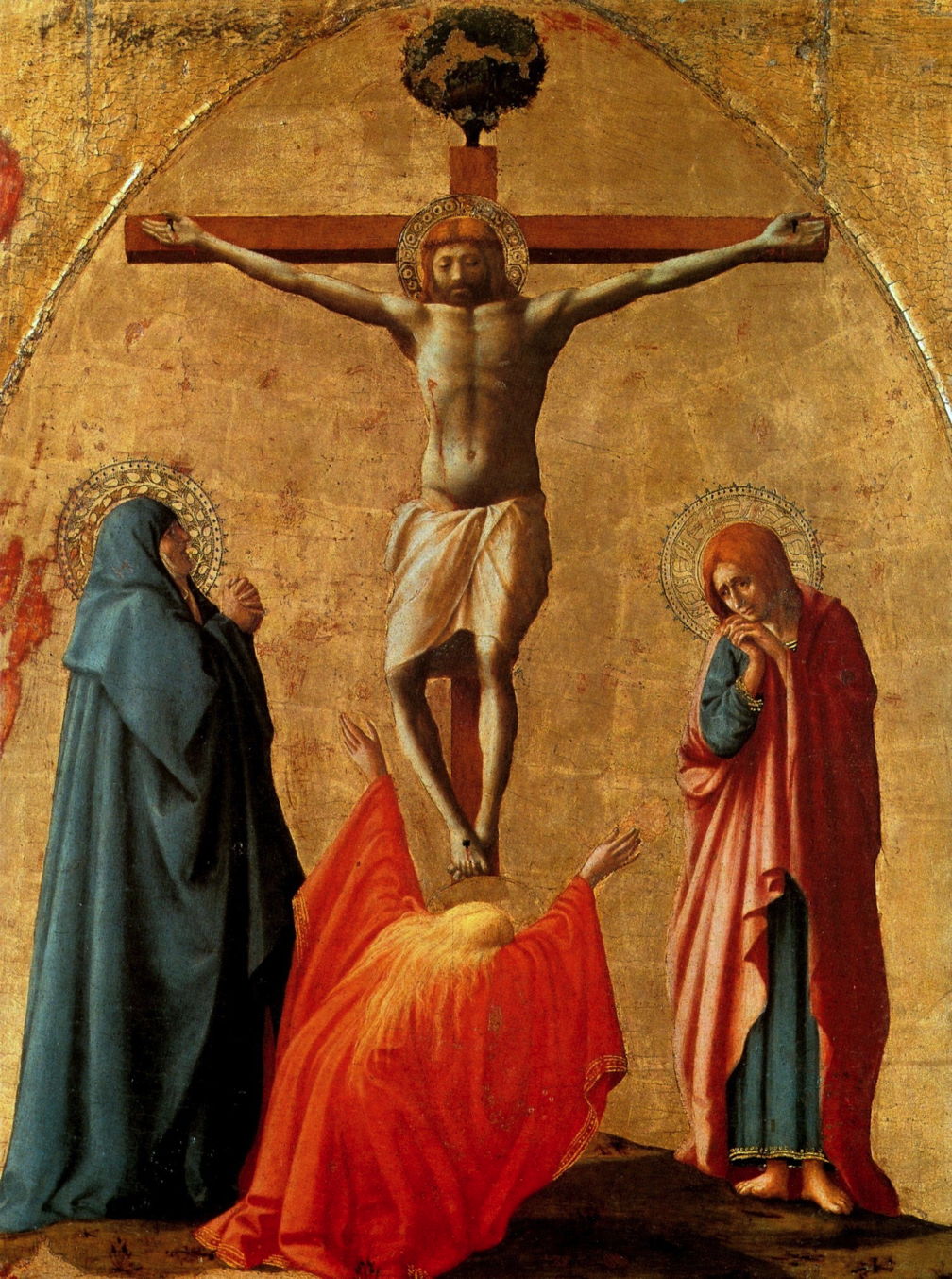
Although Masaccio’s Crucifixion from about 1426 was composed to the standard formulae, it also reflects his efforts to depict 3D space more faithfully. Here he recognises the fact that, at the top of an altarpiece, the scene will always be viewed from below. Accordingly Christ’s head appears to be oddly flexed at the neck, when the painting is seen from perpendicular to its picture plane. He has shaded and modelled Christ’s body, the faces, and clothes of the three Marys to give effective depth and volume.
Just over a century later, in Venice, Jacopo Tintoretto created his vast masterpiece, which remains one of the most thorough accounts of the whole day.
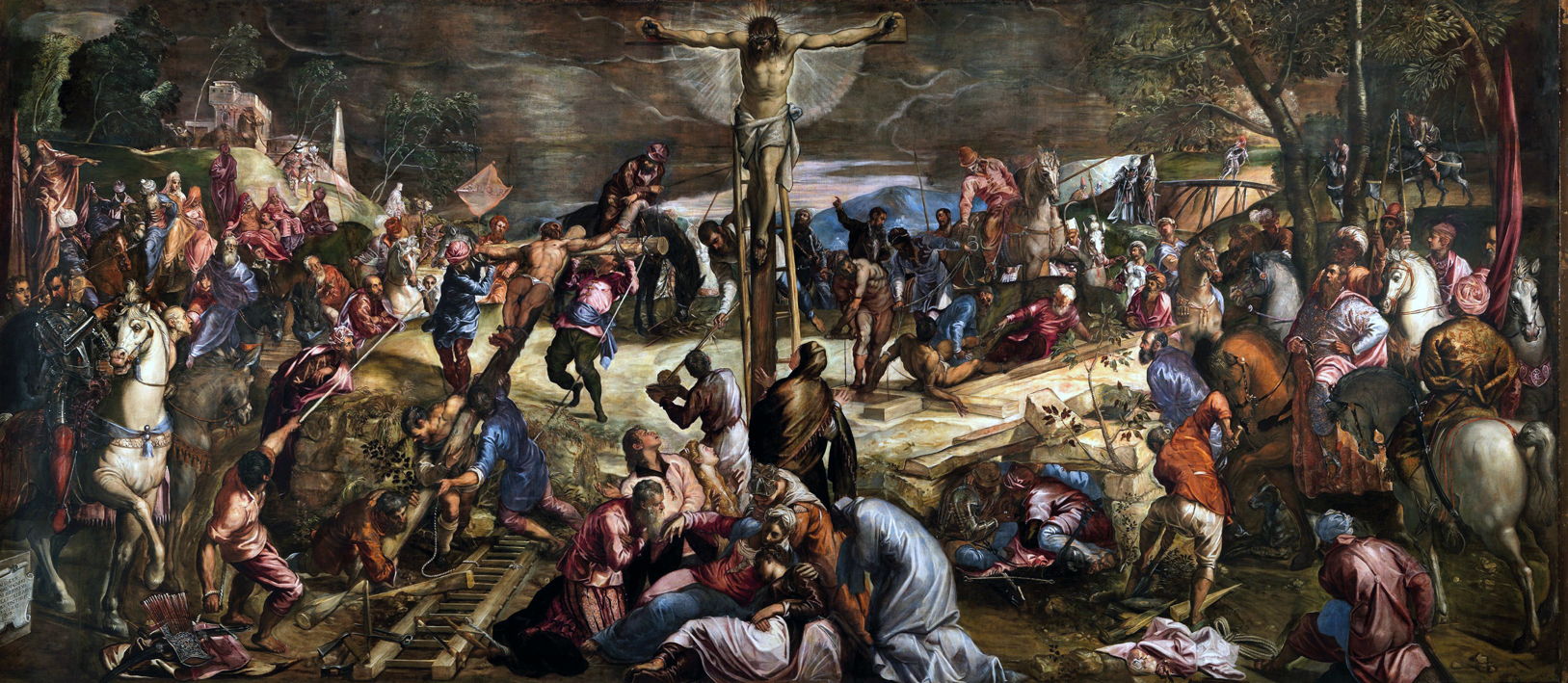
With the experience of his previous Crucifixion behind him, Tintoretto applied lessons he had learned painting tall works for the Madonna dell’Orto. He makes use of space and uses a narrative technique based on the traditional ‘multiplex’ form popular during the Renaissance, in which its single image shows events at more than a single point in time, but in an ingenious and modern manner. Naturally, the painting centres on Christ crucified, but the two thieves executed beside him are not shown, as would be traditional, already hanging from their crosses.

Instead, to the right of Christ, the ‘bad’ thief is still being attached to his cross, which rests on the ground. To the left of Christ, the ‘good’ thief is just being raised to the upright position. There’s nothing in the well-known gospel accounts which makes this view anachronistic, but it’s most probable that the crucifixions were more simultaneous.
It’s thus an innovative artistic device which shows the three executions at different times, and is therefore ‘multiplex’ (or ‘continuous’) narrative. But it avoids the archaic repetition of figures or other content, as Tintoretto applies it to discrete passages within the whole.
Spaced out around the canvas are relevant sub-stories from that whole. At the foot of Christ’s cross is his group of mourners, including the Marys. Each of the crosses has attendant workers, busy with the task of conducting the crucifixion, climbing ladders, hauling on lines, and fastening each victim to his cross. This mechanical and human detail brings the scene to life and adds to its credibility and grim process.
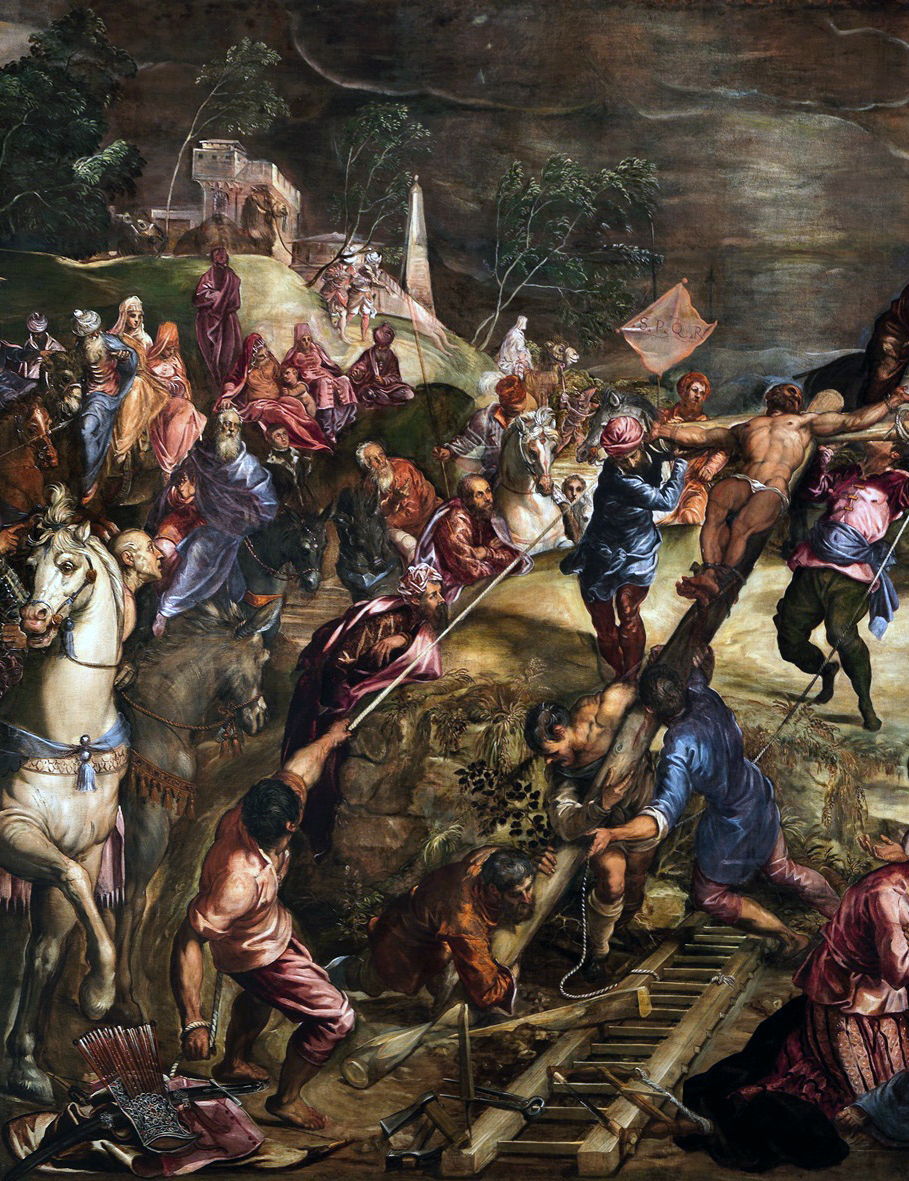
The crowd on the left is more spread out than in his earlier depiction. In the distance is a flag bearing the letters SPQR representing the Roman Empire, and its link through Pilate. Most faces are turned towards Christ, with their eyes wide in awe.
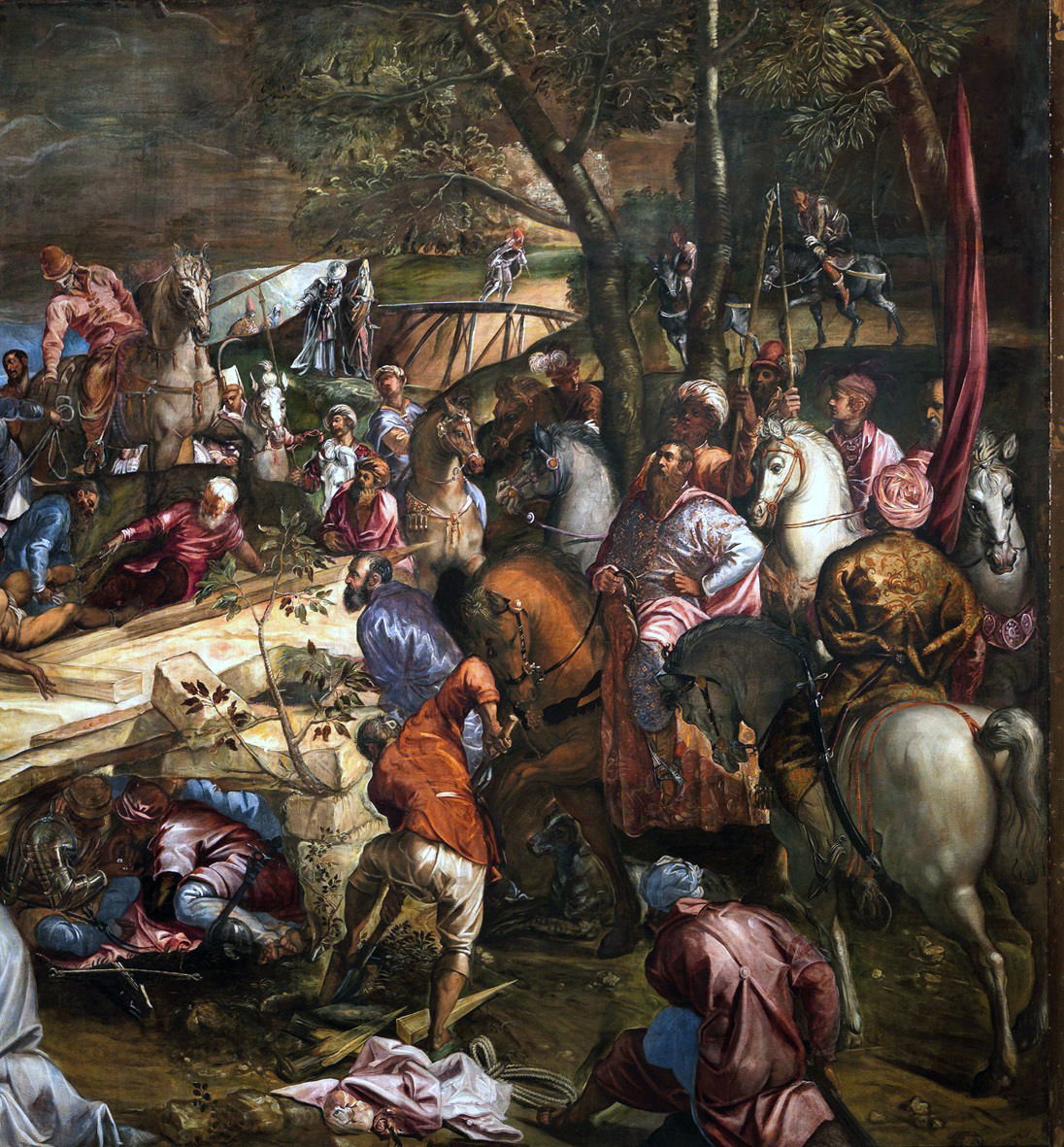
On the right, in a small rock shelter suggestive of a tomb, two men are gambling with dice. To the right of them, a gravedigger has just started his work with a spade. The ruling class, perhaps Herod himself, have turned up on horseback, and they too stare wide-eyed at Christ.
This formed a vast centrepiece for the Albergo in the Scuola Grande, for which Tintoretto painted other scenes from the Passion.
Tintoretto makes no attempt to paint a sequence of events in a thread of individual scenes. Instead, different passages appear in their spatial context. I have marked up the image below to enumerate those that I can identify.

These are, in approximate order of the sequence of events:
- the distant flag bearing the letters SPQR, representing the Roman Empire, and Pilate’s trial of Jesus;
- the ruling class, perhaps including Herod himself, on horseback;
- the ‘bad’ thief is being attached to the cross on the ground;
- the repentant thief is being raised on his cross to the upright position;
- Christ’s cross is already fully raised, and the crucifixion in progress;
- at the foot of Christ’s cross is the group of mourners, including the Marys;
- a sponge is being dipped in vinegar to be offered to Christ;
- a gravedigger has started his work with a spade;
- two men are gambling with dice in a small rock shelter.
Conventional painted narrative would normally include backward and forward references in time, within an image dominated by the transformative moment or peripeteia. In this case, Tintoretto has introduced asynchrony with four backward and three forward references which together extend the detail in its narrative, in particular providing a vivid and broad account of the crucifixion itself.
Almost three centuries later, paintings of the Crucifixion remained central in European religious art. Although many put them into more contemporary contexts, Eugène Delacroix painted a pair that succeed in their simplicity.

Several of Delacroix’s religious paintings suffered undeserved fates. His Christ on the Cross from 1846 was shown at the Salon the following year, and despite praise and comparison with the crucifixions of Rubens, it was sent to a dark and damp chapel in Vancé, well to the south-west of Paris and deeply provincial. The artist was understandably unhappy that it should be condemned to deteriorate in such conditions, and petitioned the Minister of State for it to be sent back to Paris for repair and care.

His pastel version of that work was painted slightly later, in 1847-50, probably for Haro, who supplied the artist with his materials, after the latter had admired his oil original at the Salon.
 The Eclectic Light Company