
After order had returned to the chariot of the sun, Jupiter checked around heaven for any damage caused by the sun’s extreme heat. He then restored rivers and vegetation to Arcadia, where he took a fancy to a nymph who was to become the victim of Ovid’s next myth of metamorphosis.
This story is exceptional in several respects. Remarkably, Ovid never names the Arcadian nymph in question, thus depersonalising her, although she’s known to be Callisto. He does reveal the identity of her father as Lycaon, last seen transformed into a wolf-man shortly before the Great Flood, whose only survivors were Deucalion and Pyrrha. Ovid makes no account of that. Her story is also one of the cruellest in the whole Metamorphoses, as she is the victim of rape for which she’s punished viciously by Juno.
Jupiter watches Callisto, a follower of Diana, as she rests from hunting in the heat of the noon sun, and decides that this time he’ll get away with deceiving his wife Juno. He therefore appears to Callisto in the form of Diana, chaste goddess of the hunt. When Callisto tells him that Diana is even greater than Jupiter, he knows that she is all but conquered. As she tries to tell him about her hunting, he embraces her and smothers her with kisses.
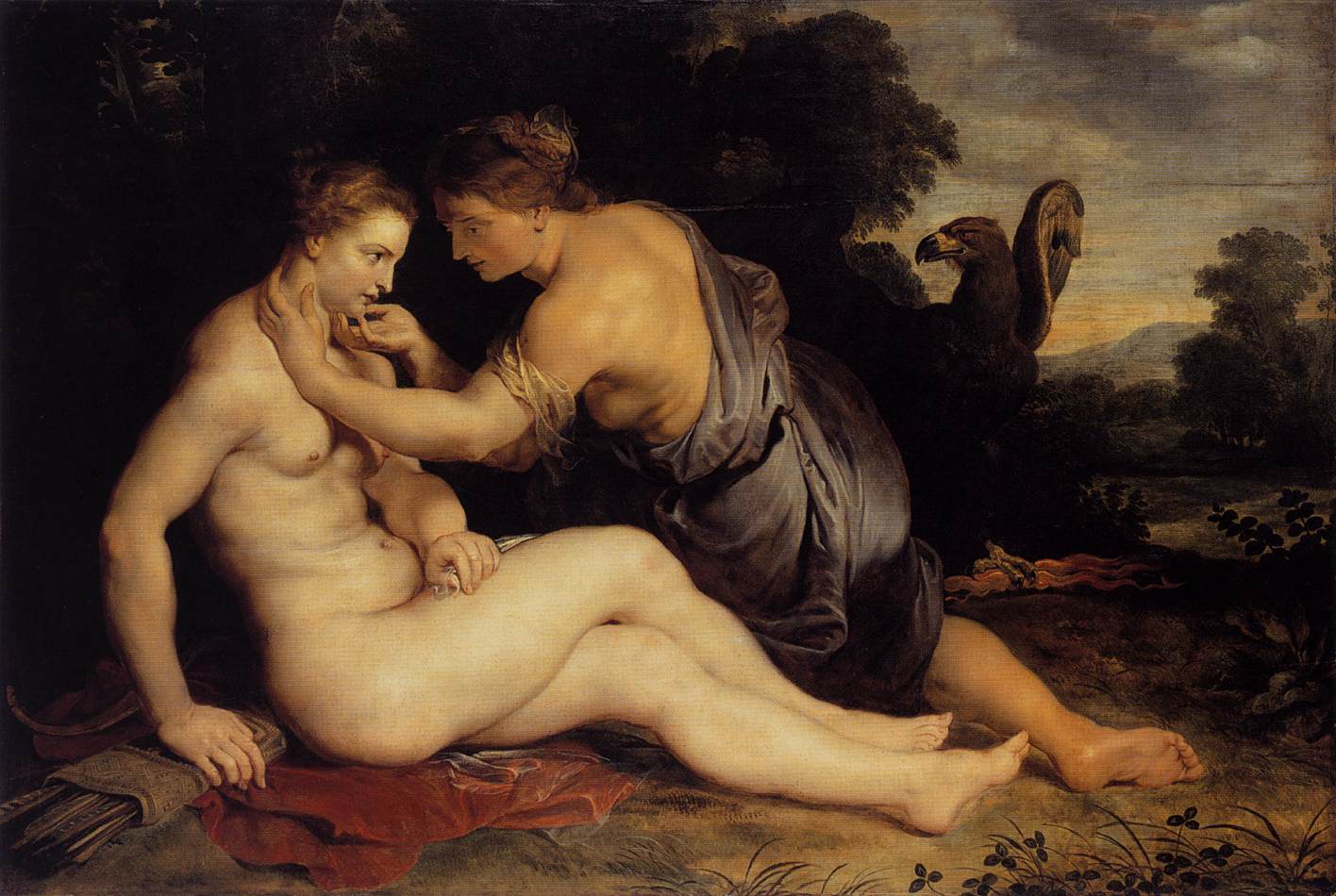
One of the best accounts of this is Peter Paul Rubens’ subtle and thought-provoking Jupiter and Callisto from 1613. Diana looks a tad more masculine than in most depictions, and their facial expressions are more serious, with Callisto hesitant and suspicious. Most importantly, Rubens tells us that this Diana is more than meets the eye: parked in the background is Jupiter’s signature eagle, with a thunderbolt in its talons.
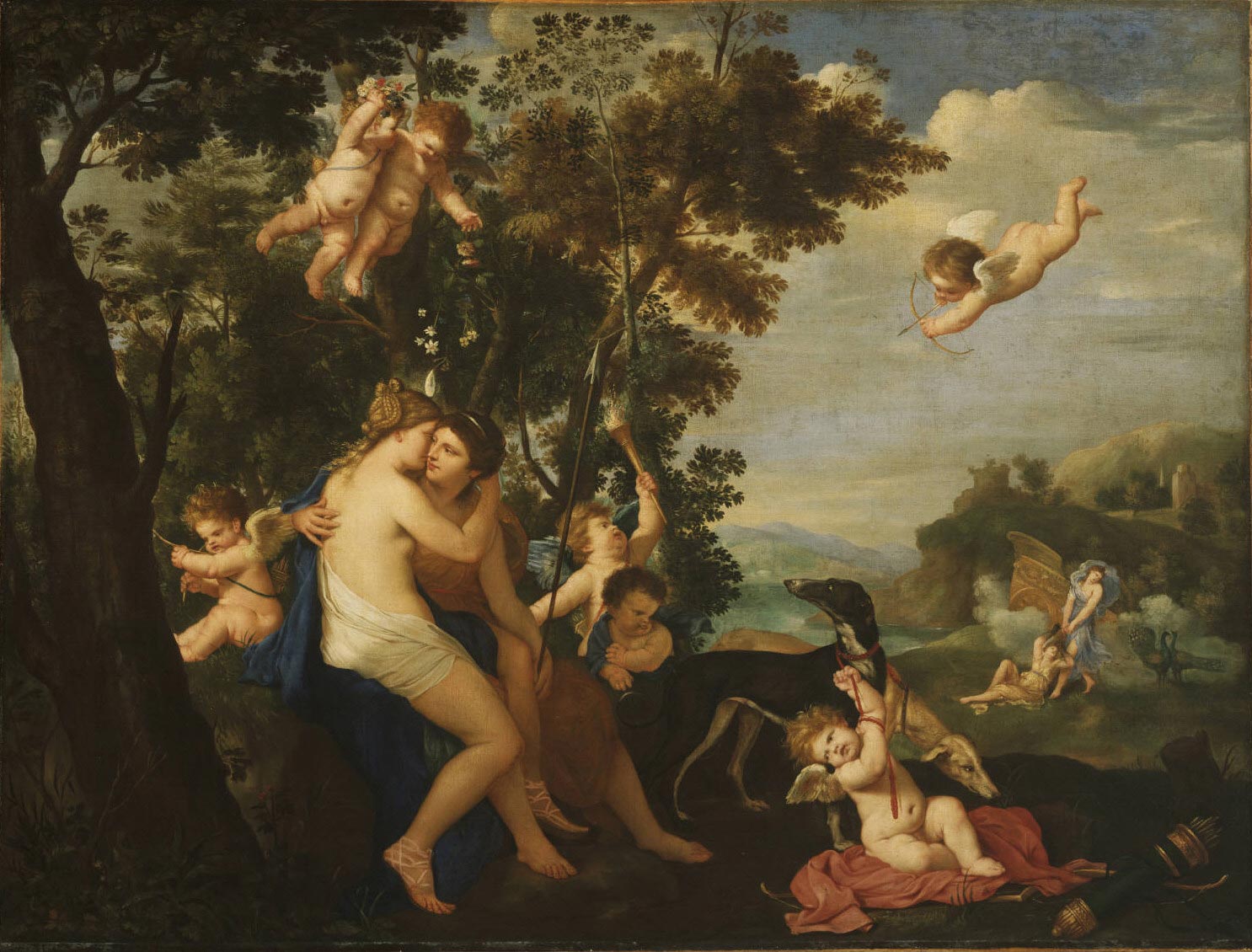
Although Callisto and Diana/Jupiter aren’t shown as sensitively in this painting of Jupiter and Callisto attributed to Karel Philips Spierincks and from about 1630, and there are plenty of inappropriate Cupids, the artist has used multiplex narrative to good effect: in the distance Juno is shown dragging Callisto along by her hair.
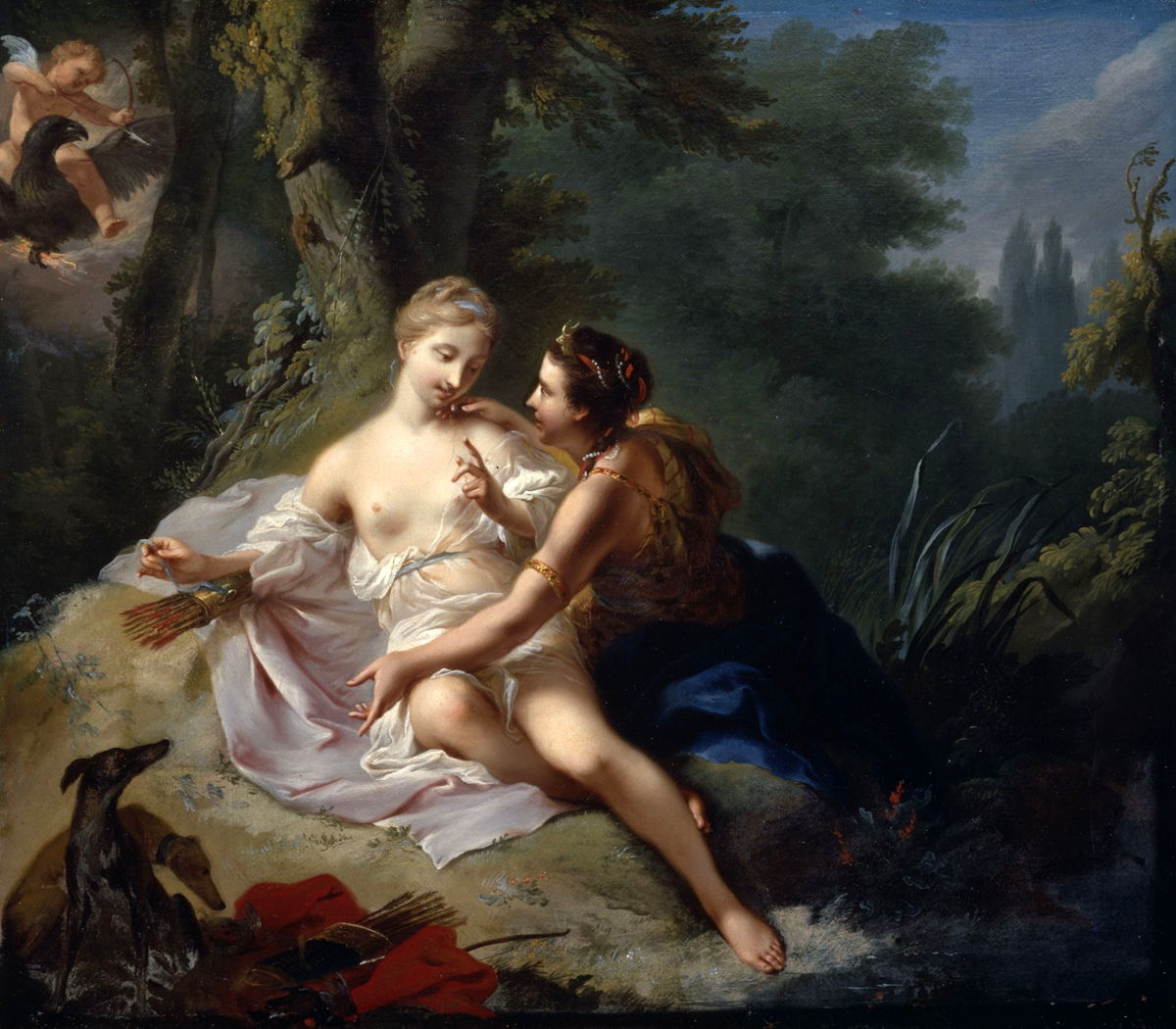
Among Johann Heinrich Tischbein’s fine mythological paintings is his Jupiter in the Guise of Diana Seducing Callisto (1756), featuring Cupid riding astride Jupiter’s eagle, at the extreme left.
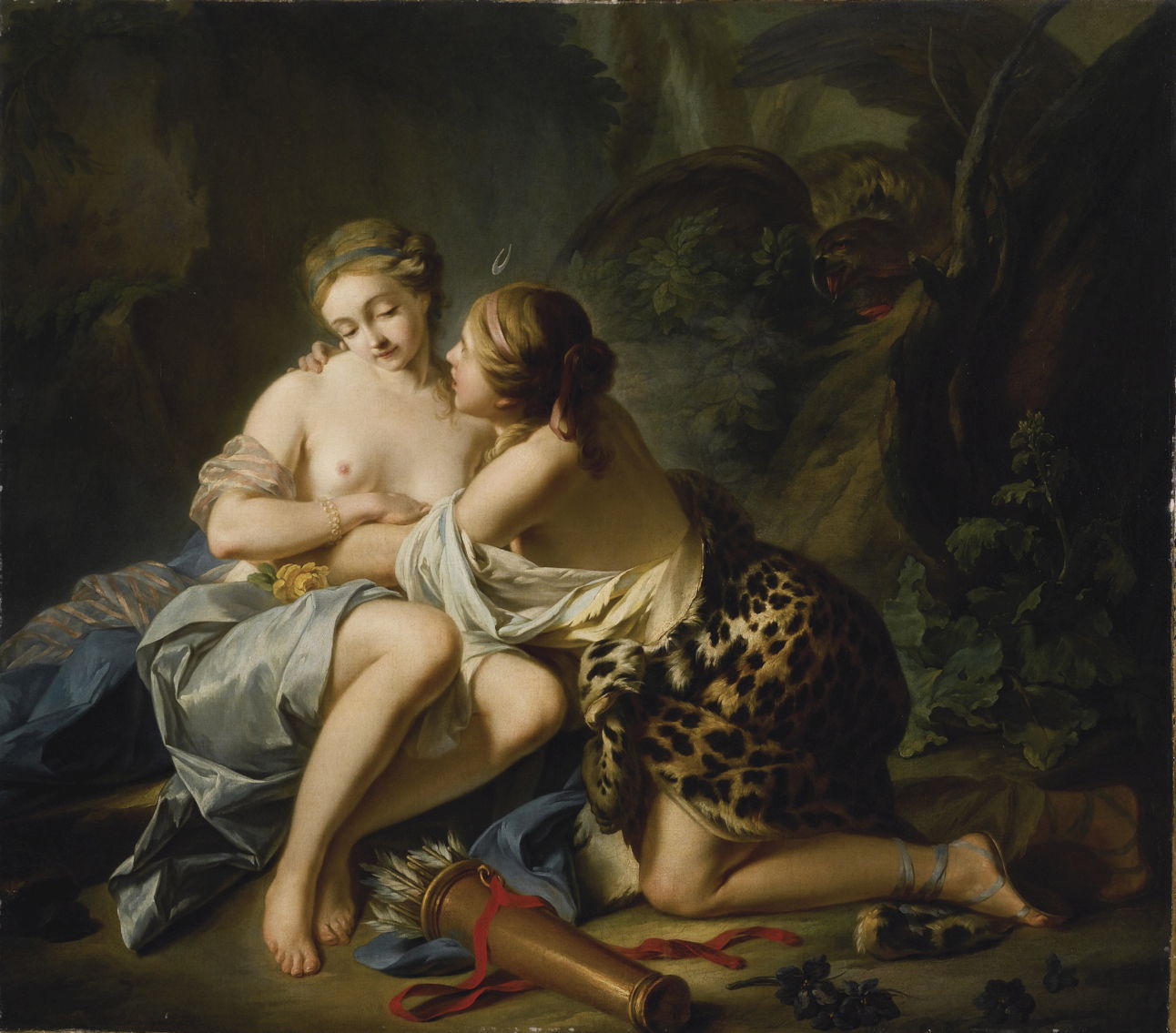
Jean Simon Berthélemy’s much later Jupiter, in the Guise of Diana, and Callisto, probably painted around 1800, may have been inspired by Rubens, but adopts a different approach. Callisto appears coy and cautious, and Diana highly persuasive. If only Callisto were to turn round and see Jupiter’s eagle, she might understand the trap she is in.
The rape complete, Jupiter flies back up to heaven, leaving a shocked and bewildered Callisto to return to Diana and the other nymphs. Callisto falls pregnant, as becomes more obvious with time. When she’s out with Diana and her followers during her late pregnancy, they stop to bathe, revealing her condition. That’s the ultimate proof that she hasn’t been chaste, so Diana throws her out, and the other followers drive Callisto away in disgrace.
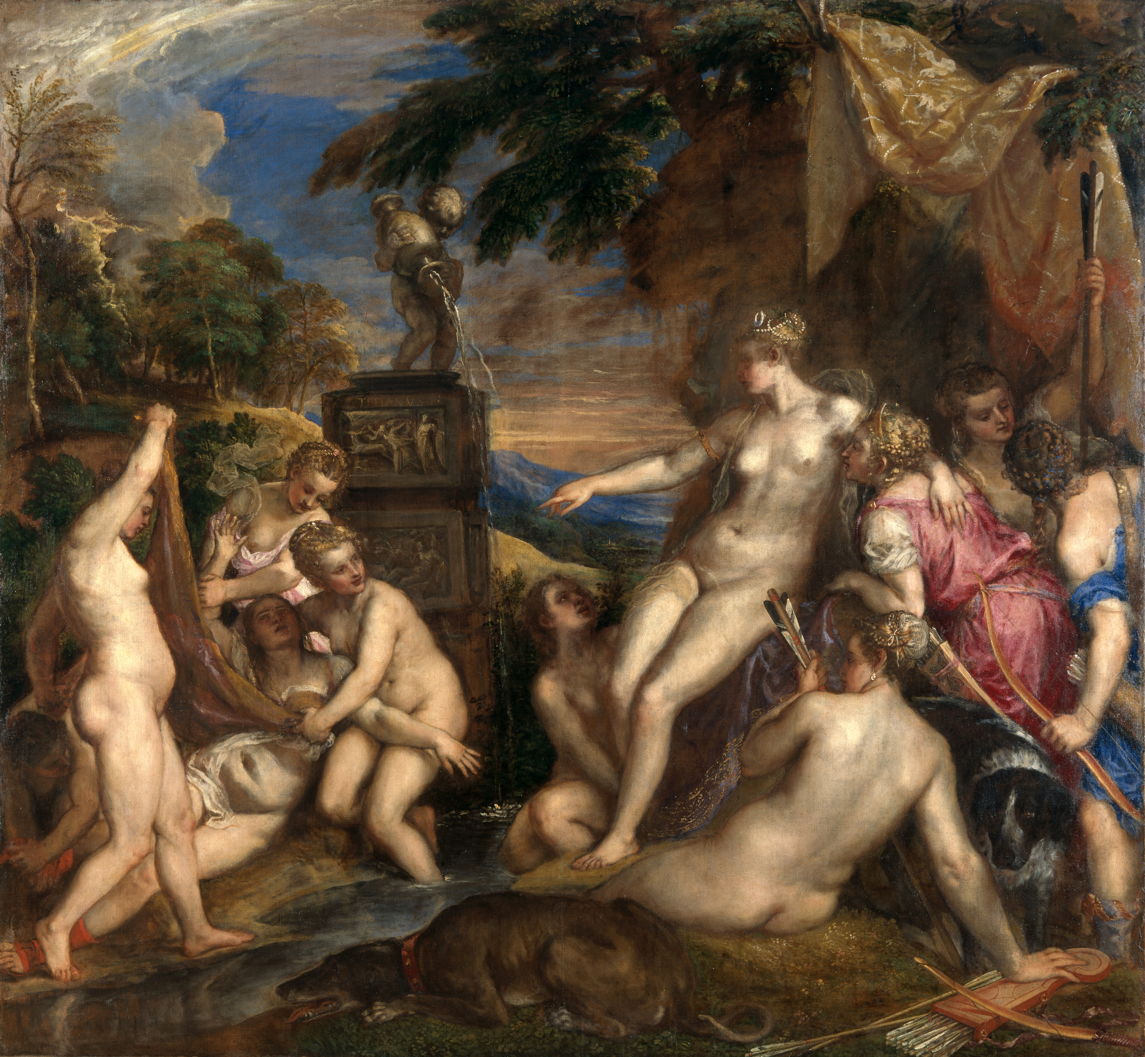
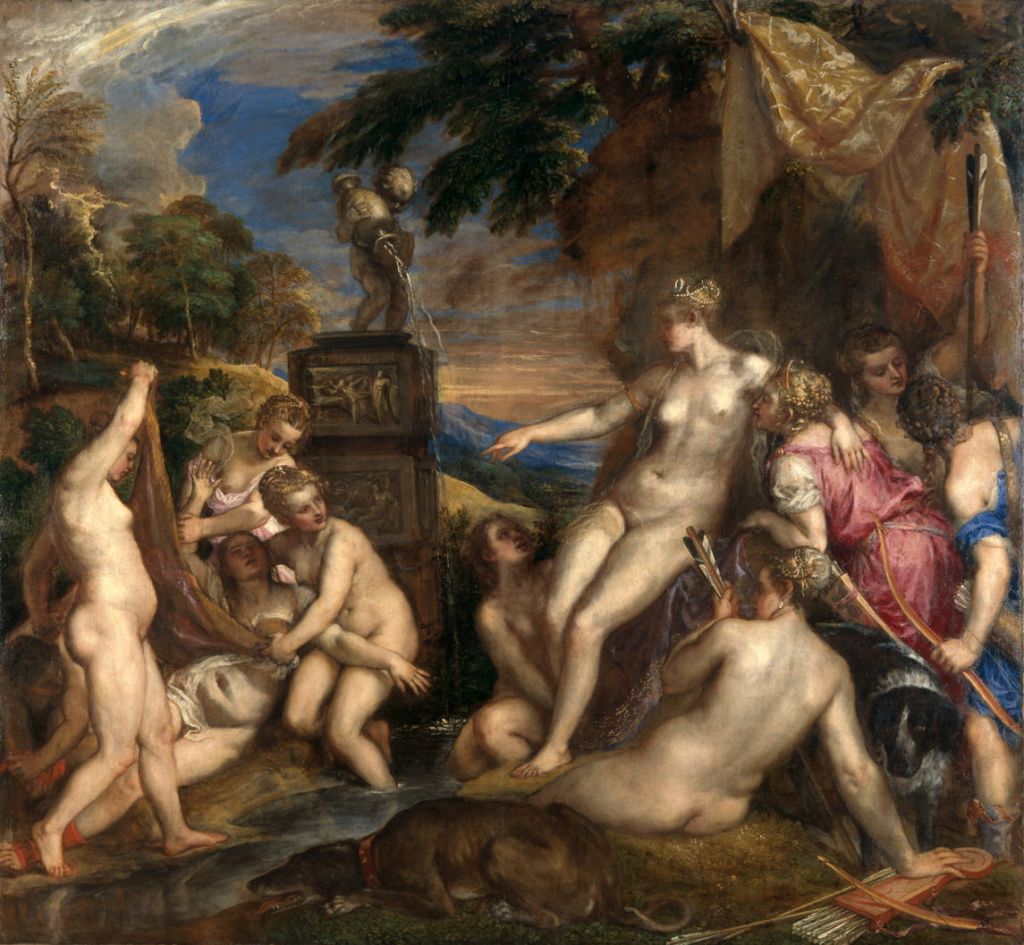
Titian’s Diana and Kallisto from 1556-59 is better narrative than most of the paintings of this scene. Diana is shown just right of centre, with her characteristic coronet, pointing down at the nymph at the left who seems to have fallen into a swoon while being undressed, and whose belly shows that she’s pregnant.
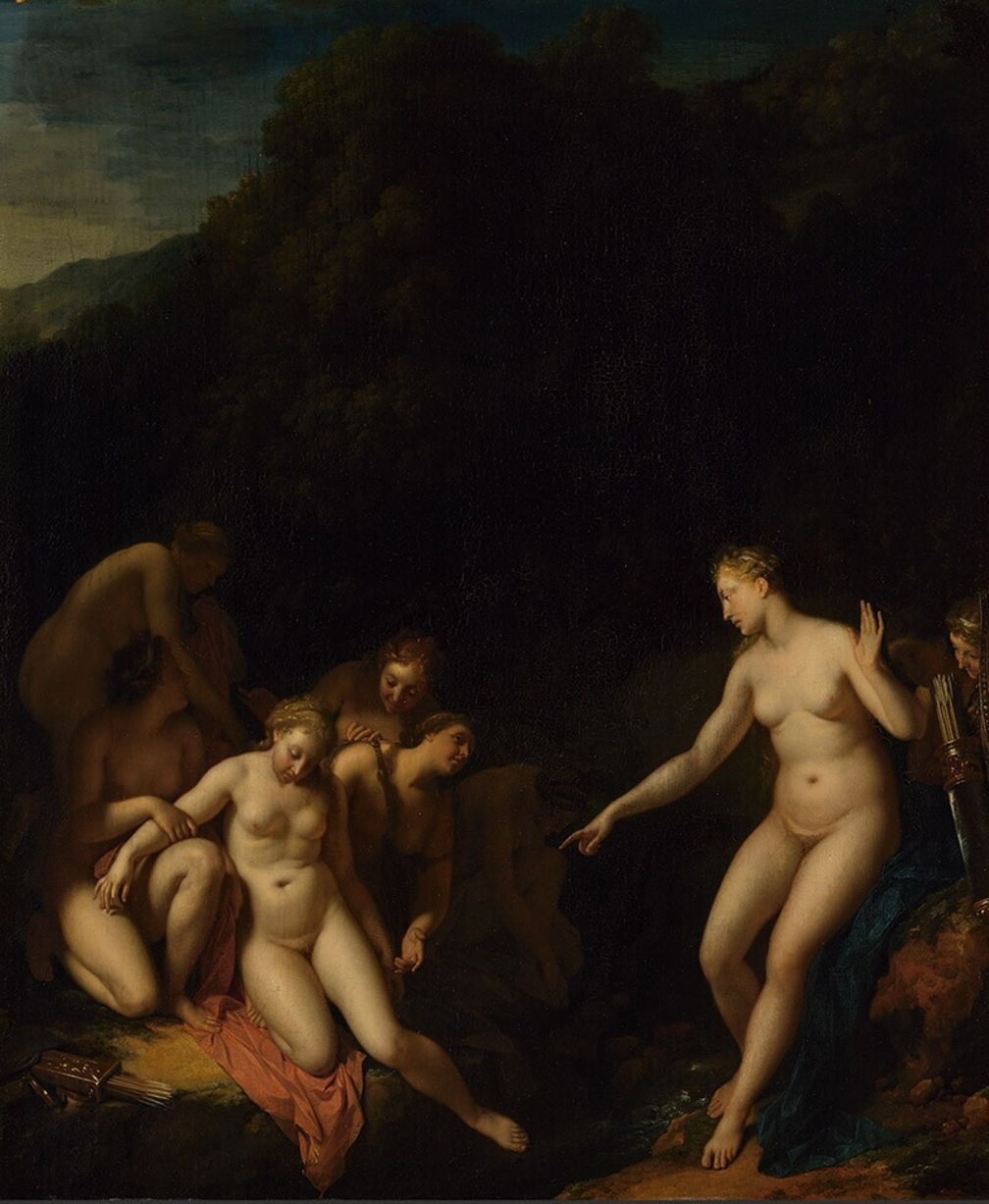
Adriaen van der Werff’s Diana Discovers Callisto’s Slip from 1704 shows Diana, at the right, pointing out Callisto’s swollen abdomen as a sign of her pregnancy.
Juno had also sensed the situation, and worked out her husband’s role. Instead of taking it out on the rapist god, she aims her wrath at his victim Callisto. Juno waits until Callisto’s son, Arcas, is born, then drags Callisto away by her long black hair and transforms her into a bear.
Callisto is distraught, and roams the woods alone. When her son Arcas reaches the age of 15, he comes across his mother, still a bear, but neither knows the identity of the other. Arcas is just about to kill the bear when Jupiter finally takes pity, removes them both and turns them into constellations, a process known as catasterisation.
With Callisto and Arcas as the Great Bear and Little Bear, Juno wants one final act to ensure that her husband cannot sneakily turn Callisto back into a human when her constellation has set out of sight. She therefore instructs the gods of the sea that they shall not let either constellation sink below the horizon. Indeed, in Greece and Italy at that time, neither Ursa Major nor Ursa Minor ever set below the horizon.
As Juno puts it, “thus the guilty rue their chastisement!” as she sails off through the heavens in her chariot with peacocks.
Ovid leaves sufficient clues to make it clear that his version of Callisto’s story is a parody of what all too often happens after a rape. Both men and women twist the facts to somehow lay the blame not on the rapist, but on the victim, just as Diana and Juno did. This stigma only grows when the victim becomes pregnant as a result, and they’re seen as guilty harlots to be chastised and ejected from society.
 The Eclectic Light Company