
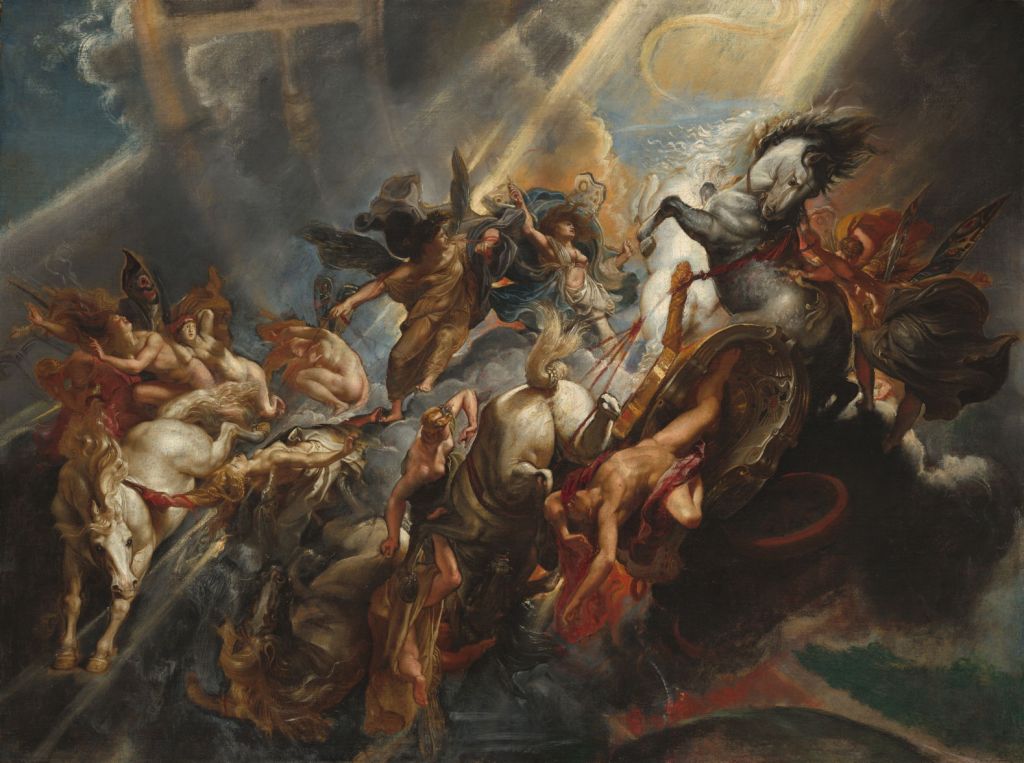
Ovid leads into the myth of Phaëthon, one of the longest in his Metamorphoses, from Epaphus, the son of Io, who is a childhood friend of Phaëthon. This story balances the earlier account of the Flood with that of the earth laid waste by fire, a myth less common across different cultures, which may have its roots in one of the catastrophic volcanic events of the Mediterranean in ancient times.
Epaphus has a friend and rival who like him is the child of a single-parent family, with a god as the absent father. In Phaëthon’s case, his father is reputed to be Phoebus, god of the sun, and his mother is Clymene. Epaphus mocks Phaëthon, who in turn reports this to his mother, who despatches her son to visit his father in the Land of Dawn.
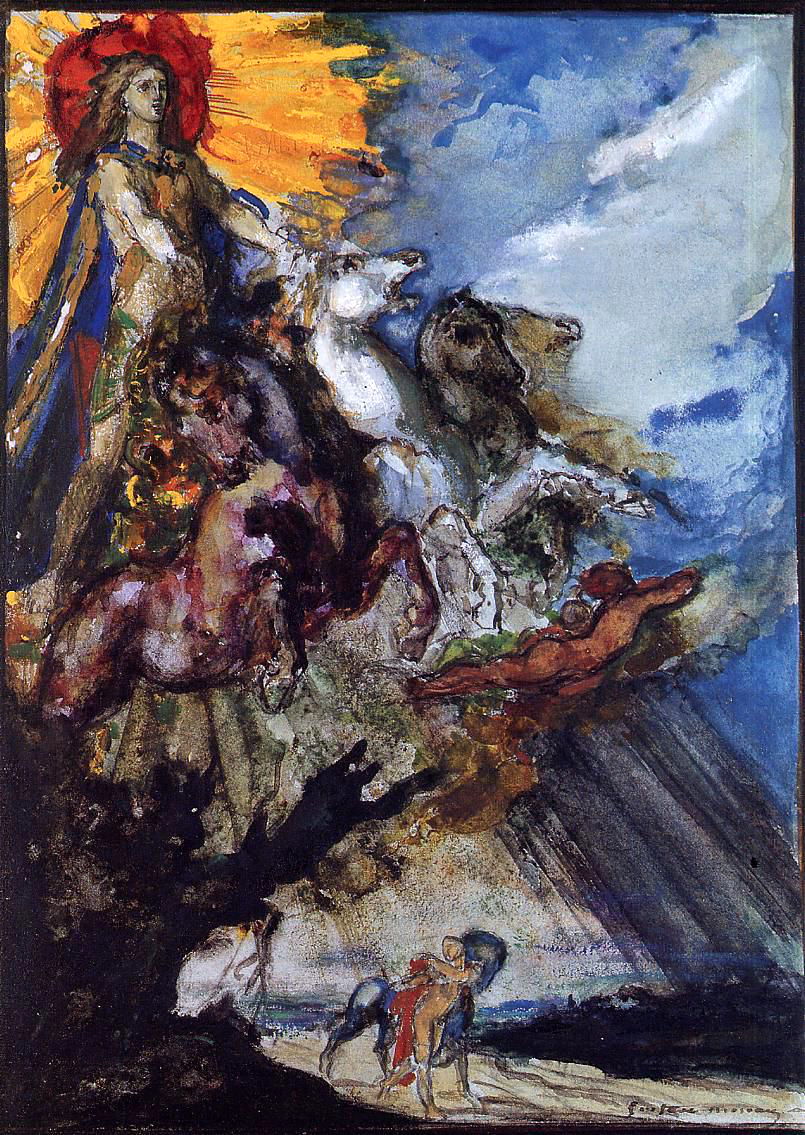
Phoebus and Boreas (1879) is Gustave Moreau’s sketch showing Phoebus in his sun chariot at the left, and Boreas, the cold north wind, to the right of centre. This results in the cold, windy and changeable weather typical of the winter, as shown in the clouds.

The Chariot of Apollo, or Phoebus Apollo (c 1880) is Moreau’s finished version, showing just Phoebus Apollo driving his sun chariot.
Book 2 of the Metamorphoses opens with a description of the Palace of the Sun, where Phaëthon asks his presumptive father Phoebus to provide him with a token as proof of his paternity. Phoebus promises his son anything he desires, so the youth asks to take charge of his father’s chariot of the sun for a day.
In Greek and Roman myth, the sun is drawn across the heavens by Phoebus’ chariot, with four horses, named here as Eous, Aethon, Pyrois, and Phlegon, in harness. In trying to dissuade Phaëthon from his wish, his father explains the great challenges that lie in controlling the chariot as it crosses the constellations, and how difficult it is to restrain the team of horses.

Nicolas Poussin’s Helios and Phaeton with Saturn and the Four Seasons (c 1635) is an early exploration of the scene in the Palace of the Sun. At first this may seem puzzling, as Poussin doesn’t show a palace as such, although Phaëthon is on his knees in front of Phoebus (Greek Helios), pleading with him to be allowed to take charge of the chariot of the sun, shown behind and to the left.
The artist also uses this as an opportunity to depict the four seasons in detailed personifications. Spring is Flora-like in front of Phaëthon, wearing a crown of flowers. Summer sits to the left, next to some ripe corn. Autumn is the older man with fruit slumbering in the right foreground. Winter is opposite him, frosty and shivering in front of a small brazier.
Poussin also unintentionally highlights an issue pervading these relatively modern depictions of this myth: the god Phoebus, or Helios, has become transformed into Phoebus Apollo, a fusion that seems to have occurred after about 200 CE.
Despite Phoebus repeatedly telling his son how hazardous and disastrous his wish would prove, Phaëthon is insistent, and his father is bound by his oath. Phaëthon then leaps into the chariot, and departs on its course across the heavens. He immediately loses control, and the sun runs off track. The chariot comes too close to the earth, and starts melting its polar regions, and scorching its surface. Ovid describes how the sun wipes out the population of whole cities, and how forests and even mountains are destroyed. The Ethiopian people have their skin darkened as a result, and all the rivers of the earth are turned to vapour in the heat.
The goddess of the Earth appeals to the gods, forcing Jupiter to respond by hurling one of his thunderbolts at Phaëthon, who is killed instantly and falls to earth in flames. The chariot lies broken, its horses scattered.
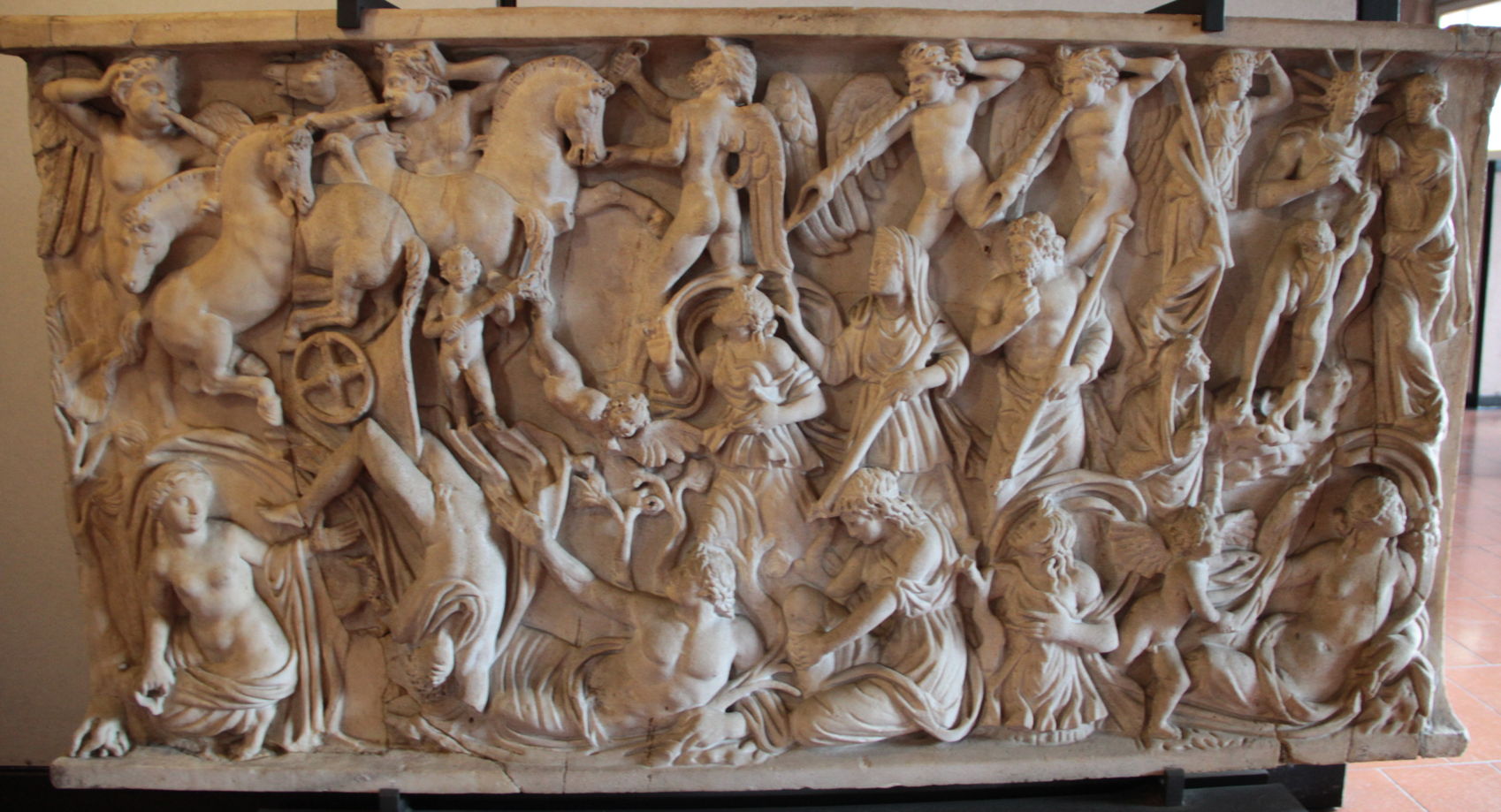
Phaëthon’s death and fall from the chariot have been depicted in a series of works from classical times. This superb marble panel from a sarcophagus made in about 250 CE is atmospheric, for example.

Jacopo Tintoretto’s Fall of Phaëthon (1541-42) tells the conclusion to this story, as Phaëthon loses control of the chariot of the sun, and comes crashing towards the earth.

Rubens’ The Fall of Phaeton, started in about 1604, is perhaps the best of several superb paintings of Ovid’s story. He seems to have reworked this over the following three or four years, and elaborates the scene to augment the chaos: accompanying Phaëthon in the chariot are the Hours (Horae, some shown with butterfly wings), who are thrown into turmoil, and time falls out of joint as Phaëthon tumbles out of the chariot.

In Gustave Moreau’s brilliant watercolour The Fall of Phaëthon (1878) everything is searing orange. The sun chariot is just about to crash to the ground, Phaëthon stands in distress within the chariot, and the horses are in total disarray. Phoebus Apollo, shown in one of his representations as a lion, pursues the chariot in alarm, and a huge serpentine basilisk or dragon rises up from the earth. At the left the moon is shown just peeping over the horizon, and the thunderbolt from Jupiter is flying down to strike Phaëthon.
The scorched remains of Phaëthon are buried by Naiads in a distant tomb, and his mother Clymene is left to mourn his death. Phaëthon’s lamenting sisters are then transformed into poplar trees, and their tears into amber (electrum). Phaëthon’s beloved friend Cycnus is transformed into a swan who shuns the heat by taking to the water that extinguishes fire. Finally Phoebus recovers his horses, and vents his rage on them.

Santi di Tito’s fresco of The Sisters of Phaethon Transformed into Poplars, from about 1570, shows the four young women with leaves sprouting from their hands and heads, as they lament the death of their brother. A swan makes a cameo appearance in the foreground, referring to the transformation of Cycnus.
Paul Barolsky has explained why this painting should appear where it does, on the wall of a small windowless study used by Francesco de’ Medici in his Palazzo Vecchio in Florence. Francesco would retreat to this little room to study his collection of precious stones, including specimens of the resin amber, believed by the Greeks to have been petrified sunlight. The myth of the creation of amber from the tears of Phaëthon’s sisters would there have been highly appropriate.
Jupiter checks heaven for damage caused by the sun, then restores the rivers and vegetation of Arcadia, where he takes a fancy to an Arcadian nymph who is the victim of Ovid’s next story.
 The Eclectic Light Company