
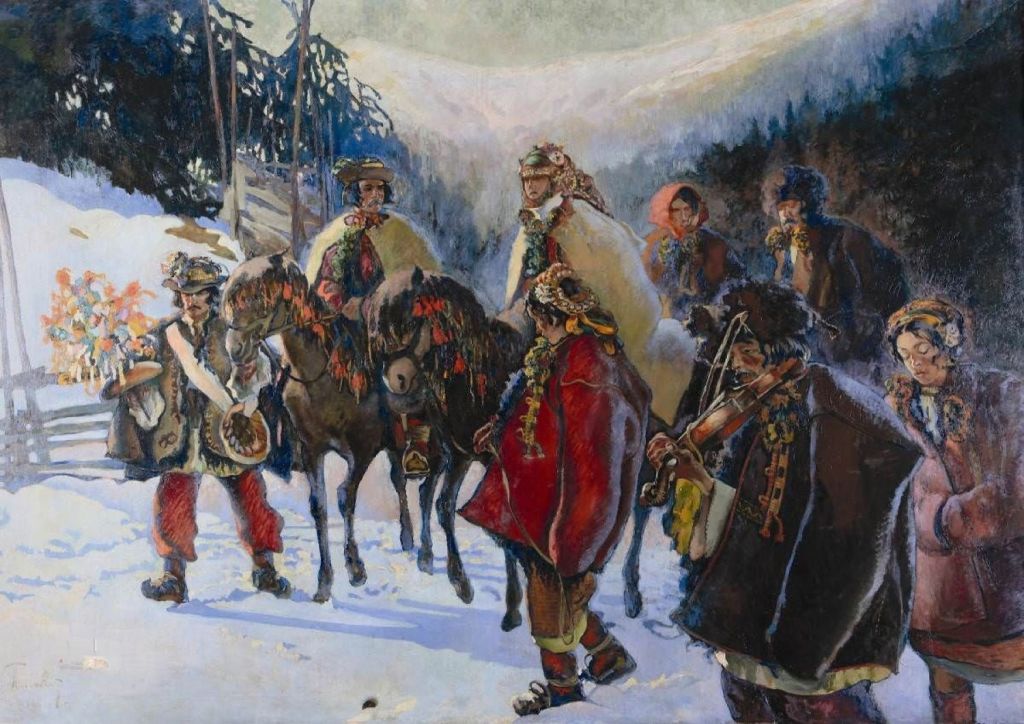
So far, this series has largely concentrated on topography and form, and tended to ignore those who live in mountainous regions. In this article, I show a selection of paintings of two peoples who have lived, farmed and socialised in areas that few of us would cope with: the Hutsul of the Carpathian Mountains, on the borders of Austria, the Czech Republic, Poland, Slovakia, Ukraine, Romania and Serbia, and those of the Engadine in the eastern Swiss Alps.
Interest in mountain peoples flourished during the late nineteenth century, when rail and road transport was opening up parts of Europe that had previously been as remote as other continents. Among those who journeyed to the Carpathians was Teodor Axentowicz, an Armenian (name Թեոդոր Աքսենտովիչ) who was born in Braşov, then in Hungary but now in Romania, and trained in Germany and Paris.

His oil painting of a Hutsul Funeral from 1882 shows the people in the rigours of winter, the coffin being towed on a sledge behind a cart, and mourners clutching candles as they make their way through the snow to the stave church in the distance.

The title of Axentowicz’s painting of folk dancing is confusing. Although it names this dance as the Oberek, the second most popular Polish folk dance after the polka, the first word makes it clear that this is what’s now known as kolomyika (Ukrainian: кoлoмийкa). That’s the combination of a fast and vigorous folk dance with music and rhymed verse. It originated in the Hutsul town of Kolomyia in Ukraine, but has also become popular in north-eastern Slovenia and parts of Poland. Note how most of the dancers are barefoot.
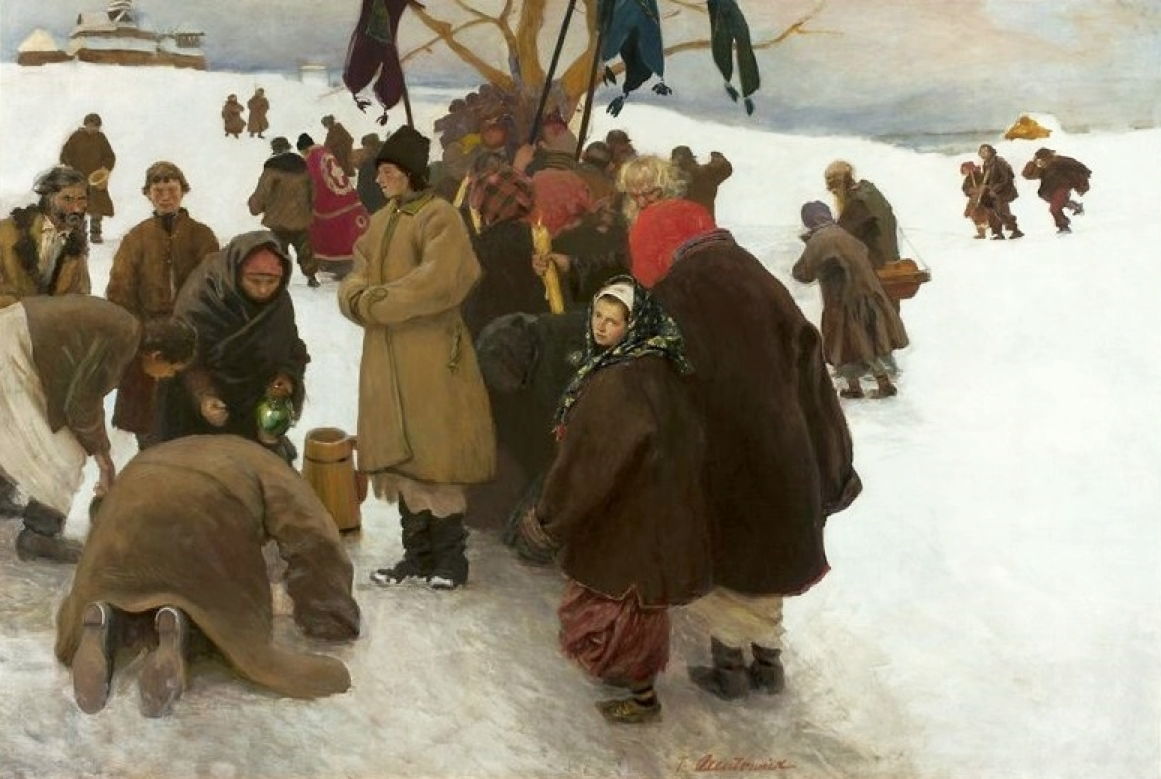
You’ll see this painting of The Feast of Theophany or Blessing of Water from 1895 under various names, but as far as I can establish this shows a Hutsul celebration of the baptism of Christ early in the New Year.
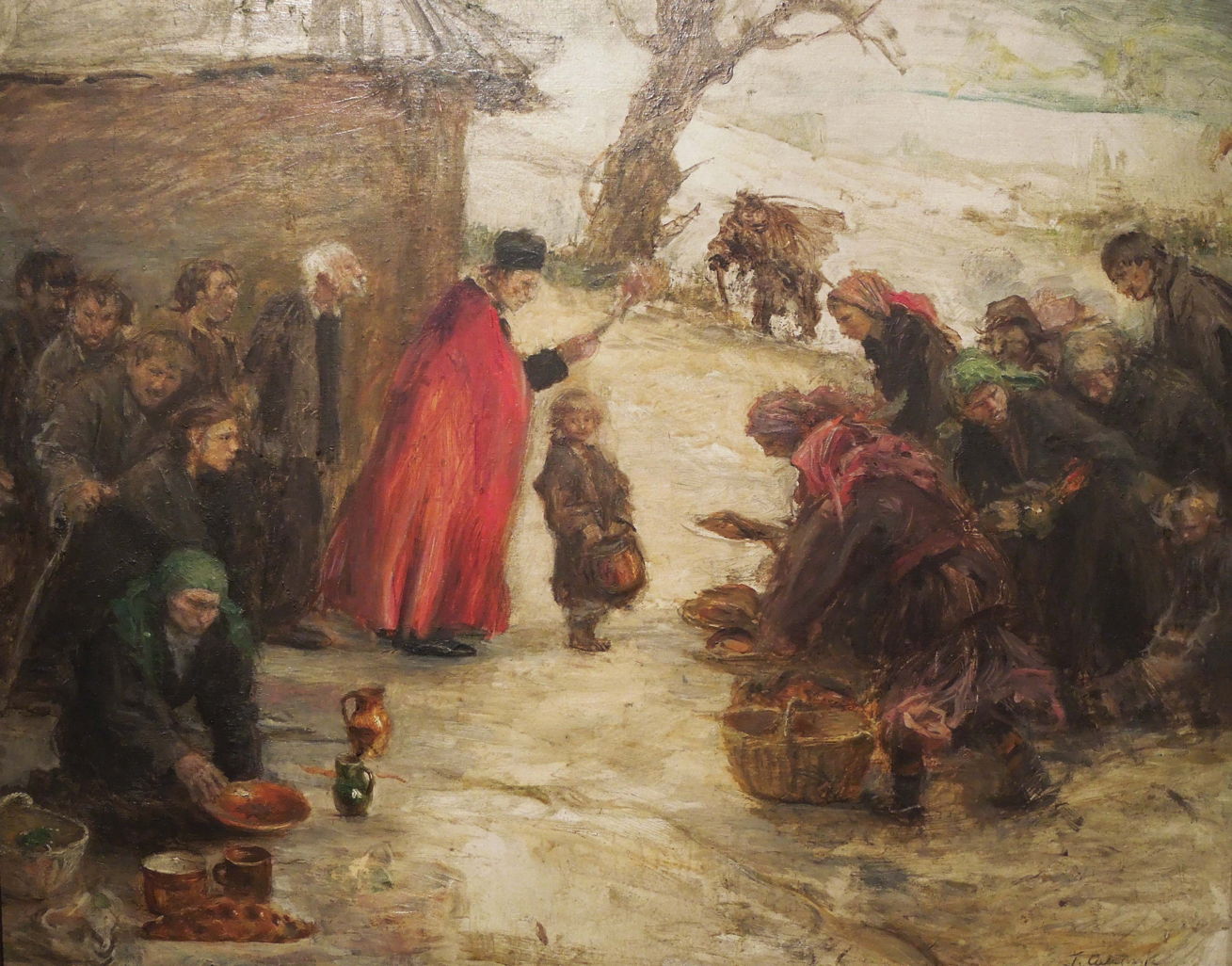
Blessing (c 1899) is also set deep in Hutsul country, with the priest apparently blessing the food brought to him by the women of the village. In the left foreground is a splendid plaited loaf or pie dish, behind which stand the men. In the distance, someone is trudging up carrying a load of kindling.
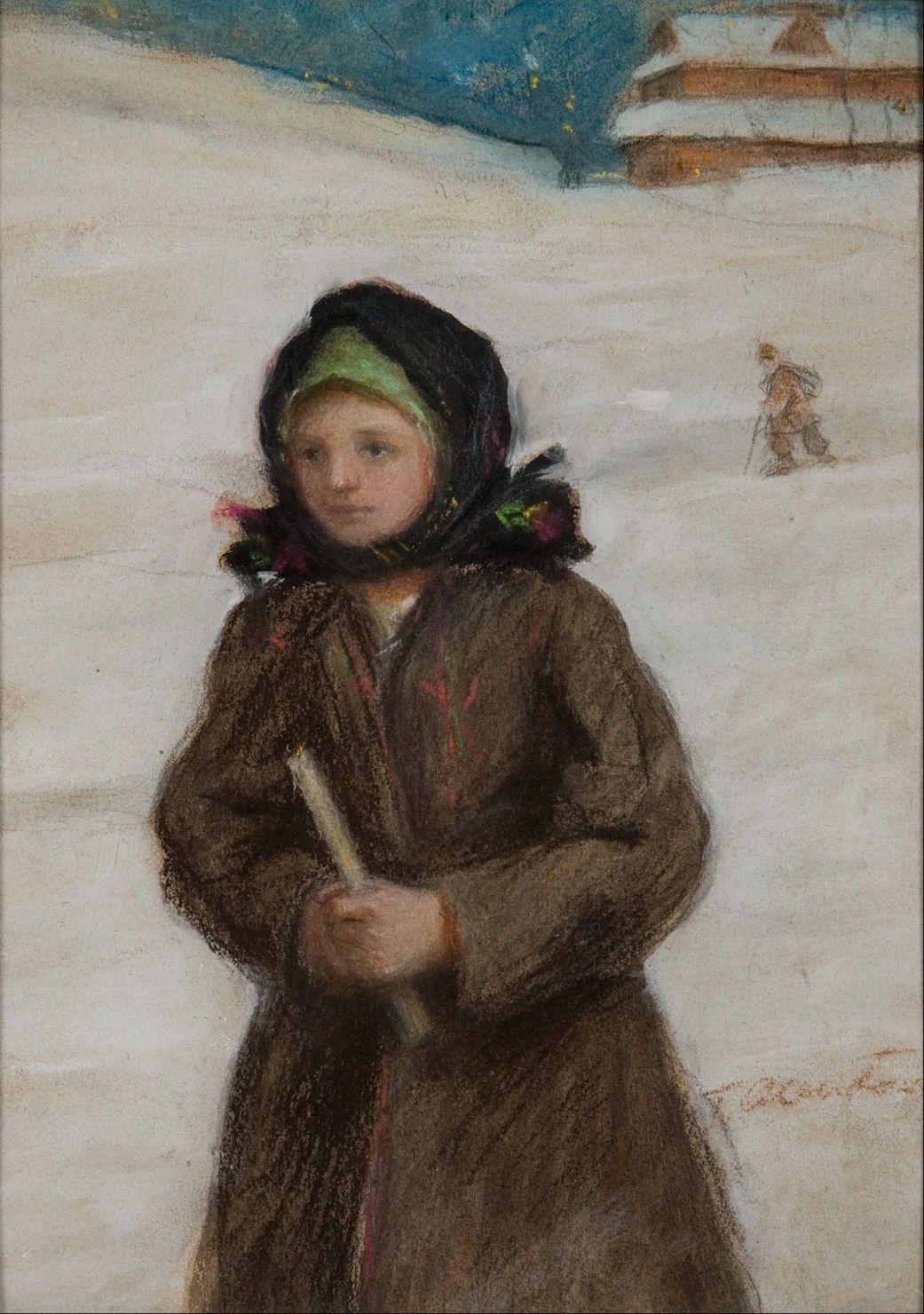
Axentowicz’s undated Girl with the Blessed Candle shows a young Hutsul woman holding a candle that has been blessed, as she makes her way through the snow on Candlemas Day, which takes place after Theophany and concludes the traditional Christmas season.
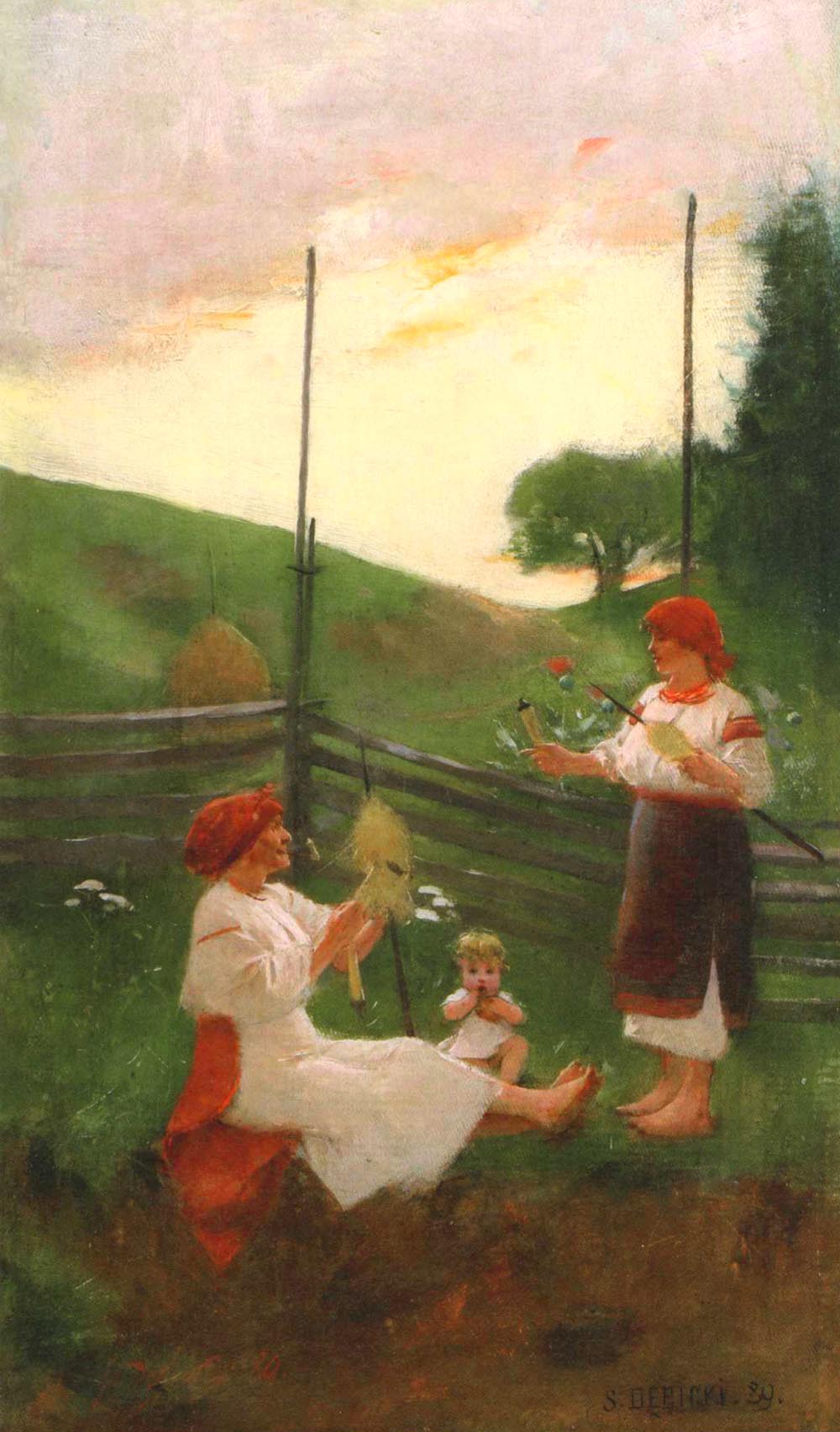
Stanislaw Debicki (1866-1929) was another visitor to the Carpathians, where he painted Spinsters (1889), showing two Hutsul women spinning during the summer. Judging by the young child, neither is a spinster in the sense of being unmarried.

Kazimierz Sichulski (1879–1942) was born in the city of Lviv in what is now Ukraine. From 1349 to 1772, that city, then known as Lwów, was the capital of the Ruthenian domain of the Kingdom of Poland. At the time of Sichulski’s birth it was the capital of the Galician province of the Austro-Hungarian Empire, although it still had strong ties to Poland, for example in being the home of the Polish Academy of Arts, and Sichulski trained in Lviv and Kraków in Poland. During Sichulski’s lifetime, Lviv was a multilingual and multicultural centre for Ukrainian, Polish and Jewish groups. His Hutsul Wedding shows a wedding party making their way through the snow in traditional dress.
Giovanni Segantini (1858–1899) has the dubious distinction of being possibly the only major painter who was stateless for almost his entire life. Born in what was then part of the Austrian Tyrol, now in Italy, he started his career in Italy, but later moved to the village of Savognin in the Oberhalbstein Alps in Grisons, Switzerland, then to Engadine, where he and his family lived in a wood cabin at an altitude of nearly two thousand metres (6,200 feet).

High Noon in the Alps (1892) is one of a pair of paintings showing a shepherdess enjoying a brief break in her work, in the intense summer sunshine high in the mountains.
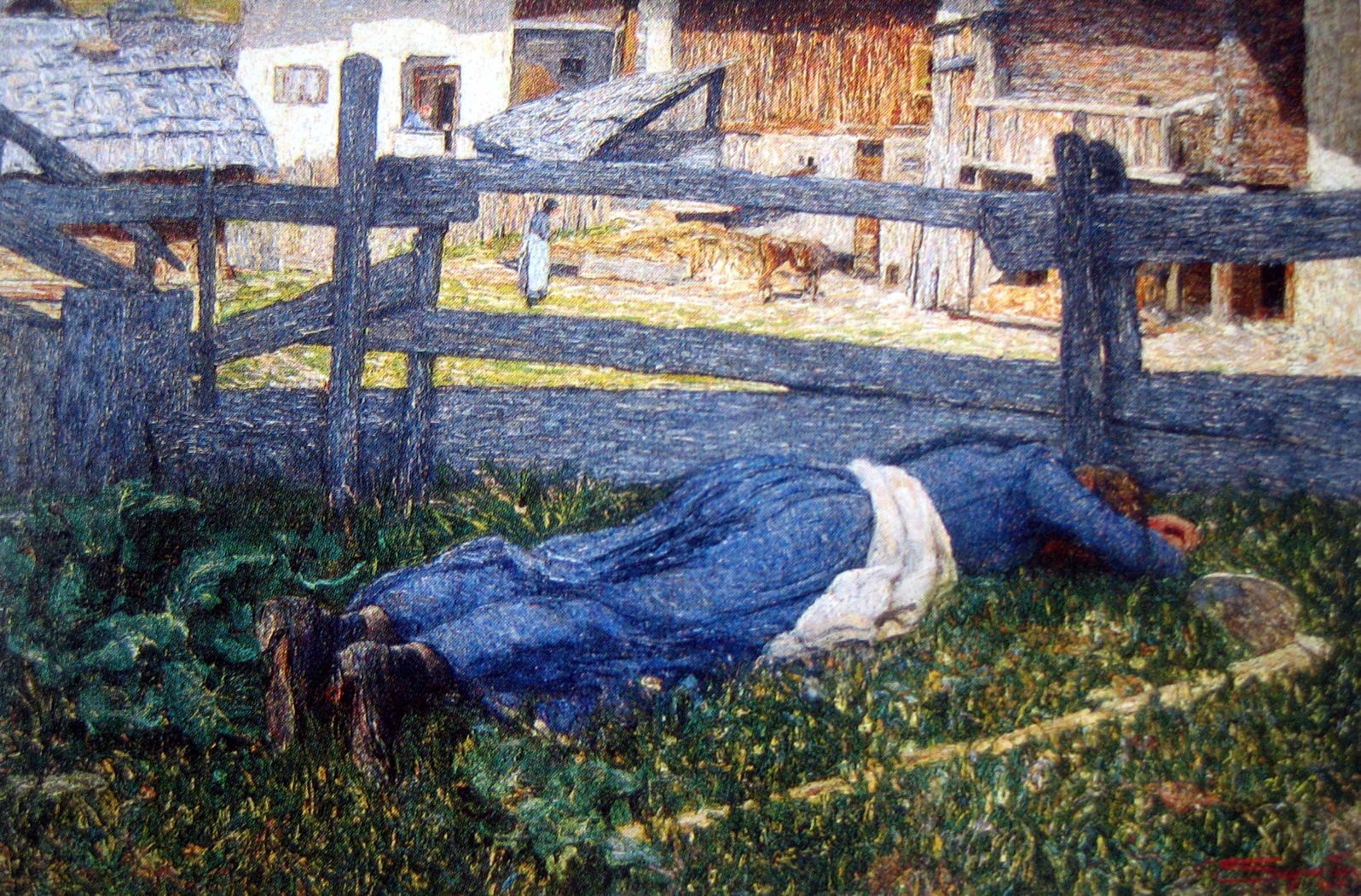
Rest in the Shade (1892) is a complement to the previous painting, here showing a young woman taking a short nap on the grass near a farm, where she has been working the ground in the vegetable patch.

Returning Home from 1895 is based on Segantini’s personal experience of a family taking the body of their son home on a cart. He recasts the story to that of parents recovering their dead son from a foreign place, where he had fallen on misfortune. The landscape is that of Maloja in the Engadine, where the artist was then living, the village church being visible to the left.
It was only after his death in 1899 that he was given Swiss citizenship.
 The Eclectic Light Company