
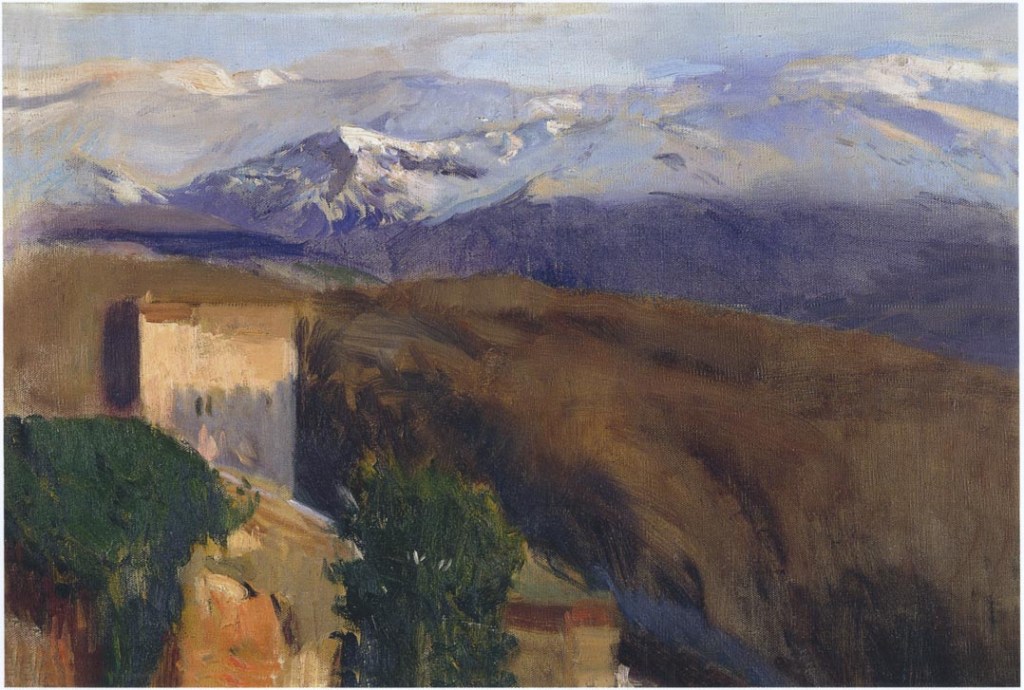
Mountains are most commonly associated with cold, particularly in the more northerly or southerly latitudes, but there are locations and times of the year when the hot plains have a contrasting backdrop of snow on the mountains above them. One place that has become popular for artists to capture this is Granada in Andalusia, in southern Spain, where the towers of the Alhambra palace rise in competition with the snowy peaks of the Sierra Nevada, which reach the summit of Mulhacén at 3,479 metres (11,414 feet) elevation. The Sierra Nevada even have sufficient snow for skiing.
Most of the artists who visited Granada and its view of the Sierra Nevada did so because of the unique collection of paintings in the Prado in Madrid. That former royal collection, first opened to the public in 1819, draws artists from across the whole of Europe, and many from further afield.

In 1867, Franz von Lenbach and a student of his travelled to Madrid to copy the Masters in the Prado for his patron Baron Adolf von Schack. The following year, von Lenbach painted two works in Granada: The Alhambra in Granada (1868) is a magnificent sketch including the backdrop of the distant mountains, and appears to have been painted in front of the motif. It was perhaps this painting which established this motif as an almost unique combination of foreground heat and the contradictory background snowline.

Edmund Wodick’s Granada from 1886 was probably the last work that he completed; shortly afterwards he developed pneumonia and died at the age of 69. He painted this just outside the city walls, looking across at the Alhambra and its towers, down towards the lush green plain and the snow-capped peaks in the far distance.

This is a contrasting view painted by Hernandez Miguel Vico, a local artist. The Cuesta de los Chinos is the steep road seen here, which forms one of the pedestrian accesses to the palace.

Joaquín Sorolla’s Tower of the Children from 1909 downplays the snowy mountains by tucking them into a corner.

Antonio Muñoz Degrain uses them in a tonal and chromatic progression in his View of the Alhambra. From the foreground back, this starts with dark greens, works through pinks, oranges, and yellows, then reaches the white of the Sierra Nevada in the far distance.

In 1917, Sorolla returned to this theme when he was exhausted after completing the demanding commission of fourteen large murals for the Hispanic Society of America building in Manhattan. In his Sierra Nevada, Granada, the mountains dominate, with patches of cloud to add uncertainty to their forms.
There are other locations with similar contrasts that have been painted occasionally, and further contenders for the best views combining hot and cold are in California, where they have been painted more recently.
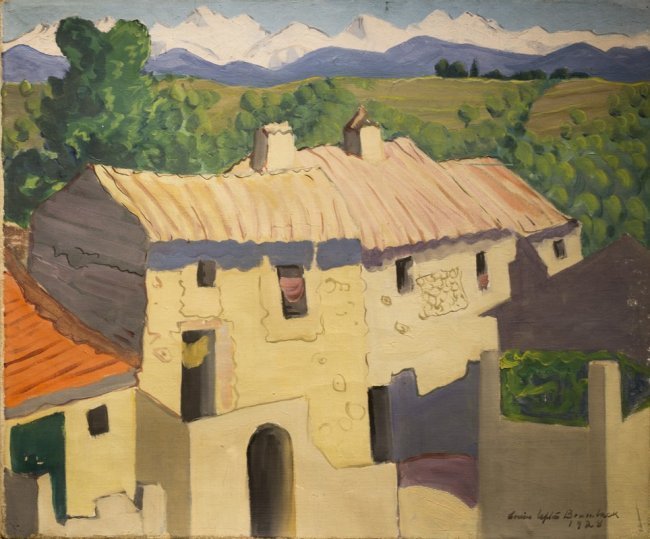
Almost every other painting I’ve seen by Louise Upton Brumback shows a beach scene, typically not far from where she lived in Gloucester, MA. Her Afternoon Sun from 1928 shows what I believe is a landscape in California, with snow-covered mountains in the far distance. Maybe one of you will recognise this view?
 The Eclectic Light Company