
Rope is one of our oldest known tools, and widely used in activities from farming and boating to climbing and exploration. Like most of our tools, it rarely makes the limelight in paintings and visual art, but where it does it can make quite a story, a whole thread in fact. This article shows the only example I know of rope forming the thread of a series of major paintings. Tomorrow’s article will show individual paintings that feature rope.
After taking a short break in 1565 from painting his series for the albergo of the Scuola Grande di San Rocco in Venice, Jacopo Tintoretto had three remaining works to complete these scenes from the Passion. He had previously painted the last in that series showing the Crucifixion, and these hang close-packed on the opposite wall.

The right of the three shows Christ before Pilate, and like the others was completed between 1566-67. Pilate is the bald and bearded man in the red robe sat on a throne to the right of centre, and is talking to the High Priest or his representative at the lower right, as he symbolically washes his hands. Christ dominates the canvas as he stands, his face and eyes cast down, to the left of centre. His hands are bound by thick rope, the unifying theme through the series.

In the centre is Ecce Homo, ‘behold, the man’, showing the bloody and battered figure of Christ exposed to an unseen crowd, of which the viewer is a member. Christ wears the crown of thorns, and his hair and beard are matted with dried blood. His wrists and ankles are again bound with rope. He gazes into the distance, here looking across the albergo to the image of himself on the cross, providing a subtle forward link in the narrative.
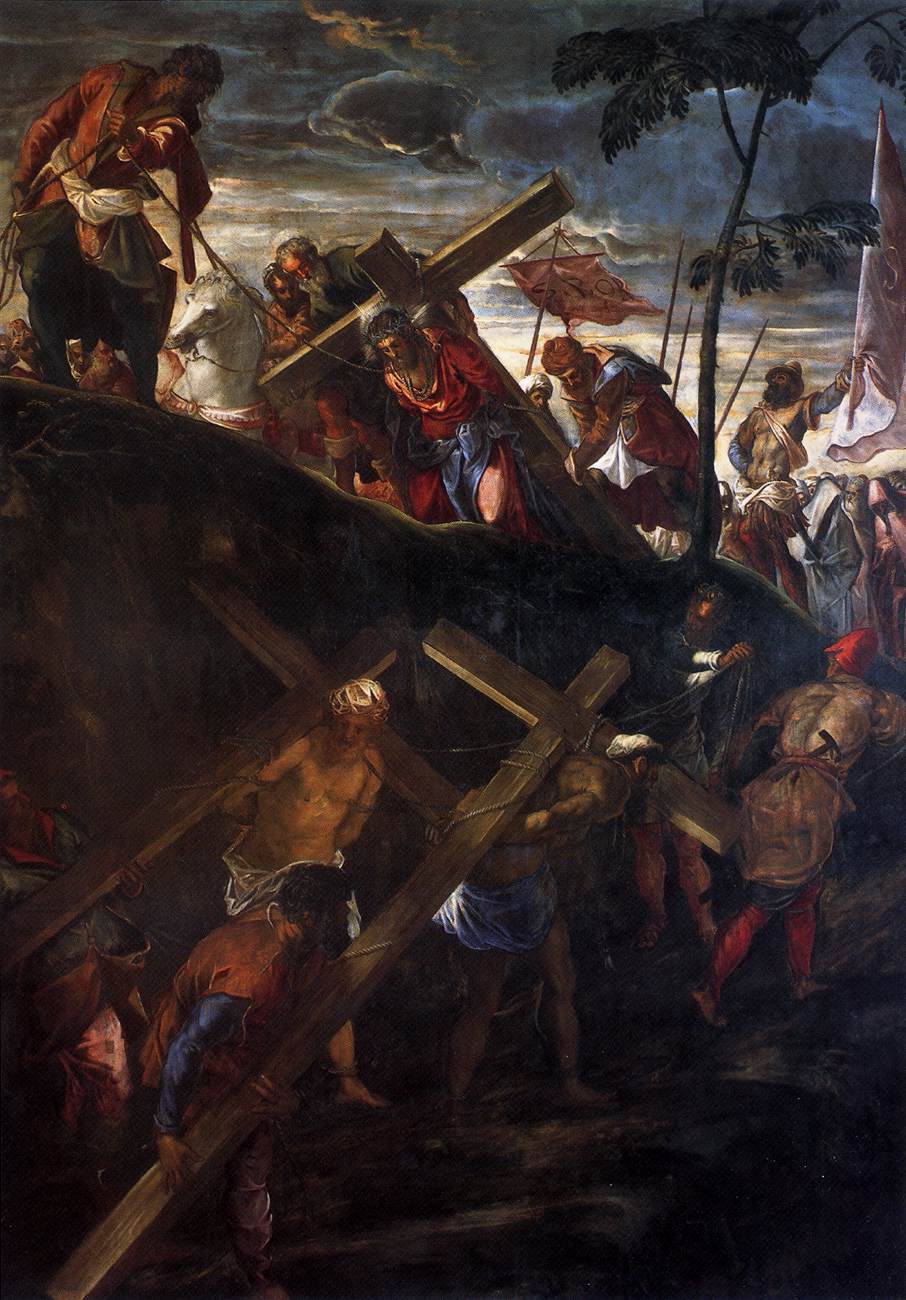
At the left is the Ascent to Calvary, unusual among paintings of this phase of the Passion for its inclusion of all three of those to be crucified bearing their crosses. Christ is naturally prominent in the upper half of a composition dominated by diagonals, formed by the winding path and the crosses themselves. He and the two thieves are each given assistants who help them with the burden of the crosses.
In the upper distance are banners declaring the oversight of the Roman authorities, in their inscriptions of SPQR. Tintoretto links this with the Crucifixion with the inclusion of the tradesmen and their tools who were shortly to be responsible for the mechanics of the executions. Here thick ropes bind the figures together, as they’re used to attach the crosses to their bearers, and to draw the three along to their deaths.
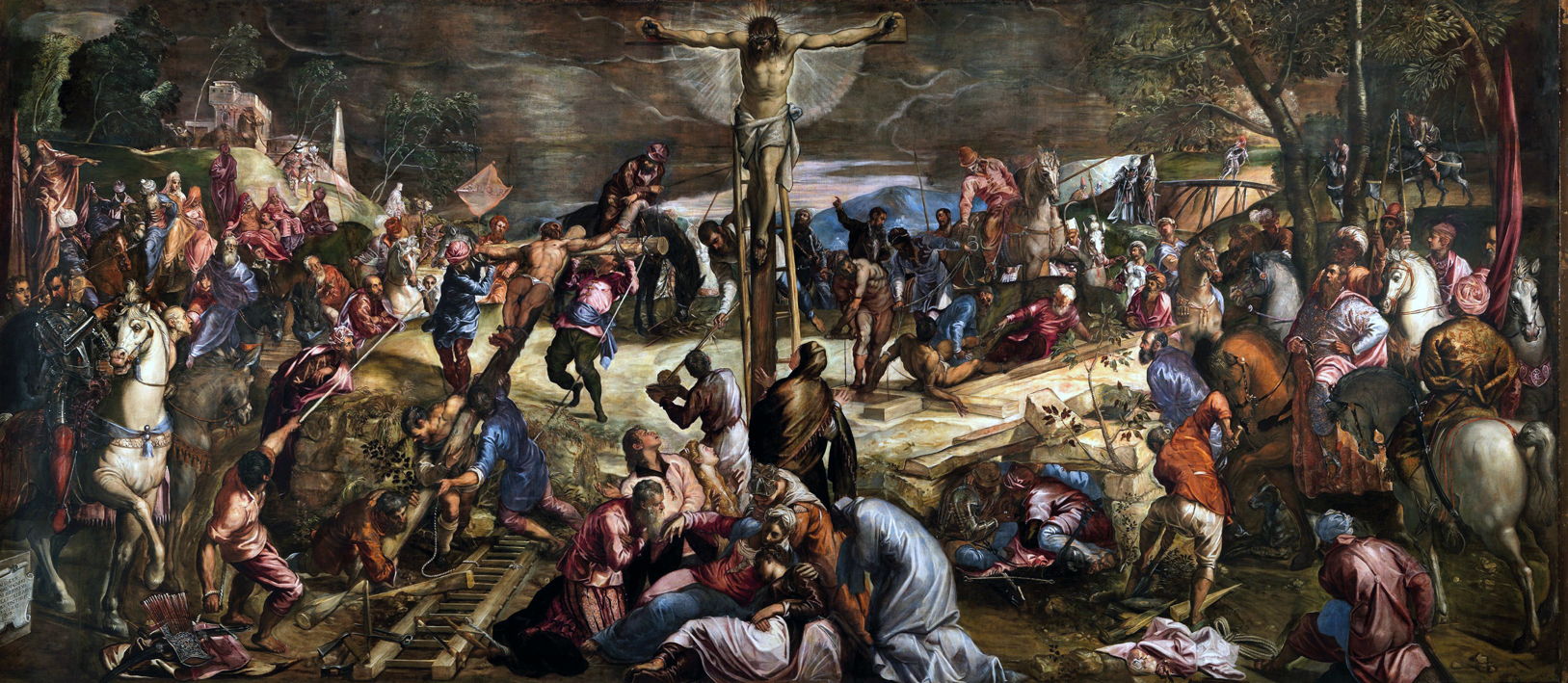
Tintoretto had previously painted one of the major religious works of the century, his vast Crucifixion, completed in 1565 for the opposite side of the albergo. This is over 5 metres (17 feet) high, and 12 metres (40 feet) across. He makes use of space and uses a narrative technique based on the traditional ‘multiplex’ form popular during the Renaissance, in which its single image shows events at more than a single point in time, but in an ingenious and modern manner. Naturally, the painting centres on Christ crucified, but the two thieves executed beside him aren’t shown, as would be traditional, already hanging from their crosses.

Instead, to the right of Christ, the ‘bad’ thief is still being attached with ropes to his cross, resting on the ground. To the left of Christ, the ‘good’ thief is just being raised on his cross to the upright position, again with ample use of rope. There’s nothing in the well-known gospel accounts to make this view anachronistic, but it’s most probable that the crucifixions were more simultaneous.
It’s thus an ingenious artistic device which shows the three executions at different times, and is therefore ‘multiplex’ (or ‘continuous’) narrative. But here it avoids the archaic repetition of figures or other content, as Tintoretto applies it to discrete passages within the whole.
Spaced out around the canvas are relevant sub-stories from that whole. At the foot of Christ’s cross is his group of mourners, including the Marys. Each of the crosses has attendant workers, busy with the task of conducting the crucifixion, climbing ladders, hauling on ropes, and fastening each victim to his cross. This mechanical and human detail brings the scene to life and adds to its credibility and grim process, and the narrative thread of the rope.
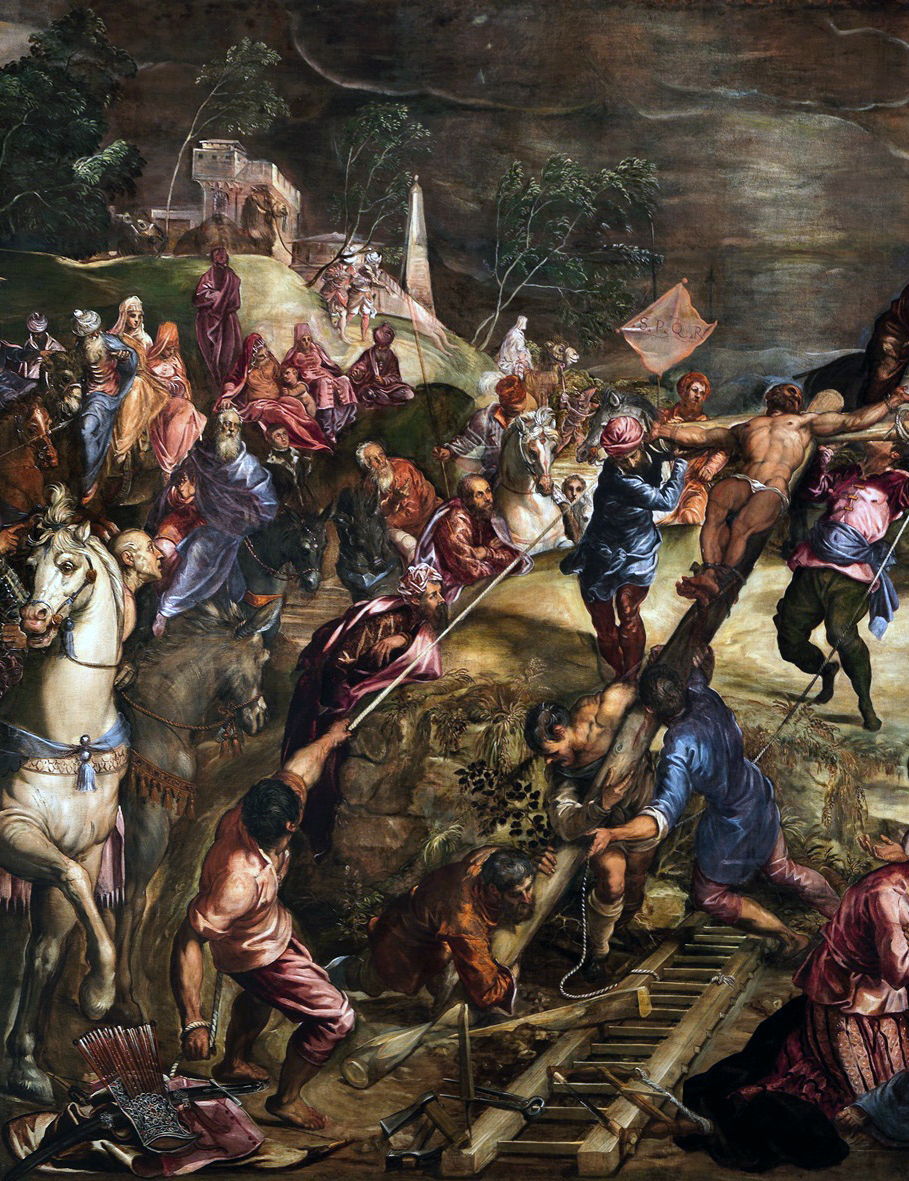
The crowd on the left is more spread out than in his earlier depiction. In the distance is a flag bearing the letters SPQR representing the Roman Empire, and its link through Pilate. Most faces are turned towards Christ, with their eyes wide in awe.
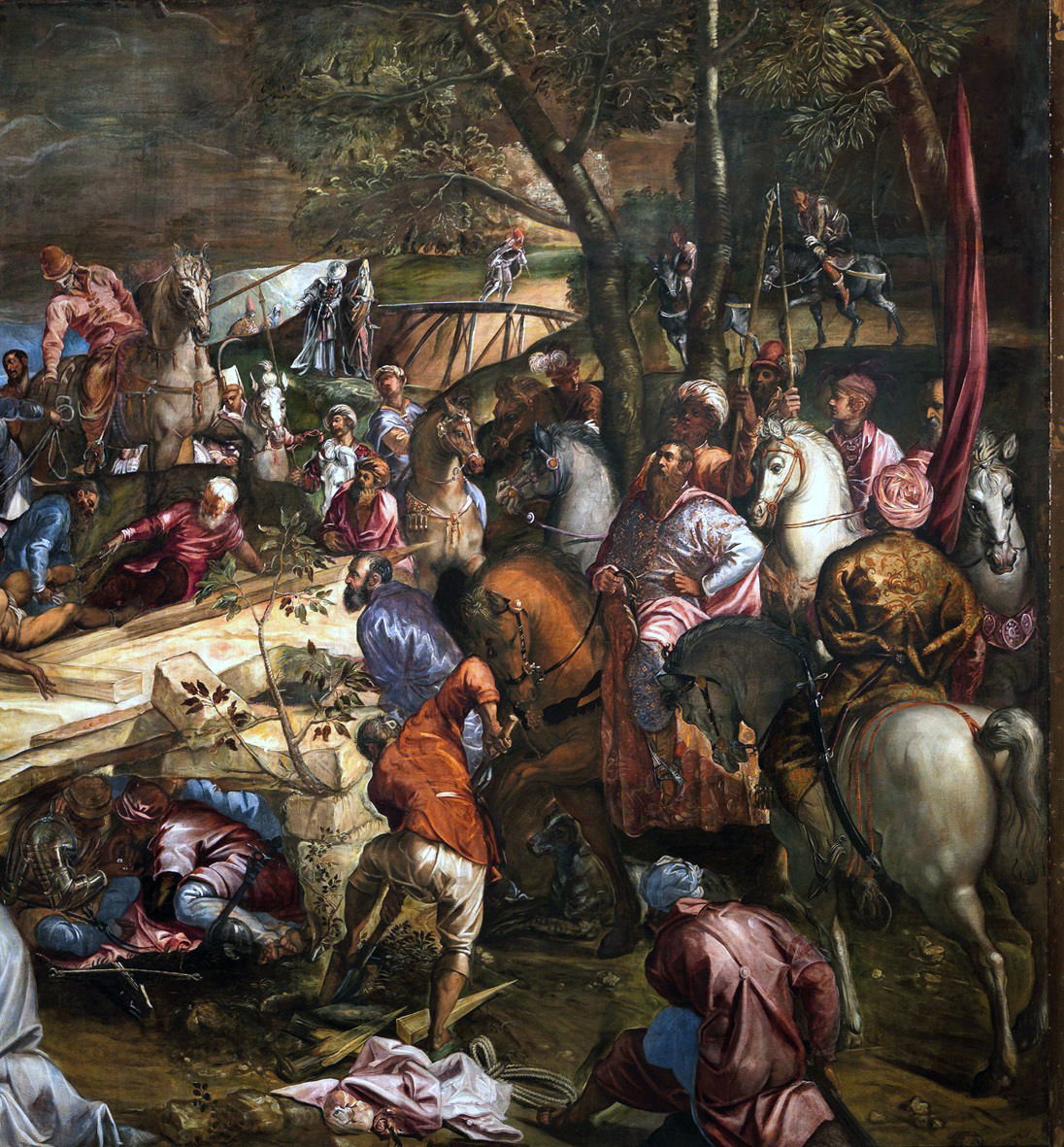
On the right, in a small rock shelter suggestive of a tomb, two men are gambling with dice. To the right of them, a gravedigger has just started his work with a spade, and there’s a coil of rope. The ruling class, perhaps Herod himself, have turned up on horseback, and they too stare wide-eyed at Christ.
References
Robert Echols and Frederick Ilchman (2009) Toward a new Tintoretto Catalogue, with a Checklist of revised Attributions and a new Chronology, in Falomir op cit.
Miguel Falomir (ed) (2009) Jacopo Tintoretto, Proceedings of the International Symposium, Museo Nacional del Prado. ISBN 978 84 8480 171 9.
Roland Krischel (ed) (2017) Tintoretto, A Star was Born, Hirmer (in German). ISBN 978 3 777 42942 7.
Tom Nichols (2015) Tintoretto, Tradition and Identity, 2nd edition, Reaktion Books. ISBN 978 1 78023 450 2.
 The Eclectic Light Company