
Soon after the death of Jan Vermeer in 1675, his paintings lapsed into obscurity, and it wasn’t until Théophile Thoré-Bürger published his attempt to catalogue and describe them in 1866 that he became appreciated. Several artists became fascinated by Vermeer’s use of defocus or blur, among them the American painter William McGregor Paxton (1869–1941), who had trained with Jean-Léon Gérôme at the École des Beaux-Arts in Paris.
At the end of the nineteenth century, Paxton thought he had discovered Vermeer’s optical secrets in what he termed “binocular vision”, and set about painting using those techniques. Sadly, many of Paxton’s earlier paintings were destroyed in a studio fire in 1904, so what I show here are from his later works.

In the Studio from 1905 is a good demonstration of this ‘binocular vision’. His model is in crisp focus, and as the eye wonders further away from her at the optical centre of the painting, edges and details become progressively more blurred. When you look at the folding screen at the left, it’s really quite soft focus, as in many of Vermeer’s paintings.

This painting of a woman marvelling at The String of Pearls from 1908 shows this effect clearly when you study Paxton’s rendering of the different strings of pearls across its image. Sharpest focus is in the woman’s face and the pearls she is staring at wide-eyed. Those adorning her dress are a bit fuzzier, and those in the reflection and on her lap resemble the defocussed jewellery in some of Vermeer’s paintings.

The following year, Paxton’s Tea Leaves (1909) not only uses this ‘binocular vision’ but lures us to speculate what is going on. Two well-dressed young women are taking tea together. The woman in the blue-trimmed hat seems to be staring into the leaves at the bottom of her cup – a traditional means of fortune-telling – but neither seems to be talking to the other.

Notice the zone of relative sharpness extending from the right shoulder of the woman at the left, across the silver teapot to the hands of the woman in the hat. This contrasts markedly with the much softer blue edge of the screen above them, for instance.
Paxton not only had the advantage of being able to study Vermeer’s paintings as he travelled in Europe, and an understanding of modern optics, but experienced the widespread use of cameras with lenses that had limited depth of field.

Paxton’s domestic interiors included not just the posh people, but their servants, here The House Maid also from 1910. She should be dusting with the feather mop tucked under her arm. Instead she’s completely absorbed in reading. The sharpest focus here is in the maid’s left arm and shoulder, rather than the objets d’art on the chess table in the foreground.

The New Necklace (1910) is one of Paxton’s best-known paintings, and perhaps his most intriguing open narrative. A younger woman is sat at a narrow bureau writing. She has turned her chair so that she can reach behind and hold out her left hand to receive the new necklace of the title. This is being lowered into her hand by a slightly older woman, in a dark blue-green dress, whose face and eyes are cast down, and her left hand rests against her chin.
Edges are at their crispest in the middle of the canvas, in the upper body and left arm of the seated woman, and the new necklace, and become more blurred both in the foreground and behind them, just as in photographic depth of field.

Most of Paxton’s paintings are of his time, and quite unlike those of Vermeer in their motifs or even composition. Woman with Book from about 1910 is one notable exception, with sunlight cast through the window at the left, a woman who even resembles one of Vermeer’s models standing reading a large book, and a painting on the wall behind her. Its optical focus seems to be in the purse which she holds high against her left shoulder, with blurry bright reflections below the arm of the chair in the left foreground.

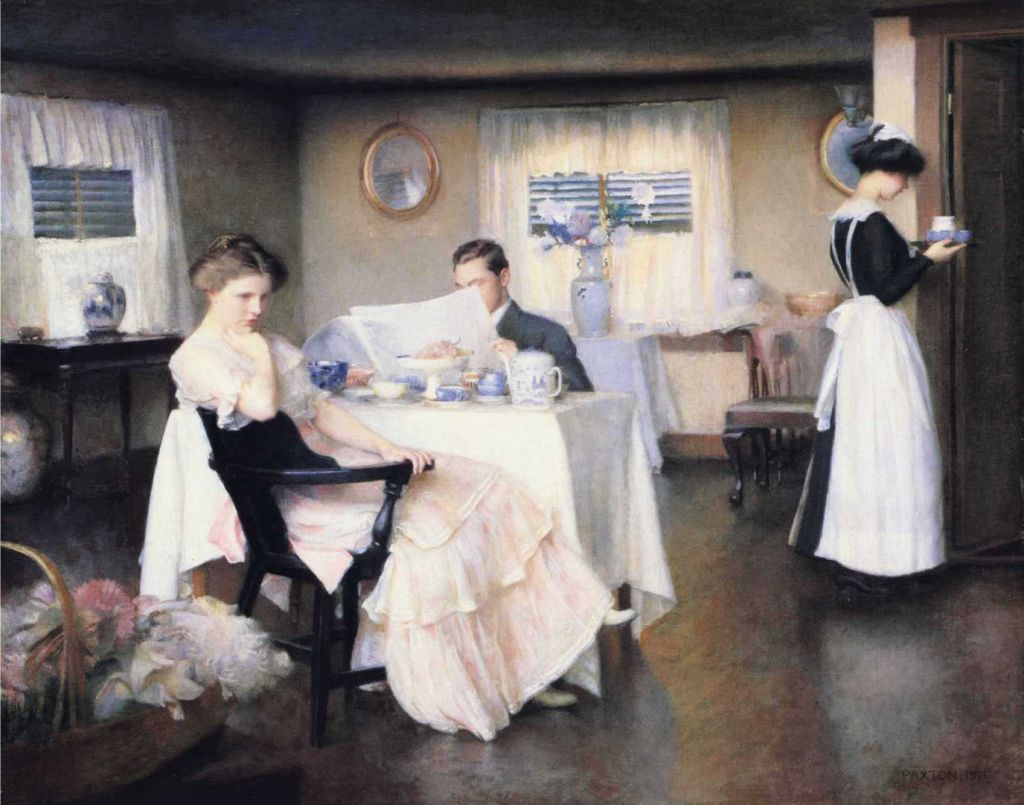
In The Breakfast from 1911, the sharpest edge is that of the newspaper and the man’s head behind it. The bouquet of flowers in the foreground and the maid at the right are markedly defocused.
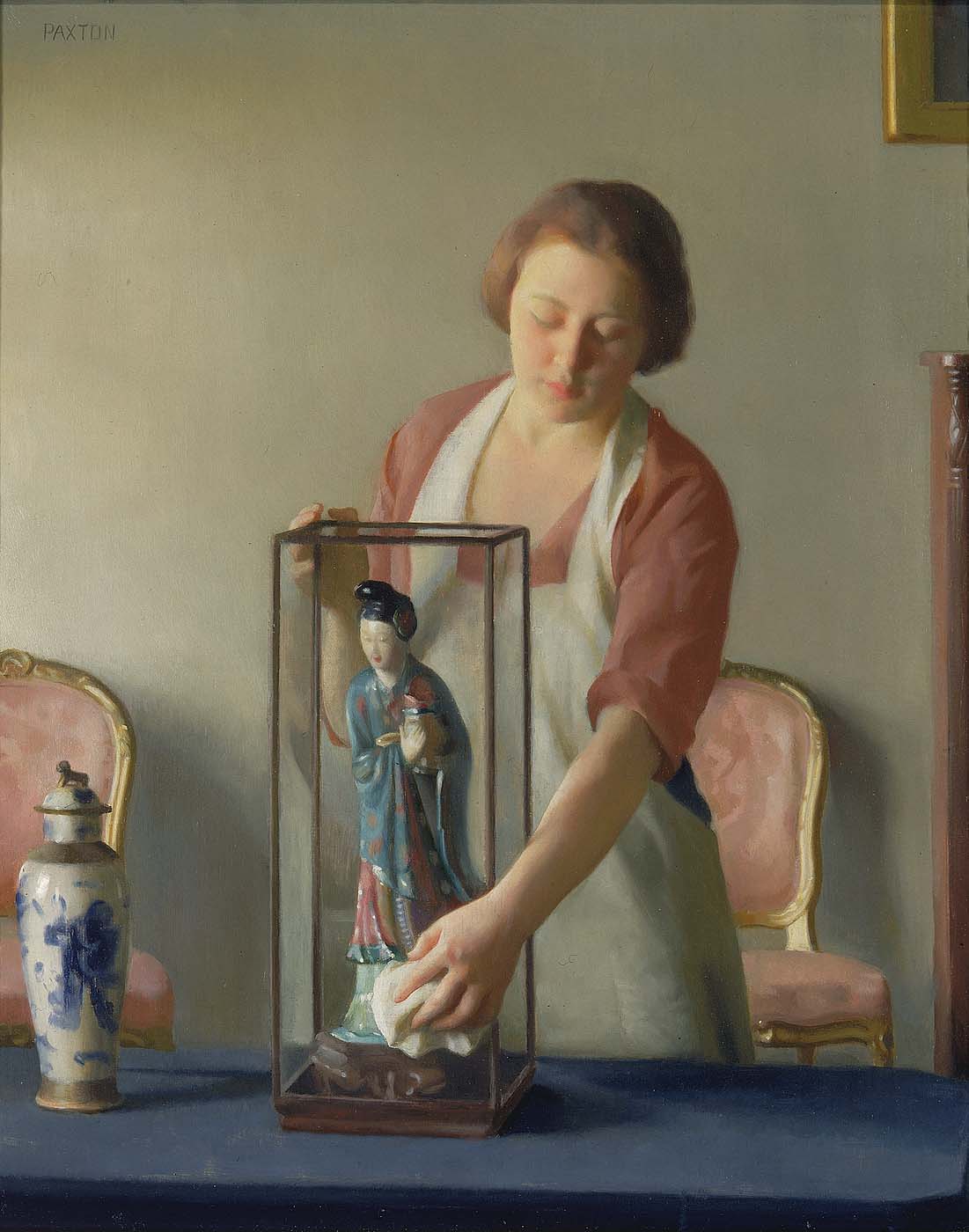
There appears to be a long gap in Paxton’s domestic interiors from 1911 to The Figurine in 1921. Their narratives seem to have faded away, but his ‘binocular vision’ is just as marked, putting the painted figurine into sharp focus, but making the woman’s face far softer. It’s also intriguing that, late in his career, Paxton turned to paintings of sculpted figures, in just the way that his former teacher Gérôme had done a quarter of a century earlier.
Looking at his paintings now, I think they explain not so much how Vermeer achieved his optical effects, but more importantly why.
Reference
I’m extremely grateful to Mark Bernstein of Eastgate Systems for first drawing my attention to Paxton and his intriguing paintings.
 The Eclectic Light Company