
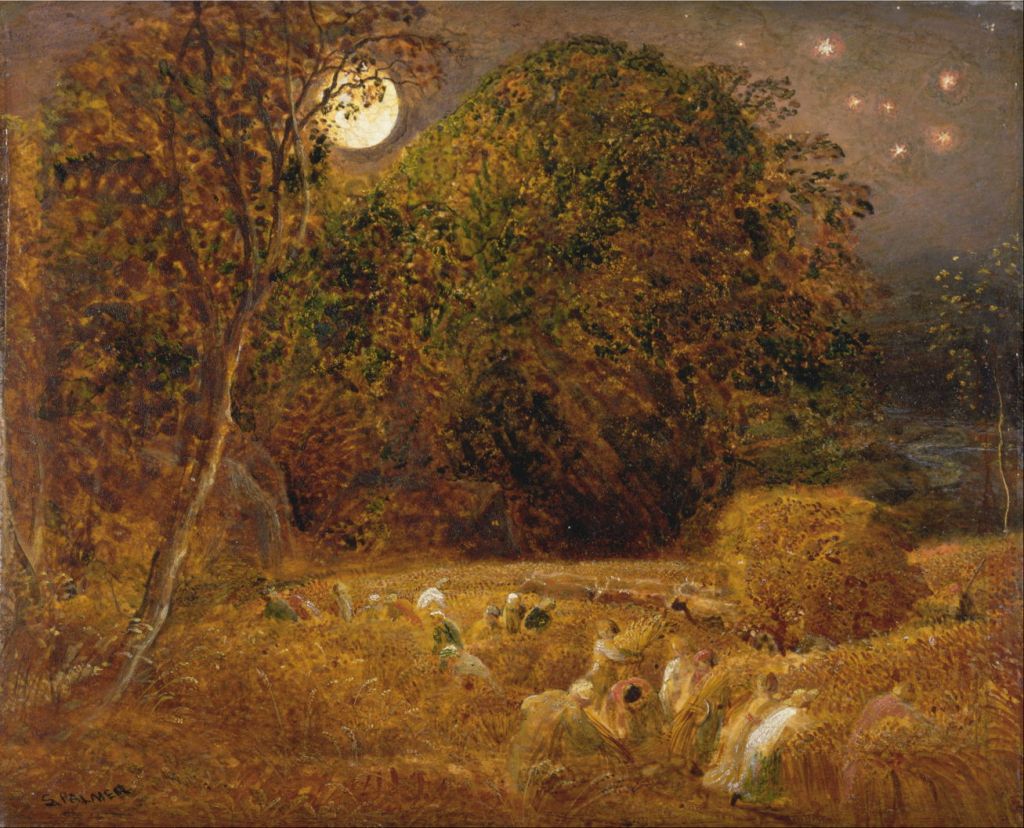
The colour of the harvest in autumn is a rich gold, the gold of the ripe grain crops, and the gold of the rich sunsets as the nights grow longer. It’s a combination distinctive of English landscape painting in the nineteenth century, not by the most popular masters Constable and Turner, but of those associated with the Ancients, particularly Samuel Palmer (1805–1881) and his mentor and father-in-law John Linnell (1792–1882), who saw themselves following in the footsteps of William Blake. While Constable and Turner headlined at the Royal Academy’s exhibitions, Linnell and Palmer captured the English countryside resplendent in harvest gold.
In 1826, Samuel Palmer moved to the rural village of Shoreham in Kent, in the valley of the River Darent to the north of Sevenoaks, where he spent much of the next decade producing some of his most distinctive work. This was well before the Barbizon School in France made this strategy of living in the country a popular choice for painters. For Palmer, the village and its environs became his ‘land of milk and honey’, in a Biblical vision of Beulah.

Palmer still painted some fairly conventional works during his Shoreham period, such as the finely-detailed Oak Trees, Lullingstone Park (1828). This shows ancient oaks in the deer park of Lullingstone Castle, in the Darent Valley of Kent, between Eynsford and Shoreham. it was painted at the instigation of his mentor Linnell, who was trying to get Palmer to paint more directly from nature.
He lived alone in a tumbledown cottage in Shoreham, without a wife or partner, and was remote from the other Ancients and Linnell.

Many of his early works in Shoreham are local views, such as this ink drawing of Cornfield and Church by Moonlight (c 1830).
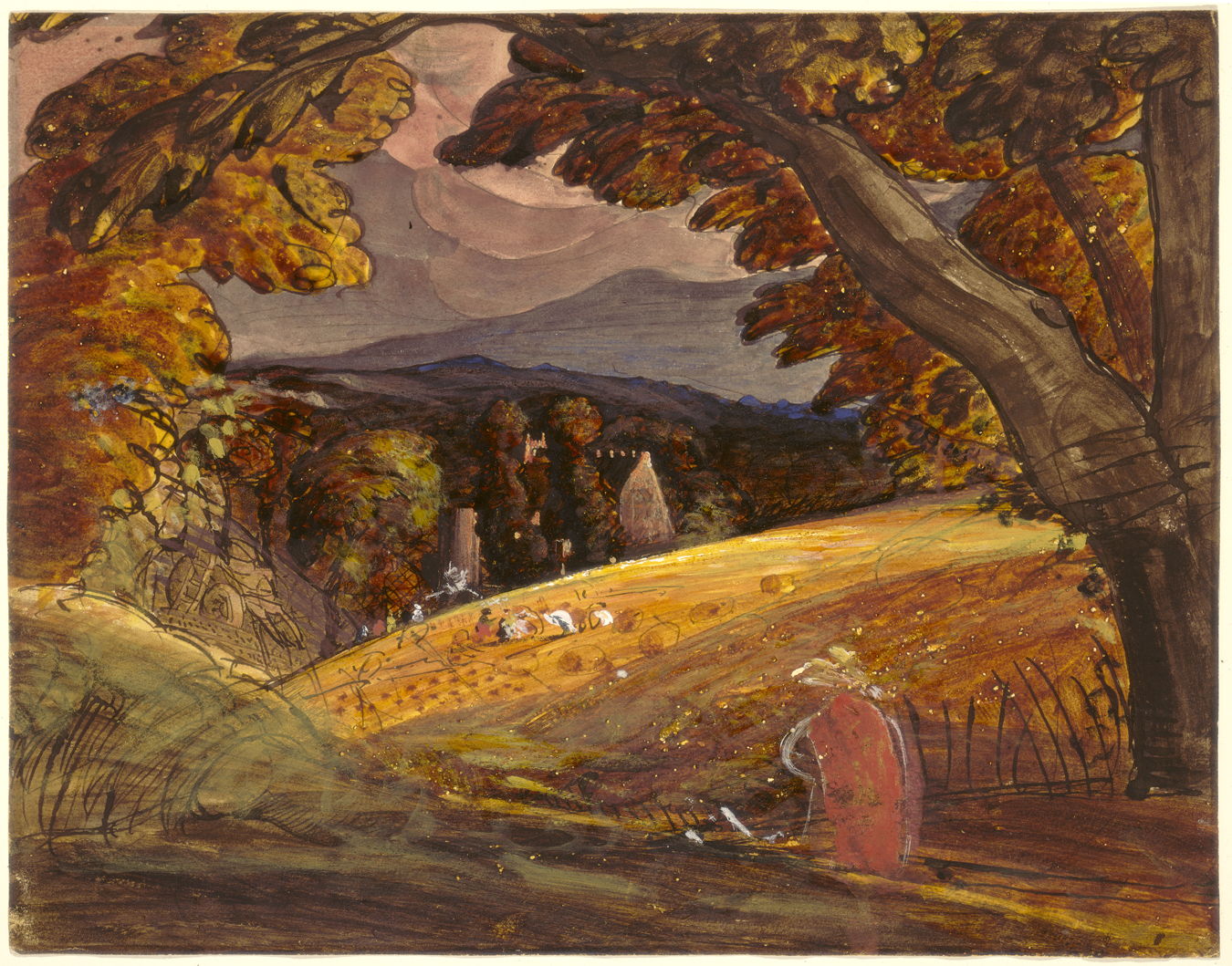
From these he developed his characteristic golden watercolours seen in Harvesters by Firelight (1830).

The Gleaning Field (c 1833) shows the local poor who have moved in, once the harvest has been completed, to gather any remains that they can salvage to feed their families.

The Harvest Moon (c 1833) is an oil sketch on paper that is one of the best of his paintings from the Shoreham period. It shows local village people, predominantly women, cutting the ripe crop in the traditional way, forming it into stooks, which are then taken away in the cart, still drawn by oxen. The combination of golden corn and moonlight transforms the scene with a deep enchantment.

From about 1830, he seems to have got out of the village more, and walked up the nearby downs to paint views from the rolling hills looking over the Weald of Kent, such as The Timber Wain (1833-34). Here a team of oxen is being used to draw a heavy wagon bearing a huge tree trunk down to the village in the valley.
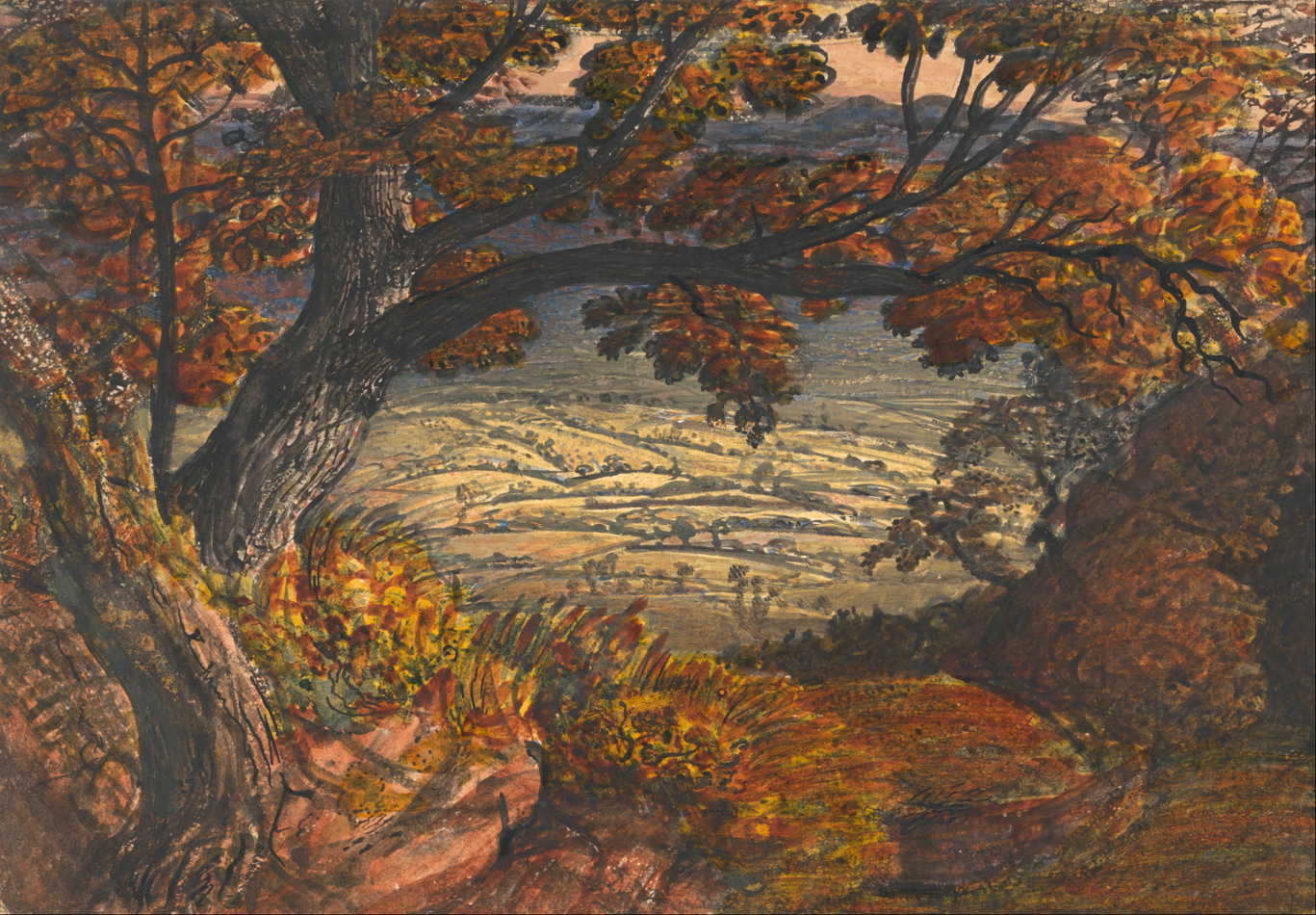
The Weald of Kent (c 1833-34) is a similar watercolour using the repoussoir of the trees to frame the distant view beyond.

Towards the end of his time in Shoreham, Palmer’s views started to open out into more conventional landscapes, such as The Golden Valley (c 1833-34). Then in 1835 he left Shoreham and returned to London. It was Linnell’s turn for harvest gold.
 The Eclectic Light Company