
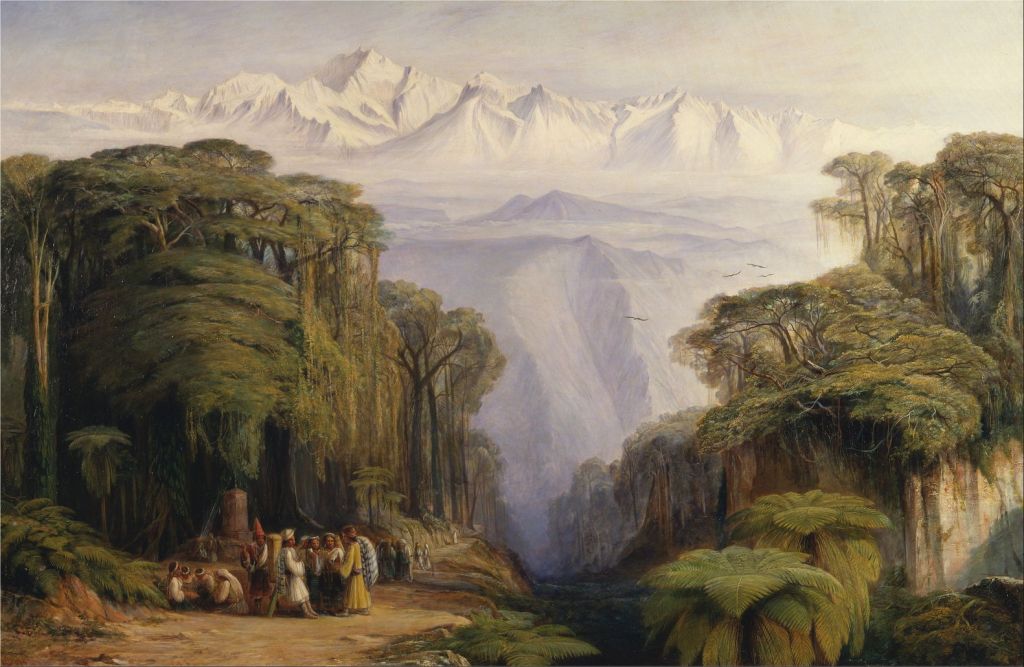
During the nineteenth century, mountains around the world were explored and surveyed. In India, this started in 1802 in the Great Trigonometrical Survey, which was finally completed in 1871. This was started in the south of the sub-continent by William Lambton, whose successor was George Everest. In 1847, when Kangchenjunga was considered the highest peak in the world, early observations suggested there might be a mountain higher still. It wasn’t until 1852 that Radhanath Sikdar identified what’s now known as Mount Everest as the world’s highest mountain, and that was confirmed in 1856.
Exploration and survey of the Rocky Mountains in North America was also underway by that time. In 1859, the established painter of mountains Albert Bierstadt first travelled west towards them in the company of Frederick W Lander, who was surveying for the US government. Bierstadt soon established a pattern of sketching and photographing spectacular scenery, then returning to his studio in the Tenth Street Studio Building in New York and turning that material into large finished oil paintings.
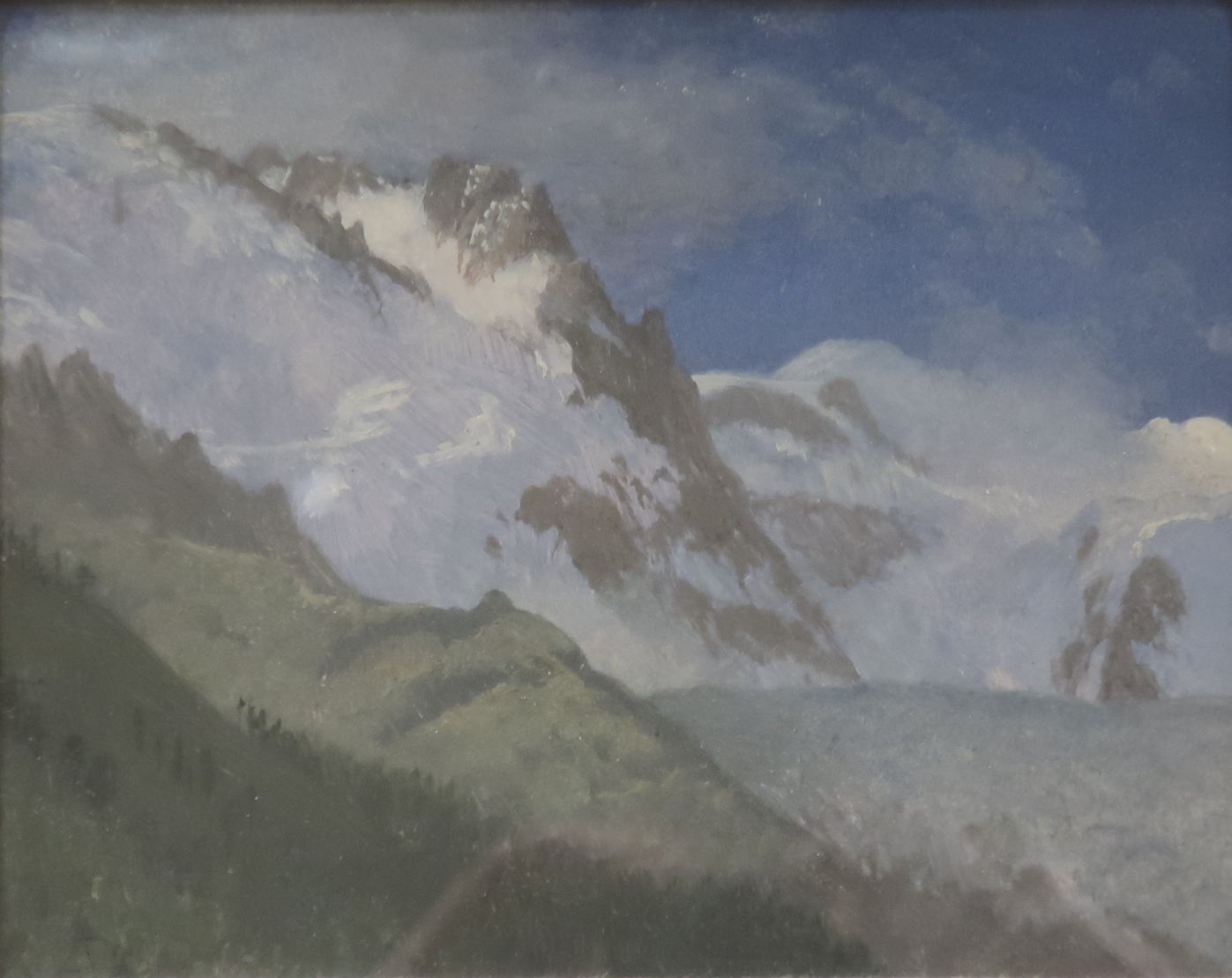
Although he also made painterly oil sketches such as this undated view of Snow in the Rockies on paper or board, Bierstadt was firmly committed to this more traditional approach.
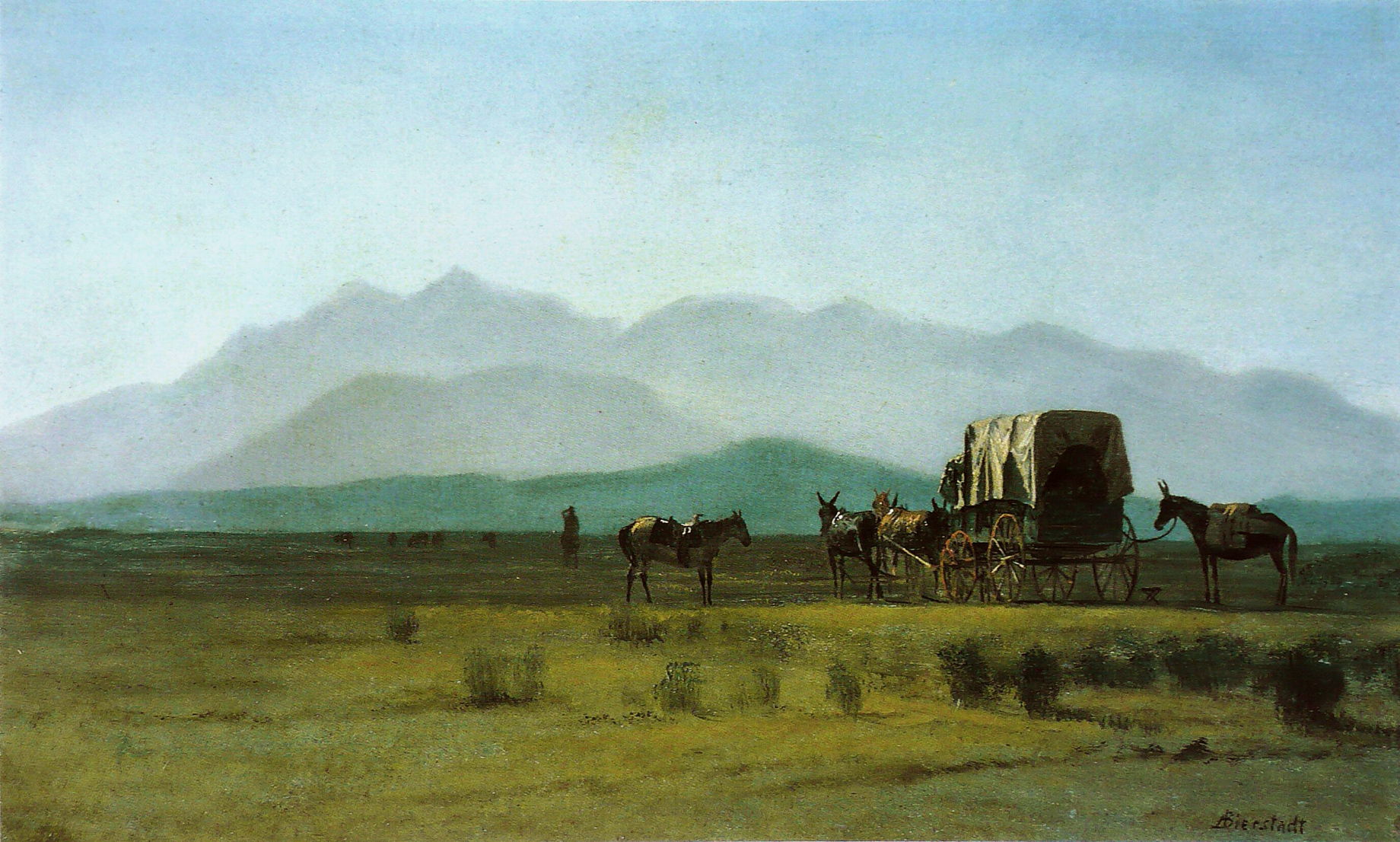
Some of his paintings made in the field, such as this Surveyor’s Wagon in the Rockies from 1859, were worked in greater detail. This gives a good idea of the better travelling conditions when he was with Lander’s survey team.
In 1863, Bierstadt was drafted to serve in the Civil War. As was not uncommon practice at the time, he paid a substitute and travelled west with the author Fitz Hugh Ludlow to amass more material for his studio paintings.
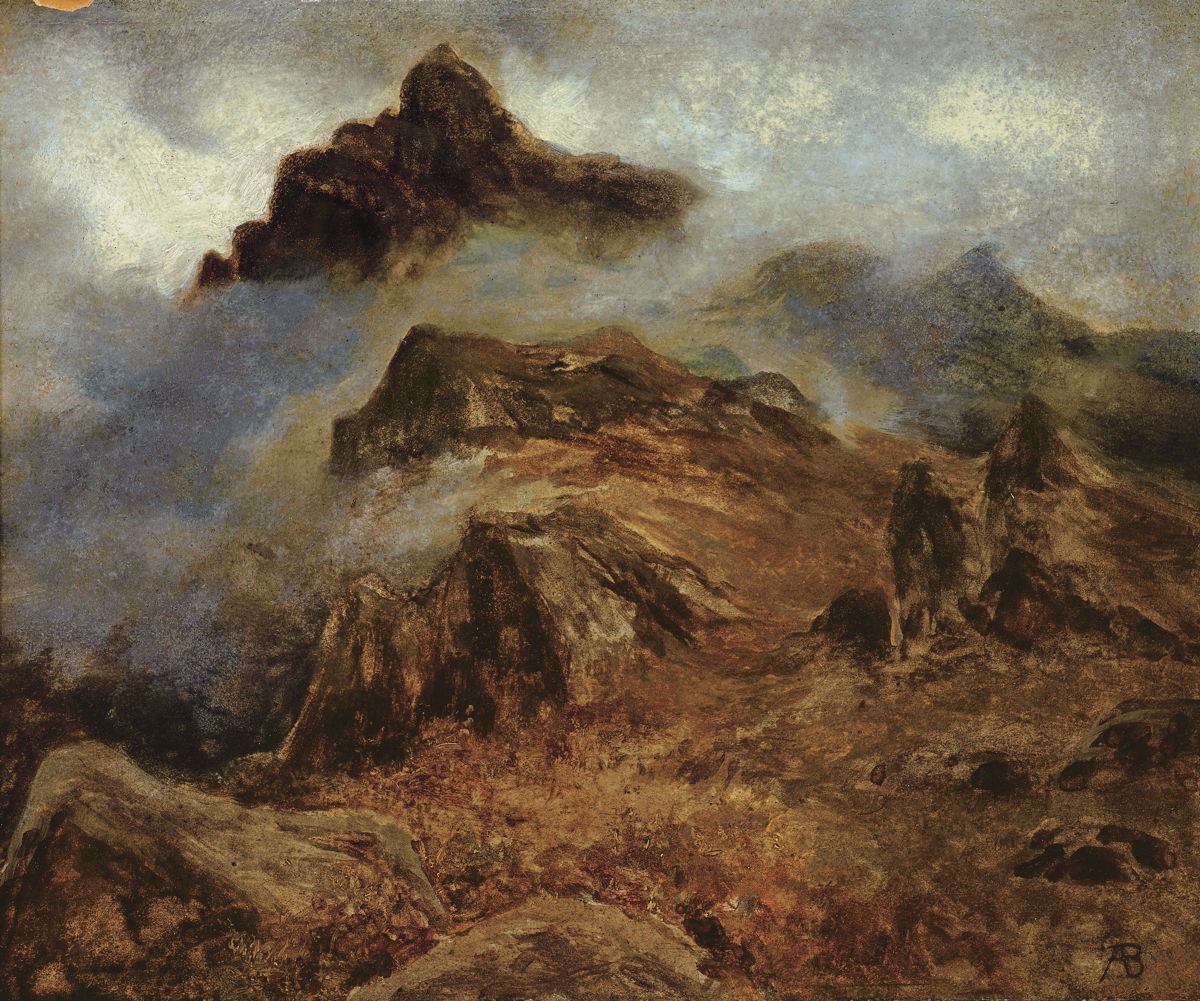
He painted this Study of Rocky Mountains on paper in 1863, almost certainly in front of the motif. It has been suggested that this was one of several oil sketches which he used when composing The Rocky Mountains, Lander’s Peak (below).

Bierstadt’s The Rocky Mountains, Lander’s Peak (1863) was one of his most successful paintings based on the studies from his first (1859) visit to the west. This shows a summit of 3,187 metres (10,456 feet), named by its surveyors after a general who died in the Civil War. The First Nation people shown are Shoshone, who Bierstadt recognised would soon only be known in history. He sold this painting in 1865 for the sum of $25,000, a record at the time and the equivalent in today’s values of around half a million dollars.
On the other side of the world, John Turnbull Thomson retired from his post as New Zealand’s first Surveyor General in 1879. As a largely self-taught painter, he intended to concentrate on his painting in the town of Invercargill, which he had earlier planned and developed.
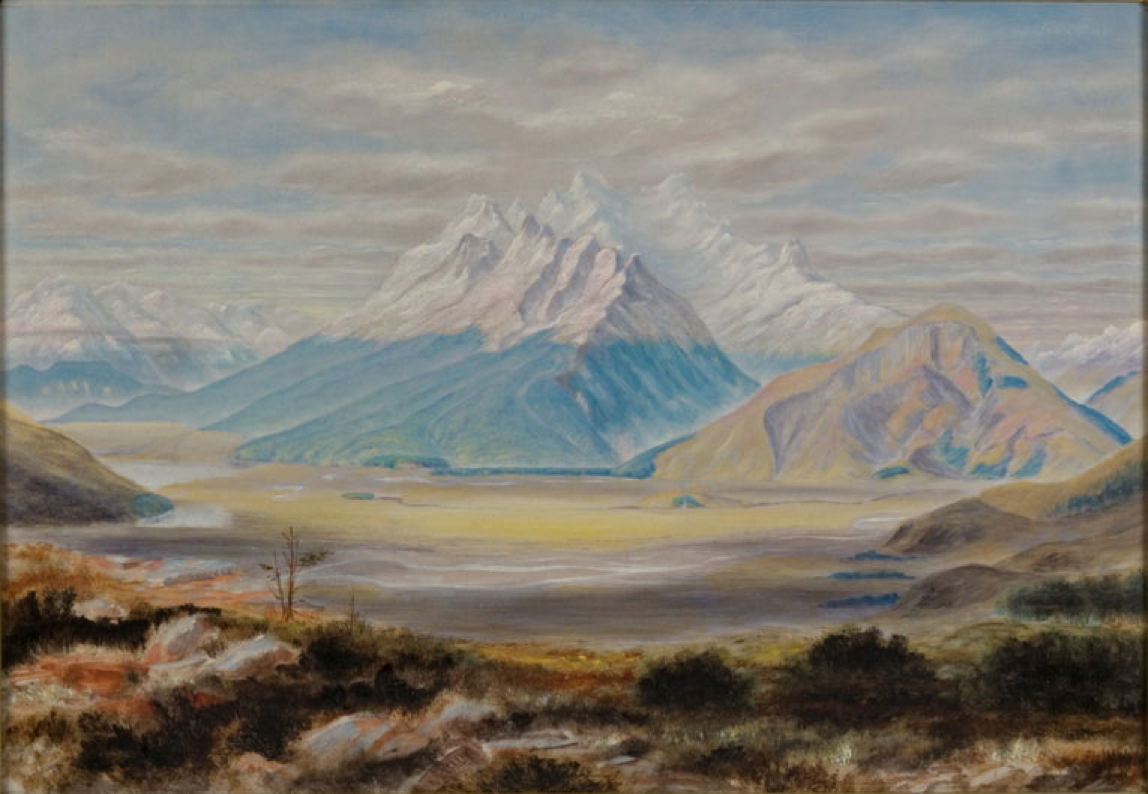
He must have travelled to paint Mount Earnslaw in 1883, just a year before his death. This mountain, also known by its original name of Pikirakatahi, is 2,819 metres (9,000 feet) high, and had been discovered and named by Thomson in honour of his father’s home town. The previous year, the mountaineer the Reverend WS Green, who had intended to climb Mount Cook, attempted to climb Mount Earnslaw, but he was forced to abandon at the halfway point, and it wasn’t climbed until 1890.

For comparison, here is professional landscape artist Eugène von Guérard’s view of Lake Wakatipu with Mount Earnslaw, Middle Island, New Zealand which he painted in his studio between 1877-79.
Meanwhile, Europeans were exploring the mountains to the north of India for flora and fauna. Among them was the greatest expeditionary botanical painter, Marianne North, who had started her career in the Americas in the early 1870s. She progressed around the world until she reached India in 1877.
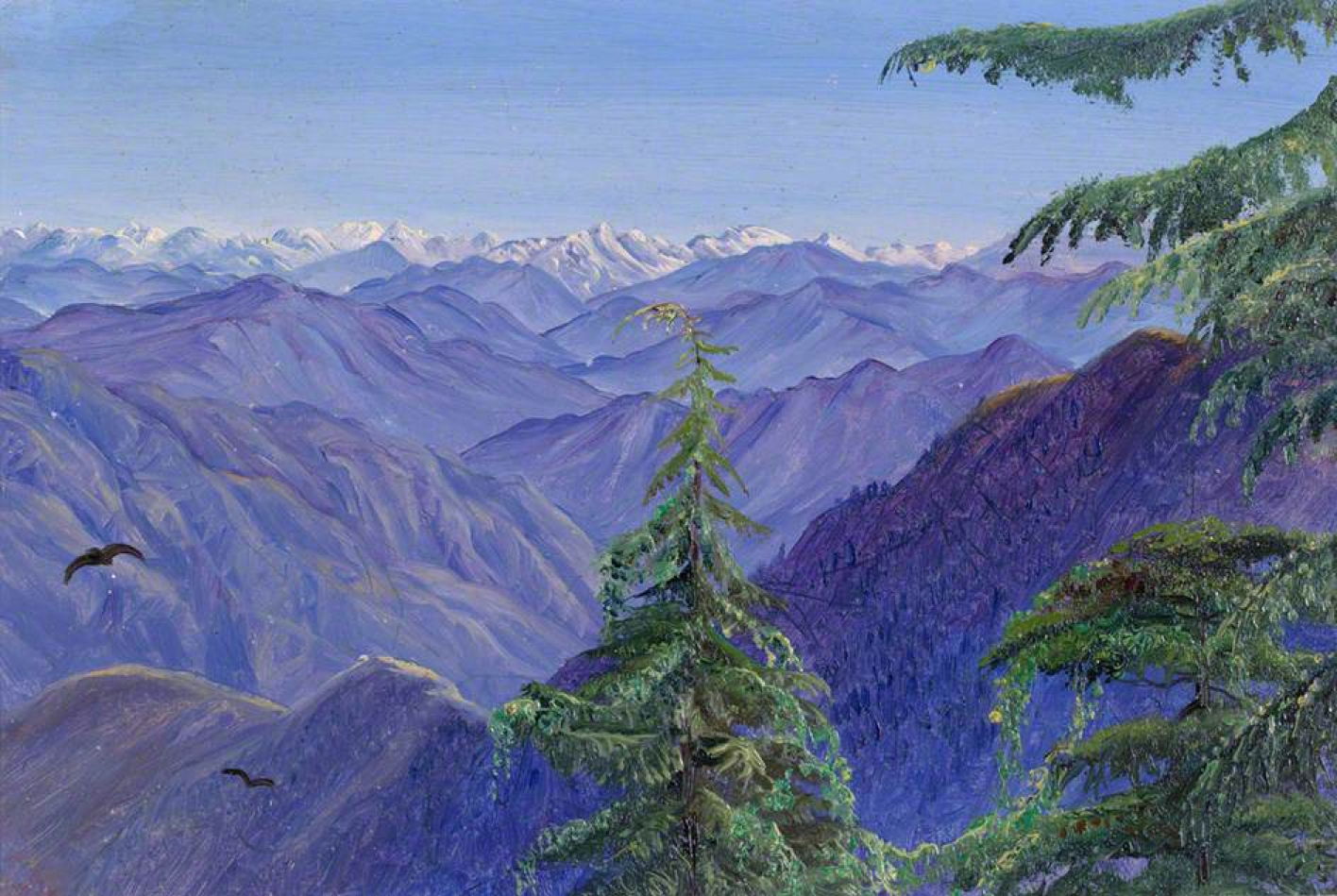
North’s breathtaking mountain view From Nahl Dehra near Simla (Shimla), Himachal Pradesh, India (1878) shows the rugged hills near the capital city of Himachal Pradesh, in the Western Himalaya. From 1864, that city was the summer capital of British India because of its far more equitable climate.

Mount Everest or Deodunga from Sundukpho, North India (c 1878) is another impressive view of the Himalaya. Deodunga has been used by several of the British in India as the name of the world’s highest mountain before it was renamed in 1856, following confirmation of its height.
Other explorers were even more improbable, including the writer and painter Edward Lear. Despite suffering from epilepsy, asthma, bronchitis, and bouts of depression, he first toured Europe as a specialist ornithological illustrator. By the middle of the nineteenth century he had travelled as far afield as the mountains of Albania, and in 1873 reached India.
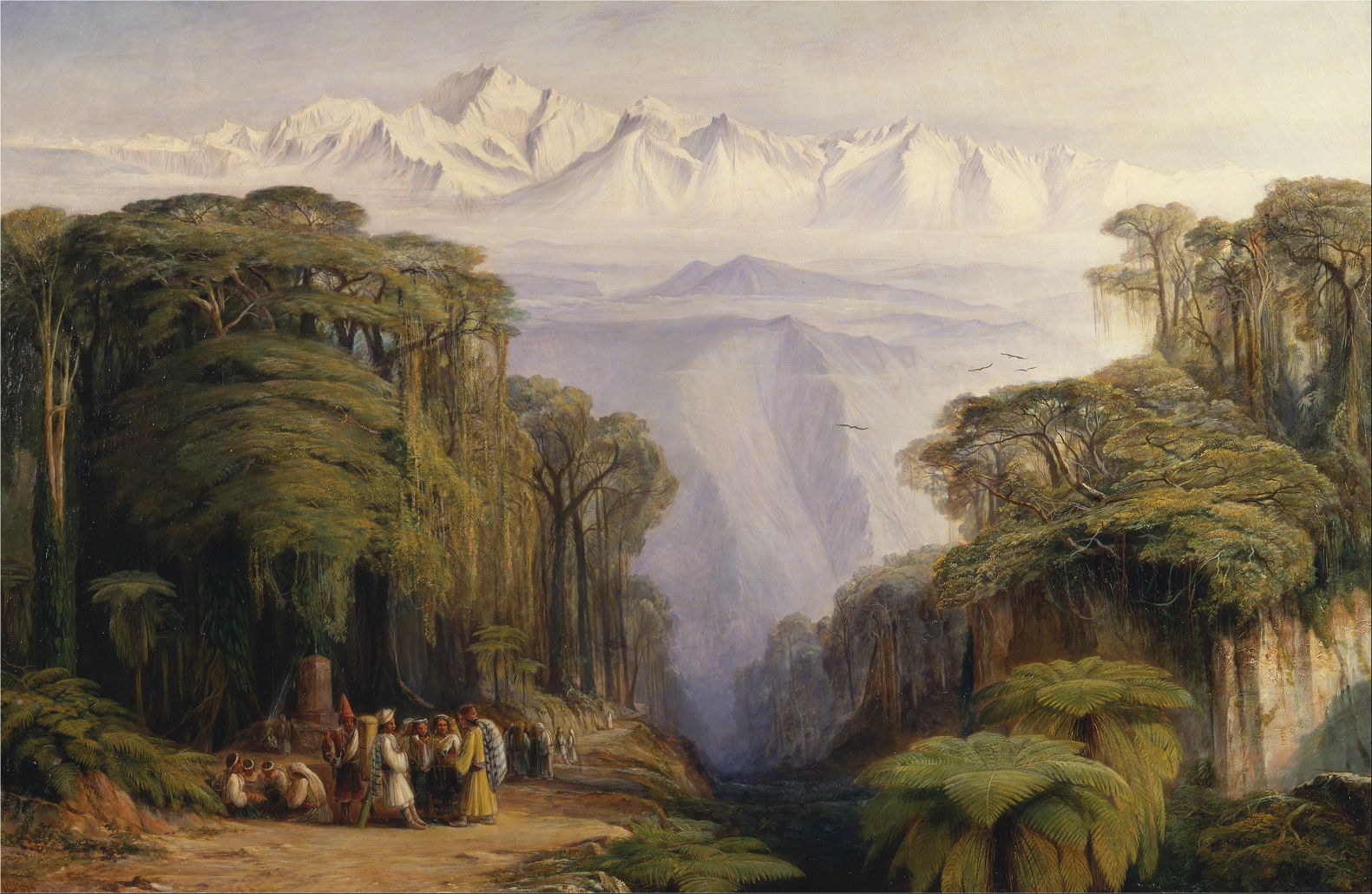
This is among Lear’s most spectacular paintings, showing the great mountain Kangchenjunga from Darjeeling (1879). Darjeeling is high in the Lesser Himalaya, at an elevation of just over two thousand metres (over 6,500 feet), in the far north of West Bengal, India. Famed for its tea plantations, it became a ‘hill station’ for British residents of India in the early nineteenth century, and just a couple of years after Lear painted this it was connected by the Darjeeling Himalayan Railway to New Jalpaiguri.
This massif is best viewed from here, about eighty miles away. Kangchenjunga itself is the obviously highest peak, to the left of the centre of the ice-covered massif. As the third highest mountain in the world, it reaches an elevation of 8,586 metres (28,169 feet). Its first successful ascent wasn’t made until 1955; because it’s a sacred mountain, teams who attain the summit stop short to avoid its violation.
 The Eclectic Light Company