
By the end of the nineteenth century, Ukrainian art schools were at last training the Ukrainian artists of the future, who were able to make their own styles and develop distinctive movements. Among them were some who went on to earn a place internationally. Unfortunately history conspired to change all this in the political unrest around the October 1917 Revolution in Russia, and two World Wars. As a result, the lives of many Ukrainian artists were brought to an early end, by disease, starvation, or execution. A large proportion of their output has been deliberately suppressed, hidden away in collections of banned works, destroyed, or looted.
Mykola Burachek (1871-1942)

Born in Letychiv, western Ukraine. Pupil of Khariton Platonov in Kyiv. Taught in Kyiv from 1917, then in Kharkiv from 1925. Died in Kharkiv during Nazi occupation.
Oleksandr Murashko (1875–1919)

Born in Kyiv. Major figurative painter in Kyiv, taught there from 1909, co-founder of Ukrainian State Academy of Arts. Shot dead by a street gang.
Kazimierz Sichulski (1879–1942)

Born in Lviv. Travelled in the Carpathian Mountains from 1905, where he painted Hutsul peoples. Taught in Lviv from 1918, then in Kraków, Poland from 1930. Returned to Lviv in 1939.
Kazimierz Sichulski’s Galician Landscapes 1
Kazimierz Sichulski’s Galician Landscapes 2
Fedir Krychevskyi (1879–1947)

Born in Lebedyn, near Sumy in north-east Ukraine. Studied with Gustav Klimt in Vienna before returning to teach in Kyiv in 1914. Rector of Ukrainian State Academy of Arts. Remained in Kyiv during the Second World War, but arrested by Soviet forces in 1943, and died of starvation in Irpin during the famine of 1947.
Kazymyr Malevych (1879–1935)

Of Polish descent, born in Kyiv, where he started his studies. Cubo-Futurist by 1912, then to Suprematism. Taught at Kyiv Art Institute from 1928 alongside Oleksandr Bohomazov. Sacked from there in 1930, arrested by the KGB and threatened with execution.
Oleksandr Bohomazov (1880–1930)

Born in Yampil, near Lyman in east Ukraine. Trained by Mykola Pymonenko alongside Oleksandra Ekster in Kyiv Academy of Arts. Lived near Kyiv, where he wrote a treatise on modern painting, forming the basis for his teaching in Kyiv from 1922.
Mykhailo Boichuk (1882-1937)

Born to the south of Ternopil in western Ukraine. Studied in Lviv and Kraków, Poland. Returned to Lviv in 1910 where he developed Monumentalism (Boichukism). Co-founder of Ukrainian State Academy of Arts after October 1917 Revolution. Active during 1920s with group decorating state buildings throughout Ukraine. Fell from grace in 1937 during Stalin’s Great Purge. With his wife and other artists, he was executed in 1937, and most of his work was destroyed.
Expatriates
Oleksandr Shevchenko (1882-1948)

Born in Kharkiv. Painted for much of his career in Moscow.
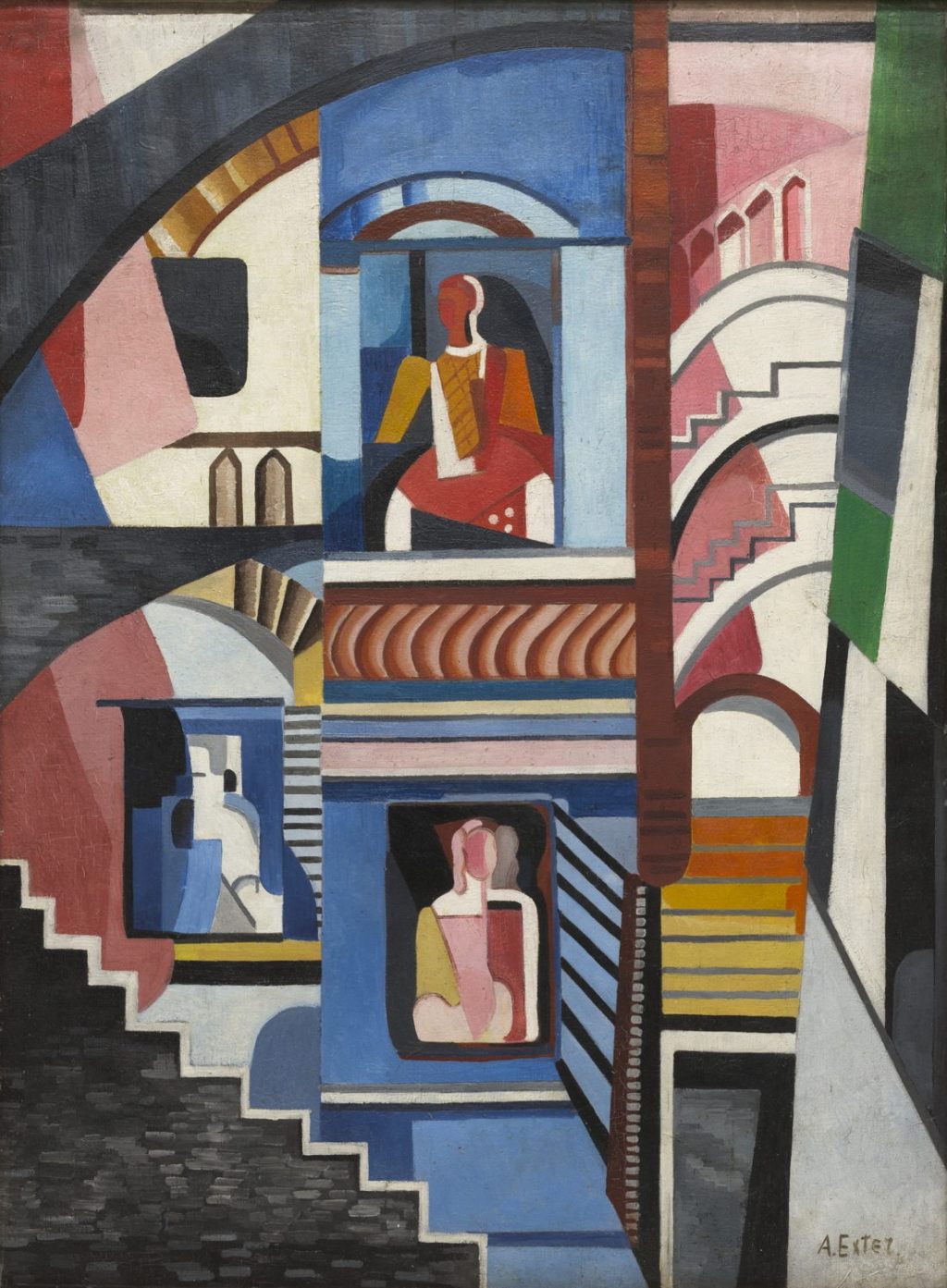
Oleksandra Ekster (1882–1949)

Born in Poland in a Belarusian family but trained under Mykola Pymonenko in Kyiv, where she launched her career. In Paris from 1906, where she developed Cubo-Futurism. Returned to Kyiv in 1914, where she opened an art school in 1918, then went to Odesa before going to Moscow, and migrating to Paris in 1924.
Arnold Lakhovskyi (1880–1937)

Born in Chornobyl, north Ukraine. Trained in Odesa and Munich. Moved to Paris in 1925, then to New York City in 1933, where he was a successful portraitist.
Wladimir Baranoff-Rossiné (1888-1944)

Born in Kherson, studied in Odesa. Moved to Paris in 1910. Lived in Nordic countries during the First World War, then taught in Moscow in 1920. Inventor, including the optophonic piano, and developer of military camouflage. Moved back to Paris in 1925. Arrested by the Gestapo in 1943, and died in Auschwitz.
Abraham Mintchine (1898-1931)

Born in Kyiv, where he studied at its Art School and with Oleksandra Ekster. Left for Berlin in 1923, then in Paris from 1925, where he painted prolifically before dying suddenly in 1931.
References
Andrey Kurkov and others (2022) Treasures of Ukraine, A Nation’s Cultural Heritage, Thames & Hudson. ISBN 978 0 500 02603 8.
Konstantin Akinsha and others (2022) In the Eye of the Storm, Modernism in Ukraine 1900-1930s, Thames & Hudson. ISBN 978 0 500 29715 5.
 The Eclectic Light Company