
One of the almost invariant characteristics of humans is that they have two eyes, even when one or both might not be capable of sight. Myth and legend has brought us two well-painted instances of exceptions to this rule: Polyphemus and other Cyclopean giants, who have but a single eye, and Argus, who was claimed to have as many as a hundred. But that isn’t always how they appear in paint.
One eye
Polyphemus is the only well-known Cyclopean giant. He makes two notable appearances in myth: his love for Acis, and his encounter with Odysseus and his crew during the Odyssey.
Galatea had fallen in love with Acis, son of the river nymph Symaethis, but Polyphemus fell in love with her. The latter did his best to smarten his appearance for her, though he became deeply and murderously jealous of Acis. Telemus, a seer, warned Polyphemus that Ulysses would blind his single eye, upsetting the Cyclops, who climbed a coastal hill and sat there playing his reed pipes. Meanwhile, Galatea was lying in the arms of her lover Acis, hidden behind a rock on the beach.
Polyphemus then launched into a long soliloquy imploring Galatea to come to him and spurn Acis. When he saw the two lovers together, Polyphemus grew angry, and shouted loudly at them that that would be their last embrace. Galatea dived into the sea, and Polyphemus killed her lover by crushing him with a huge boulder.

Johann Heinrich Tischbein gives a plain account in his Acis and Galatea from 1758. Galatea is almost naked in the arms of Acis, as Polyphemus peers at them, a voyeur behind a tree trunk.

Gustave Moreau’s first Galatea from about 1880 shows Galatea resting naked, alone in the countryside with her eyes closed, as the Cyclops plays sinister voyeur. Surrounding them is a magical countryside, filled with strange plants recalling anemones, as would be appropriate to a sea-nymph. Acis is nowhere to be seen.

One of the masterpieces of Symbolism, Odilon Redon’s The Cyclops (c 1914) follows Redon’s personal theme of the eye and sight, and further develops that of the voyeurism of Polyphemus. Polyphemus’ face is now dominated by his single eye, which looks down over Galatea’s naked beauty, with Acis absent.
Paintings of Odysseus’ encounter with Polyphemus, in which the Greek warrior blinded the Cyclopean’s single eye, are surprisingly coy at showing the giant’s face.

Guido Reni is a notable exception, in his Polyphemus from 1639-40. The Cyclopean eye socket is now empty, where Odysseus had poked its single eye out. In the distance, Odysseus and his crew are making their way out to their ships in two smaller boats, in their haste to depart.
Many eyes
Argus, or Argos Panoptes, was Hera’s all-seeing servant. With his hundred eyes he played a key role in Zeus’s rape of Io, as described in one of Ovid’s more elaborate stories in his Metamorphoses.
Knowing that his wife Hera was trying to catch him being unfaithful, Zeus transformed Io into a white cow for safe keeping after her rape. Hera was suspicious, and asked to be given the cow. Jupiter was trapped with no option but to make a gift of Io, the cow, to his wife, who then entrusted her to the care of the ever-watchful Argus, who removed her to a mountain to graze. Jupiter took pity on Io, and devised a way of getting her back, by getting Hermes to kill Argus after lulling him to sleep.
Once his victim was sound asleep, Hermes cut his head off and threw it from a cliff, ending his watch over Io the cow. Hera then plucked the hundred eyes from the head of Argus to install in the feathers of her peacocks, so explaining how those peacock feathers came to have eyes.

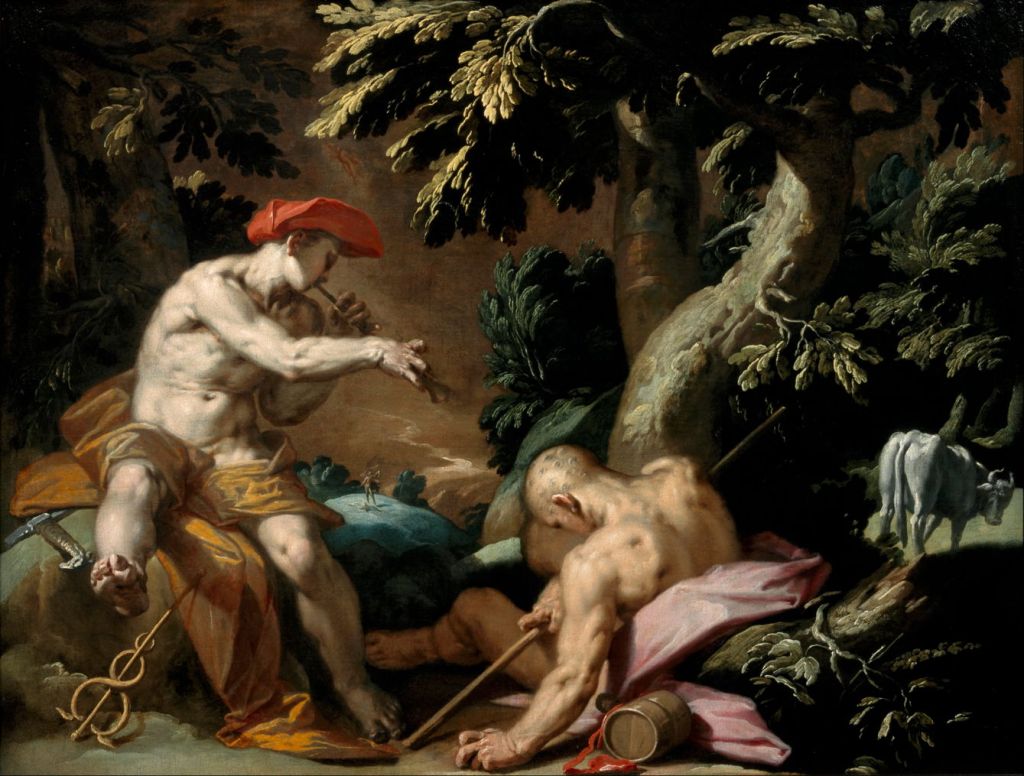
The most popular scene in Ovid’s embedded account is that of Mercury lulling Argus to sleep. However, hardly any painters depict Argus having the hundred eyes specified in the text. Abraham Bloemaert is an exception, in his carefully composed Mercury, Argus and Io (c 1592). Mercury is playing his flute at the left, as Argus falls asleep in front of him, his additional eyes visible over the surface of his head. In the distance at the right is Io as a white cow.

Perhaps the most famous painting of Mercury and Argus is that of Velázquez, made in about 1659, the year before he died. The two figures are shown in contemporary dress, with Mercury just about to raise his sword and decapitate the sleeping Argus, who has no evidence of any supernumerary eyes. Behind them is Io, not white but tan in colour.
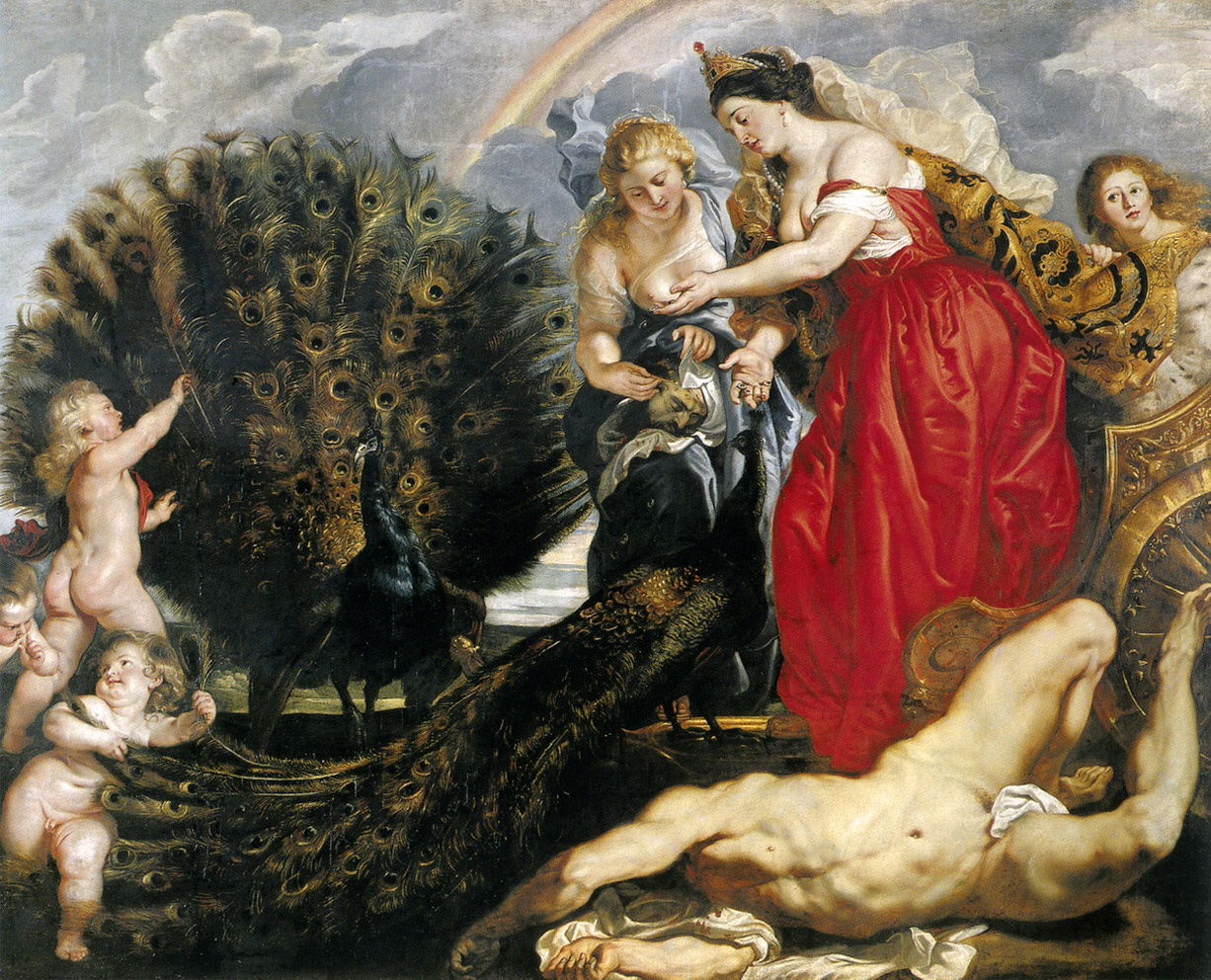
Rubens painted several skilful versions of Mercury about to kill Argus but also omitted Argus’s extra eyes. His other superb painting of this story is Juno and Argus from about 1611, showing its conclusion. Juno, wearing the red dress and coronet, is receiving eyes that have been removed from Argus’s head, and placing them on the tail feathers of her peacocks. The headless corpse of Argus lies contorted in the foreground. Rubens has taken the opportunity of introducing a visual joke, in which Juno’s left hand appears to be cupped under the breasts of the woman behind.
 The Eclectic Light Company