
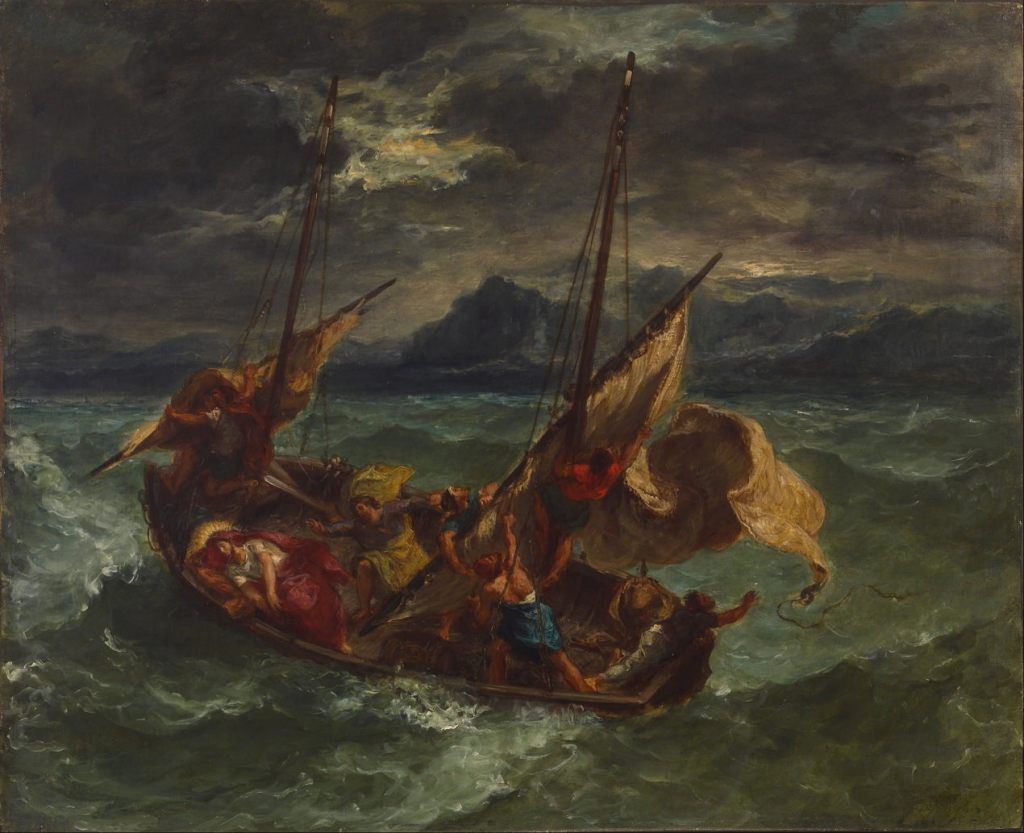
In April 1849, Eugène Delacroix (1798–1863) was commissioned to undertake his last and greatest decorative painting, of a side chapel in the Church of Saint-Sulpice in Paris. He started this when he was in his early fifties, but was already prone to periods of ill-health. By the time that he completed the project, he had turned sixty-three and his health was failing.
In the early years of this commission, he continued to paint easel works, and extended his range of narratives.

In 1852, he tackled one of the most entertaining scenes from Ariosto’s epic poem Orlando Furioso, of Marfisa and Pinabello’s Lady. The knight Pinabello’s lady had mocked the companion of the woman warrior Marfisa, an old woman named Gabrina. For that, Marfisa knocks Pinabello from his horse, which promptly gallops off into the distance, as seen at the right. Pinabello’s lady is forced to undress and hand over her clothing for Gabrina to wear, as shown in the foreground.

Fifteen years after his first painting of Ophelia’s drowning from Shakespeare’s play Hamlet, Delacroix returned to the story in 1853 and painted The Death of Ophelia again, just as loosely but with richer chroma. Although the artist has reversed the image here, she is still holding onto the branch of a tree, and about to be carried away to her death.

Saint Sebastian Tended by the Holy Women, painted in pastels between 1852-54, is a simplified copy of his large finished oil painting of the same subject completed in 1836. Delacroix wrote on the back of this to record that he gave it to Jenny Leguillou on 25 March 1855, perhaps as a devotional for her. She had been the artist’s housekeeper and companion since entering his service in 1835, and he had painted her portrait in oils in about 1840.
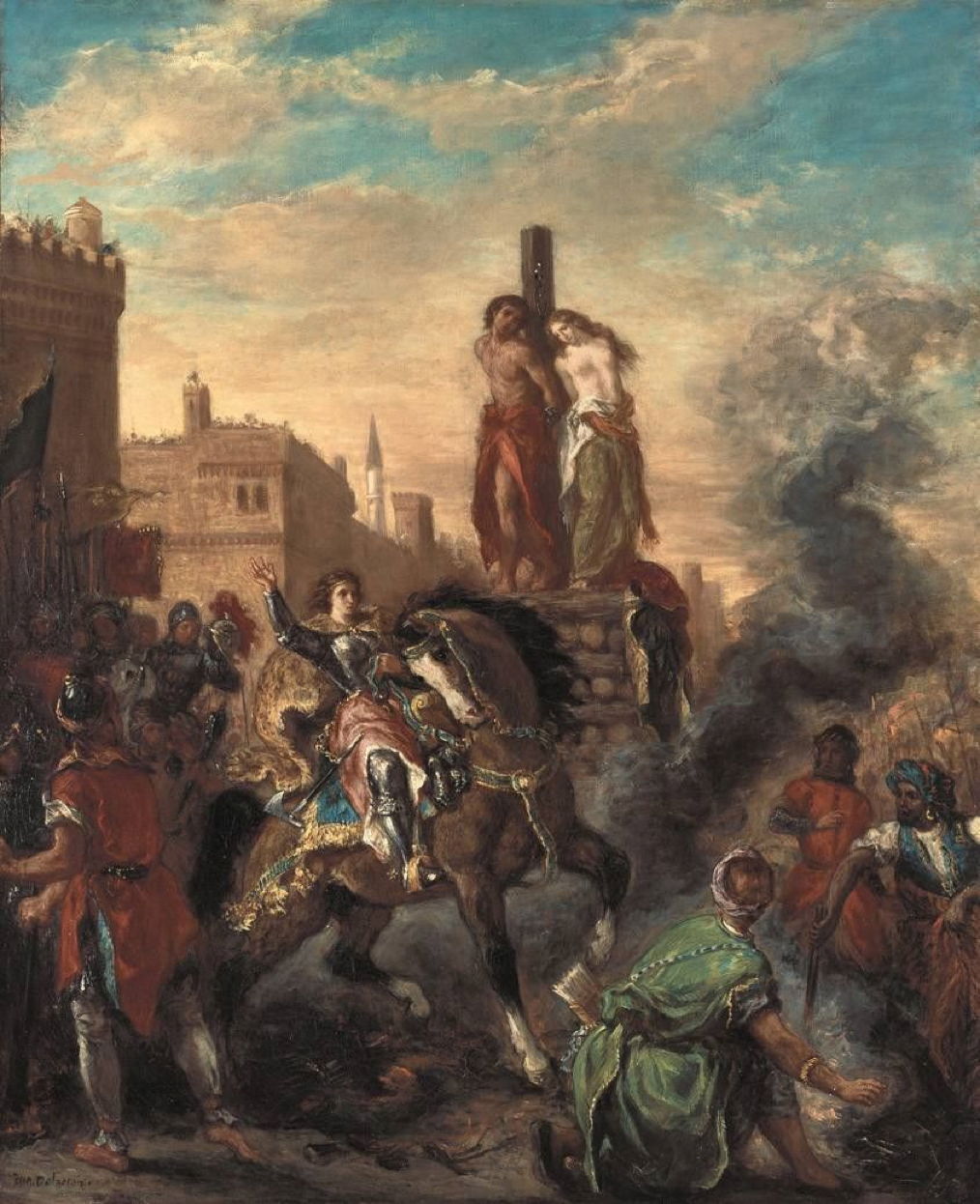
In 1853-56, he turned to Torquato Tasso’s epic poem Jerusalem Delivered for a minor masterpiece in which Clorinda Rescues Olindo and Sophronia. Clorinda has just arrived, wearing her conventional black armour as one of the enemies of the crusaders, and holds up her right hand to tell those about to burn Olindo and Sophronia at the stake to stay as they are. The stake is raised high, putting the couple in full view, although Aladine, ruler of Jerusalem, is nowhere to be seen.
Aladine cannot refuse Clorinda, nor refute her reasoning, so decrees that the couple be freed. However, he imposes the condition that they are banished from Jerusalem, and must live outside Palestine. He also banishes all the other able-bodied Christians, who could pose a threat when the crusaders arrive to besiege the city.
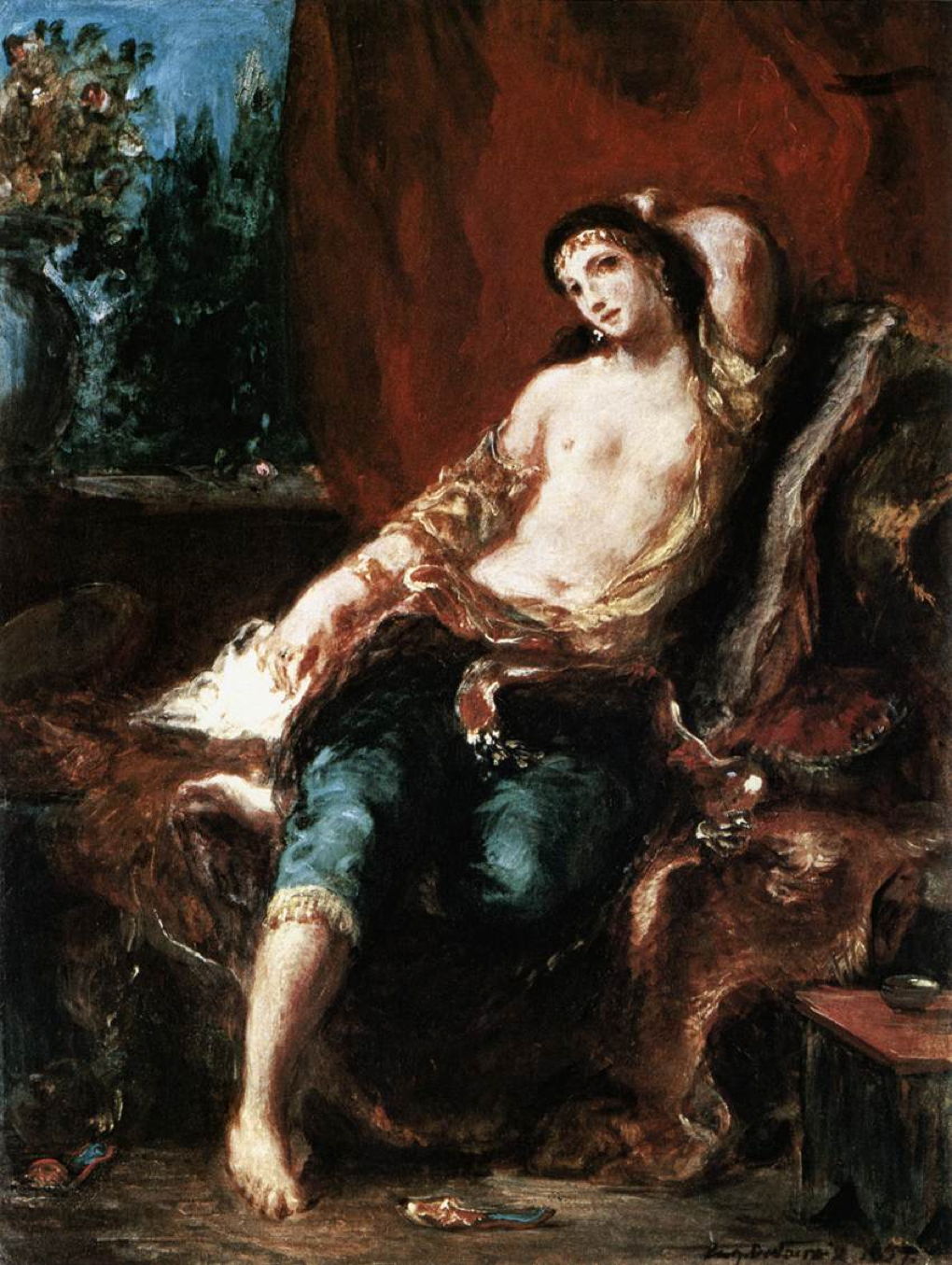
By the middle of the nineteenth century, Orientalist paintings of harems and slave markets had become all the rage. Although Delacroix had avoided such excesses, even he had a small foray into the theme in 1857, in his Odalisque. According to his diary, he worked on this painting while he was at his country house at Champrosay using a Daguerrotype of the nude model, making it one of the earliest paintings made from a photographic image by a major artist.
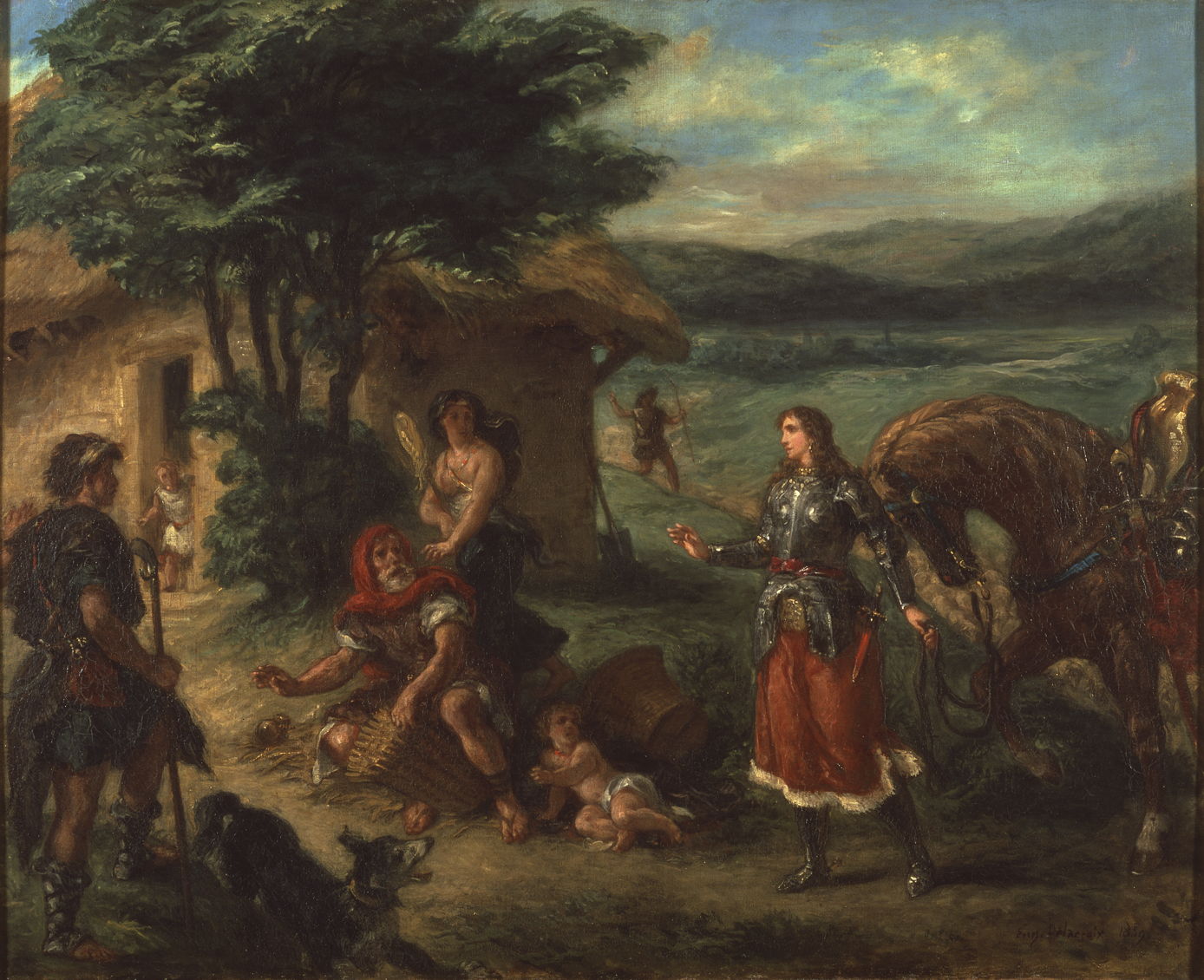
In 1859, he returned to Jerusalem Delivered for Erminia and the Shepherds, exhibited at the Salon that year. Erminia, who has fallen in love with Prince Tancred, decides to don Clorinda’s armour so that she can leave Jerusalem to join Tancred in the crusaders’ camp. When she is recognised as Clorinda, she’s forced to flee, and ends up getting lost on the bank of the River Jordan, where she meets some shepherds and is taken to their family. Erminia is still dressed as the warrior Clorinda, and her charger looks convincing too (detail below). The farming family are taken aback, and their dog has rushed out to bark at the visitor. In the distance, behind the small farmhouse, is a figure who might be pursuing Erminia.

Delacroix continued his obsession with shipwrecks going back to his mentor Géricault and his Raft of the Medusa.
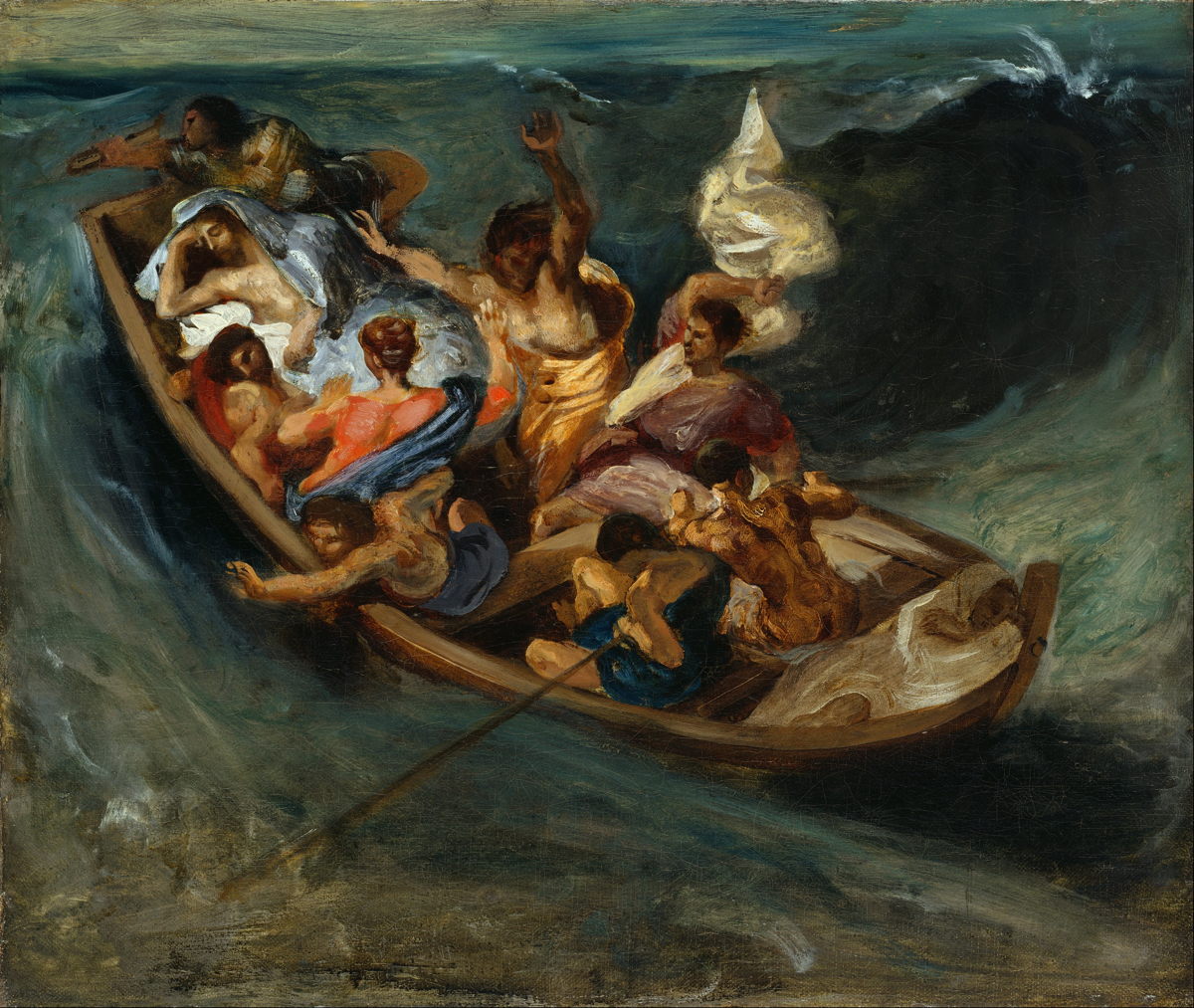
In about 1841, he started to paint early versions of Christ on the Sea of Galilee, a small boat being tossed on a rough sea, similar to that of the wreck of the Don Juan. This early version is now in the Nelson-Atkins Museum of Art in Kansas City.

In about 1853, he painted another, of Christ Asleep during the Tempest, now in the Met in New York.

Another version of Christ on the Sea of Galilee from 1853 is in a private collection.
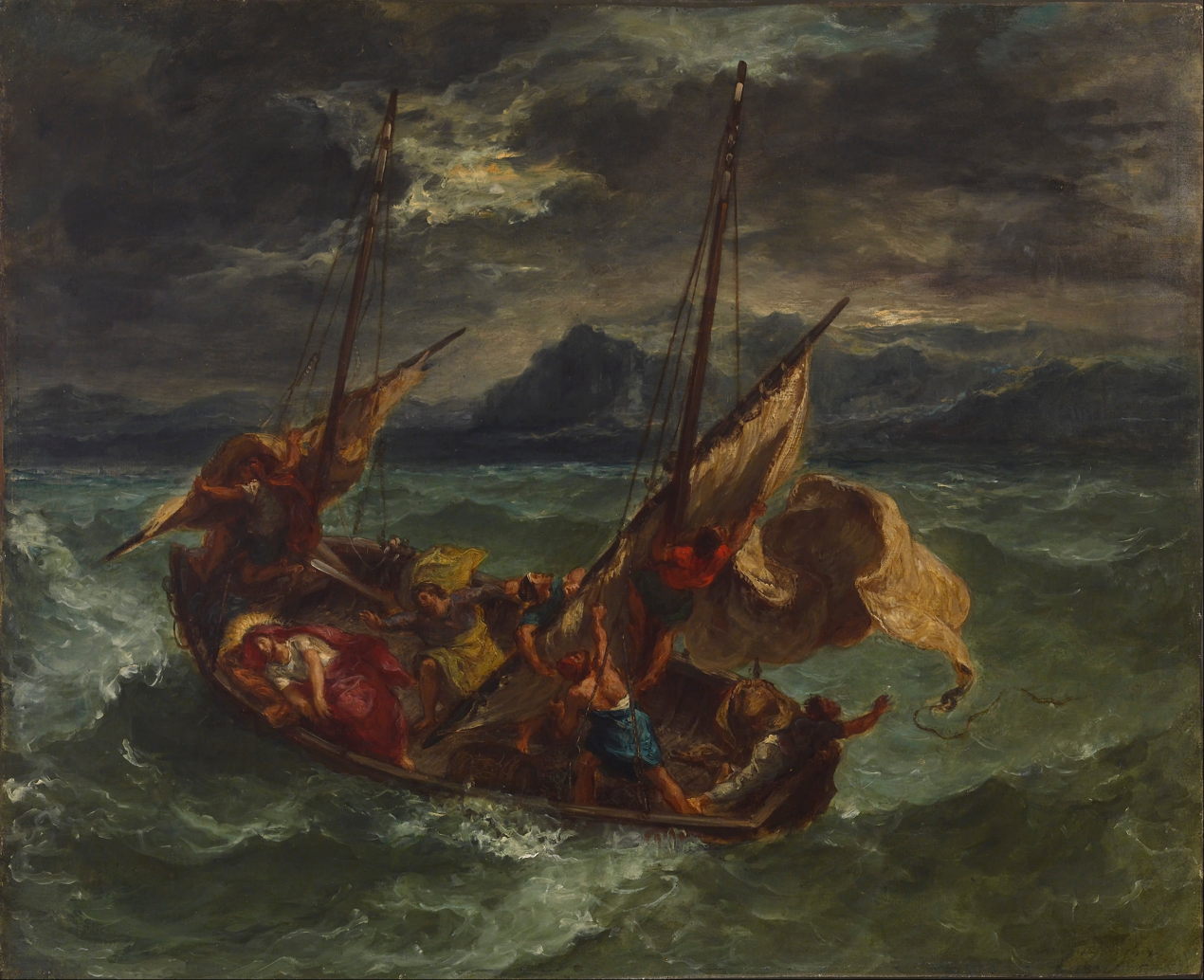
This from 1854 is in Walters Art Museum in Baltimore.
He painted at least six different versions, most during these difficult years as he started work on his paintings for Saint-Sulpice, and struggled with illness.
References
Barthélémy Jobert (2018) Delacroix, new and expanded edn, Princeton UP. ISBN 978 0 691 18236 0.
Patrick Noon and Christopher Riopelle (2015) Delacroix and the Rise of Modern Art, National Gallery and Yale UP. ISBN 978 1 857 09575 3.
Lucy Norton (translator) (1995) The Journal of Eugène Delacroix, 3rd edn, Phaedon. ISBN 978 0 7148 3359 0.
Arlette Sérullaz (2004) Delacroix, Louvre Drawing Gallery, 5 Continents. ISBN 978 8 874 39105 9.
Beth S Wright (editor) (2001) The Cambridge Companion to Delacroix, Cambridge UP. ISBN 978 0 521 65077 1.
 The Eclectic Light Company