

In the northern hemisphere we’ve now reached that stage in summer when there’s one thing you should be doing in the middle of the day, and that’s sleeping through your siesta. This weekend I’m showing a selection of paintings of people doing just that, most of them dozing in the fields. Today I concentrate on more classical scenes, starting with the story of Cimon and Iphigenia; tomorrow I’ll look at those who have been working in those fields.
Cimon and Iphigenia has probably been painted more than any other story in the whole of Boccaccio’s Decameron, by masters from Rubens to Frederic, Lord Leighton. What’s peculiar, though, is that all these paintings show a scene from the second page of a story that runs on for another ten pages, and develops quite a different plot.
Cimon’s father was a wealthy Cypriot, but Cimon, his nickname given in honour of his apparent simplicity and uncouthness, was his problem child. He was exceedingly handsome and had a fine physique, but behaved as a complete imbecile. He appeared unable to learn anything, even basic manners, so was sent to live with the farm-workers on his father’s large estates.
One afternoon in May, Cimon was out walking when he reached a clearing surrounded by tall trees, where there was a fountain. Lying asleep on the grass by that fountain was a beautiful young woman, Iphigenia, wearing a flimsy dress which left nothing to the imagination. Sleeping by her were her attendants, two women and a man. Cimon was immediately enraptured, leaned on his stick, and stared at her. As he did so, his simple mind started to change.
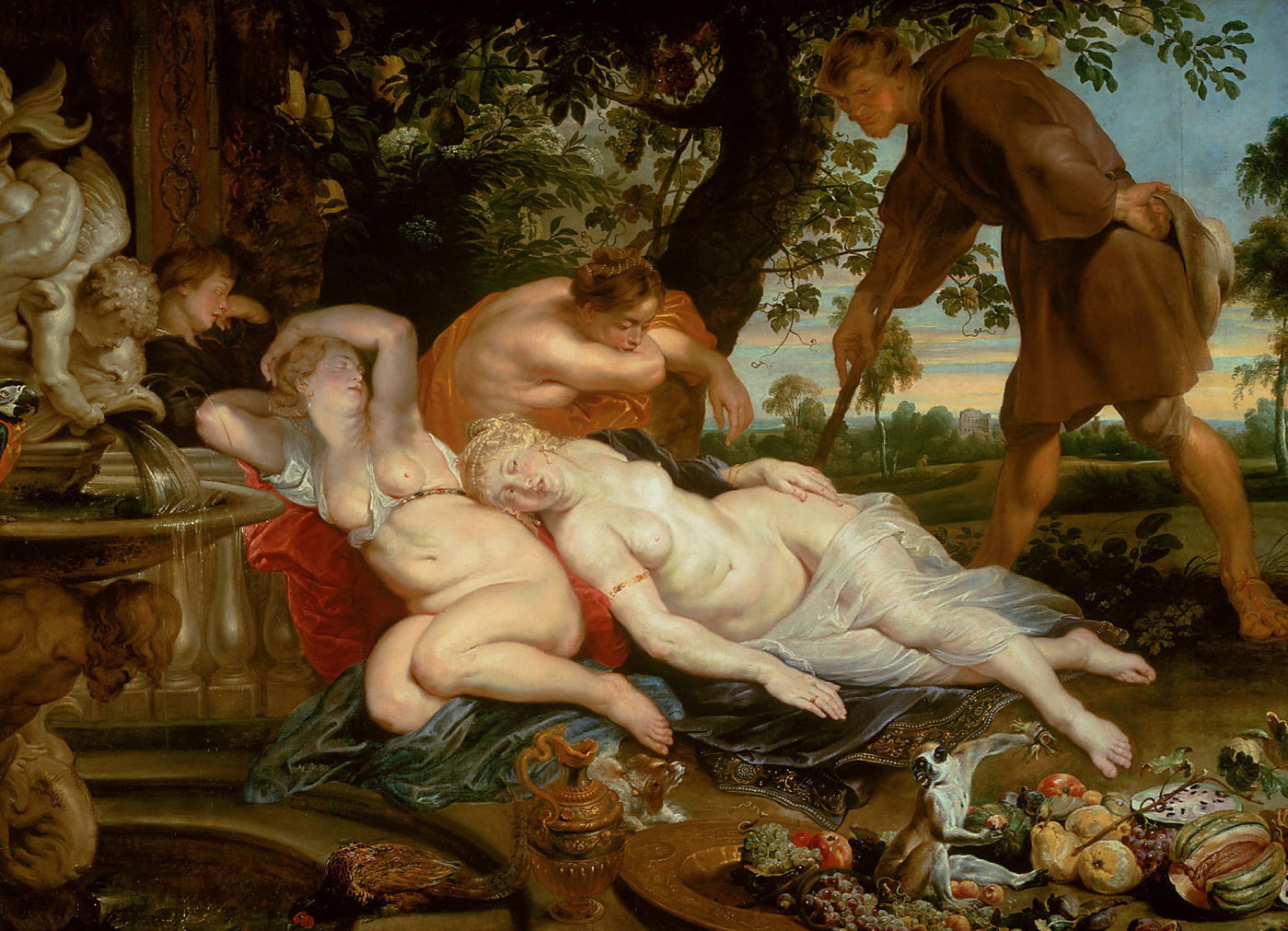
In about 1617, Peter Paul Rubens joined talents with Frans Snyders (who painted the still life with monkeys at the lower right) and Jan Wildens (who painted the landscape background) in their marvellous Cymon and Iphigenia. This is accurate in its details, with the correct quota of attendants, and a splendid fountain at the left. Cimon really looks like Boccaccio’s uncouth simpleton, and you can almost hear their soft snoring.

Benjamin West was more coy in his two depictions of this scene. His earlier Cymon and Iphigenia from about 1766 was well-received at the time.

In about 1780, Angelica Kauffman painted this delightful tondo of Cymon and Iphigenia, another variation on the same theme. The cultural contrast between the young man and woman isn’t as stark.

Frederic, Lord Leighton’s Cymon and Iphigenia from 1884 shows her stretched out languidly in sleep, in the last warm light of the day; behind her the full moon is just starting to rise. Leighton has changed the season to autumn, with the leaves already brown but the days still hot. Cymon stands in shadow on the right, idly scratching his left knee, gazing intently at Iphigenia.
As far as the painters are concerned, that’s it, and presumably the couple lived happily ever after.
Boccaccio went on to tell of Cimon turning over a new leaf, and transforming himself into the best-dressed, most cultured and refined young man on Cyprus. Despite that, he was unable to persuade Iphigenia’s father to allow him to marry the young woman, but was told that she was betrothed to a noble on the island of Rhodes. When the time came for her marriage, Cimon took an armed vessel and gave chase to the ship carrying Iphigenia to Rhodes. He boarded her ship and abducted her. After a succession of adventures and a couple of murders, Cimon ended up marrying Iphigenia, and only then living happily ever after on Cyprus.
There’s also no shortage of paintings showing nymphs asleep with lustful fauns creeping up on them.

Ker-Xavier Roussel’s Faun and Nymph from about 1910 shows a typical scene with a naked nymph asleep in the foreground, and a faun fast approaching from the right.

According to some accounts, the Hesperides were also prone to dozing in their garden. Albert Herter’s golden apples look truly metallic in his Garden of the Hesperides from 1898, as a hefty snake is coiling its way around the three women in their slumber.

Endymion was a classical Greek mythological character, an Aeolian shepherd. Although accounts differ, there are threads which run that Selene, the Titan goddess of the moon (in Roman terminology, Diana), fell in love with Endymion, when she found him asleep one day. Selene/Diana asked Zeus to grant him eternal youth, resulting in him remaining in eternal sleep. In spite of his somnolence, Selene/Diana still managed to have fifty daughters by him.
In Walter Crane’s beautiful pastoral watercolour from 1883, Endymion is seen, fast asleep, in a meadow. Diana is in her other role, as hunter, with her dogs, bow and arrows. Endymion’s flock of sheep is in the distance, and leads us on to tomorrow’s paintings.
 The Eclectic Light Company