
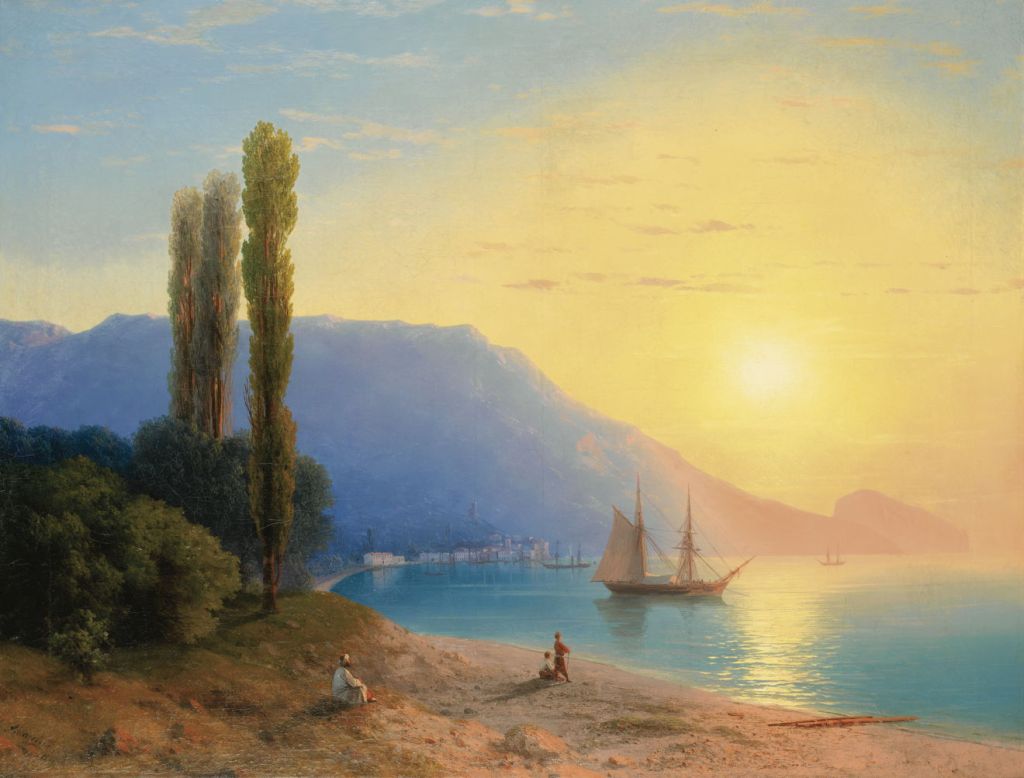
The Black Sea coast has always been very cosmopolitan, with traders and others who have been drawn there from distant lands, then settled to do business in areas like Crimea. Today’s artist came from a family of Armenian origin, lived in Ukraine, trained in Russia, travelled throughout Europe and beyond, kept his studio in and eventually retired to Ukraine: he’s the greatest marine artist of the nineteenth century, Ivan or Hovhannes Aivazovsky (1817–1900).
Like others in this series, he went under several different names. He was baptised as Hovhannes Aivazian, later known in Armenian as Հովհաննես Այվազովսկի or Hovhannes Ayvazovski, initially known in Russia as Иванъ Гайвазовскій or Ivan Gaivazovsky, and later as Ива́н Константи́нович Айвазо́вский or Ivan Konstantinovich Aivazovsky, and when he lived in Italy he became Giovani Aivazovsky.
His family had originally migrated from Western Armenia in the eighteenth century and settled in Galicia when it was part of Poland. His father moved from there to Moldavia (now Moldova) before finally settling in Feodosia in Crimea. Hovhannes Aivazovsky was born and brought up there, then went to Simferopol in Crimea for his education. When he was only sixteen he moved to Saint Petersburg in Russia, where he studied at the Imperial Academy of Arts until 1837, when he graduated with a gold medal.
Aivazovsky then returned to Crimea for two years, during which he met Russian admirals exercising their fleets on the Black Sea coast. In 1840, he was sponsored by the Imperial Academy to study in Europe. He then travelled overland through Vienna and Berlin to Venice. When in Italy, he visited Florence, Amalfi, and Sorrento, then stayed in Naples and Rome until 1842. During this period he painted many beautiful views of the Italian coast, and of Venice.

The Bay of Naples (1841) is a good example of his early paintings from Italy, in which he often sought the rich colours of sunrise and sunset. These are not large canvases, but he shows fine details such as the rivulets of water falling from the oars.
He started his return to Russia via Switzerland, Germany, the Netherlands, and Britain. While in London, he met JMW Turner, who was particularly impressed by his painting The Bay of Naples on a Moonlit Night. He then travelled to Paris, where he was awarded a gold medal from the Académie Royale, and toured through Europe again in 1843. He finally returned to Russia in 1844, where he was made an academician at the Imperial Academy, and was appointed principal painter to the Russian Navy. The bulk of his work from the middle of the century is of naval scenes and battles.
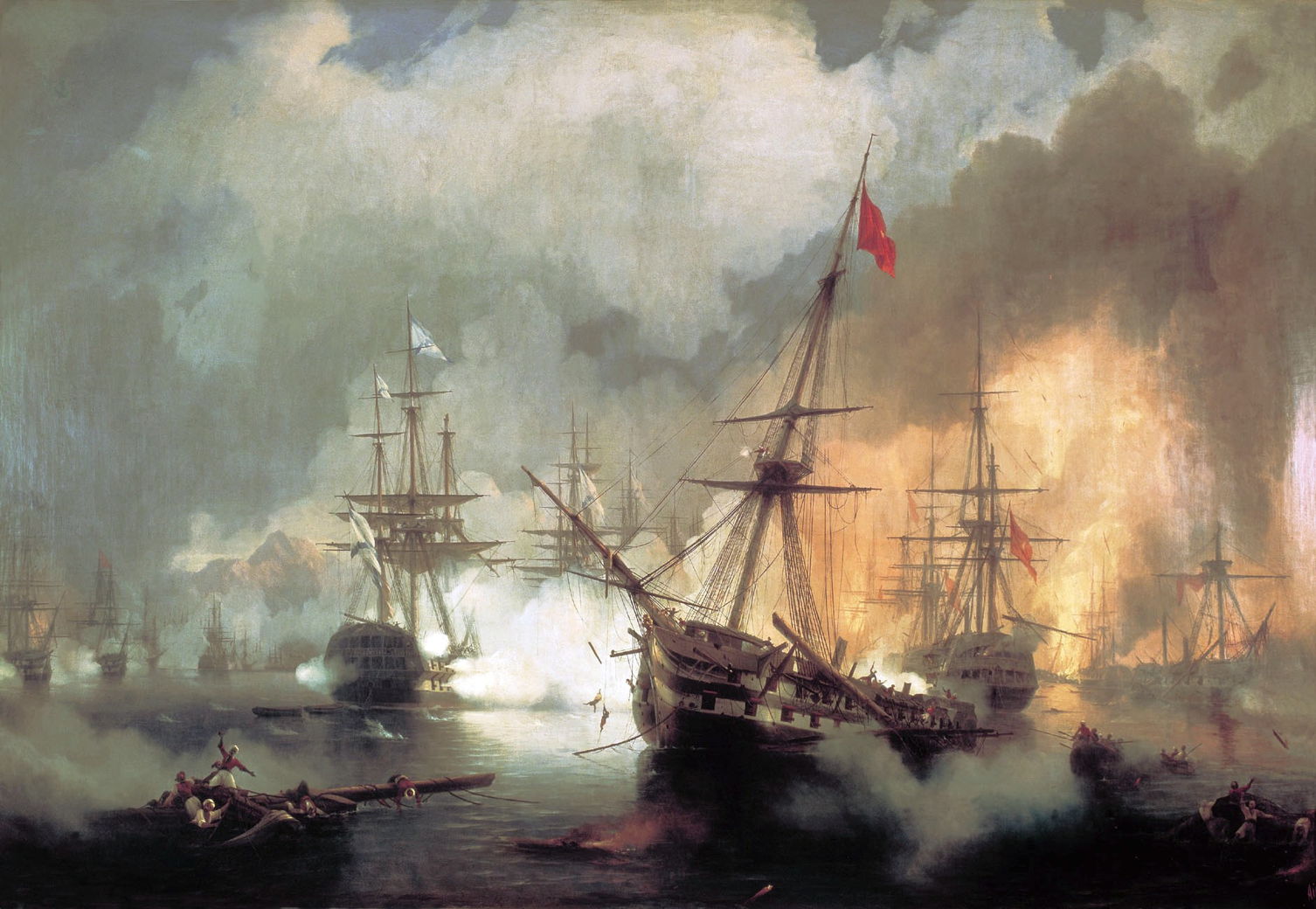
His painting of the Battle of Navarino (1846) is one of the classic depictions of this major naval battle on 20 October 1827. Fought between the combined Ottoman navies and an allied force of British, French, and Russian warships, it was the last major battle between traditional wooden sailing ships, and resulted in destruction of the Ottoman forces. It took place off the Greek coast, in the Ionian Sea, as part of the Greek War of Independence.
From 1845 Aivazovsky based himself and his family in his house and studio in Feodosia, Crimea, from where he travelled repeatedly throughout Russia and Europe.

The Ninth Wave (1850) is Aivazovsky’s best-known painting, and one of the classic depictions of shipwreck alongside Géricault’s Raft of the Medusa (1818-19), although not as a social or political statement. Its title derives from the belief that waves occur in trains of nine, progressively increasing in size to the ninth wave. Some nautical traditions claim that the number is seven rather than nine, and although there is some underlying evidence to support wave trains, inevitably real life is not as regular.
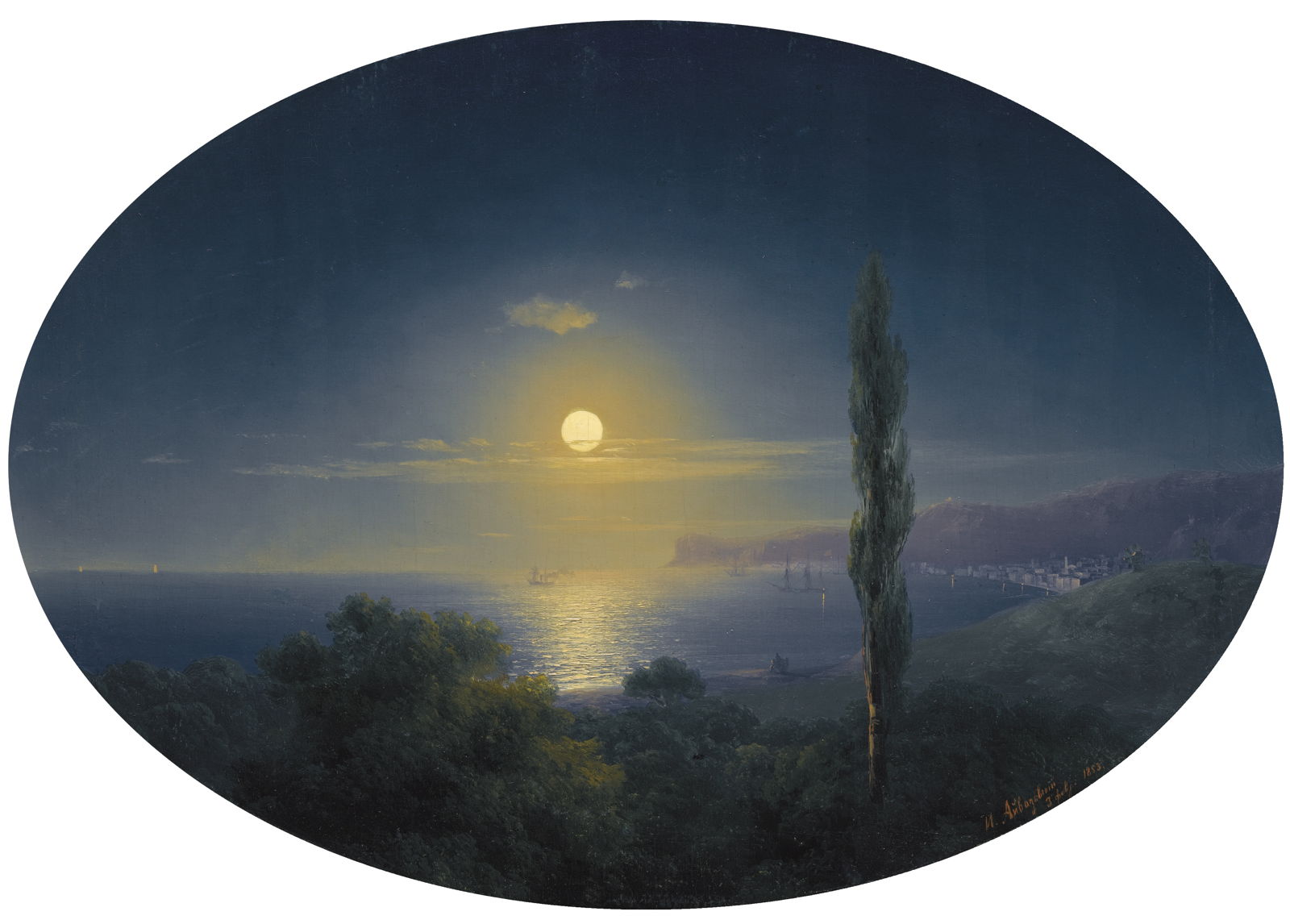
When the Crimean War broke out in 1853, Aivazovsky painted from the besieged fortress of Sevastopol, although he still found opportunity to show its beauty in his Crimean Coast by Moonlight (1853).
Aivazovsky took pupils, including Adolf Fessler, who was working as his assistant in the late 1850s when the Pontic Greek Ukrainian artist Arkhyp Kuindzhi (1841-1910) was taught in Aivazovsky’s Feodosia studio.

View of Constantinople and the Bosphorus (1856) is one of many views that Aivazovsky made of this great city (now known as Istanbul, of course), which he visited on many occasions.
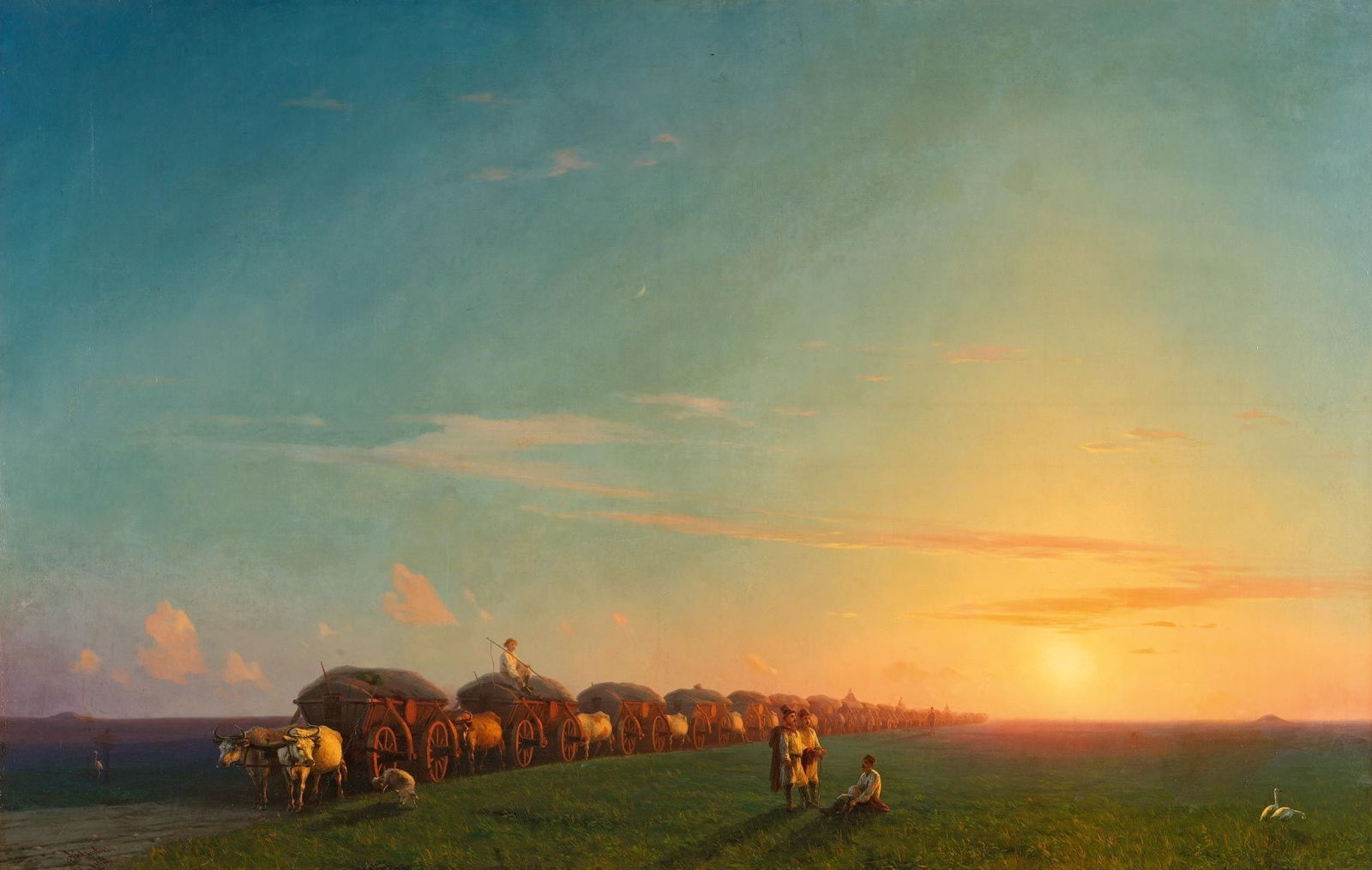
Best-known for his thousands of marine views, Aivazovsky went deeper inland for his Broad Landscape with Settlers (1856). This shows the steppe of Izumskaya, now on the border between Russia and Ukraine, where ‘salt farmers’ are seen migrating from the crowded lands of Crimea into the interior of Russia. They could instead be Chumaks, itinerant commodity traders whose businesses collapsed later in the century when the railways came to the south of Ukraine.
Aivazovsky lived in Paris from 1856-7, where he was made a member of the Legion of Honour.

Sunset over Yalta (1861) shows this popular resort city on the southern coast of the Crimean Peninsula. At this time, it was fashionable for the Russian aristocracy and gentry to spend their summers here, and many bought summer homes or dachas for the purpose.
In 1868, Aivazovsky travelled to the Caucasus Mountains, and into Armenia and Georgia the following year.

Tiflis (now Tbilisi, capital of Georgia) (1868) is one of the finest paintings of this cosmopolitan city, showing camels on its bustling streets, amid the many church towers, and its rugged surroundings, rising to the Caucasus mountains in the far distance.
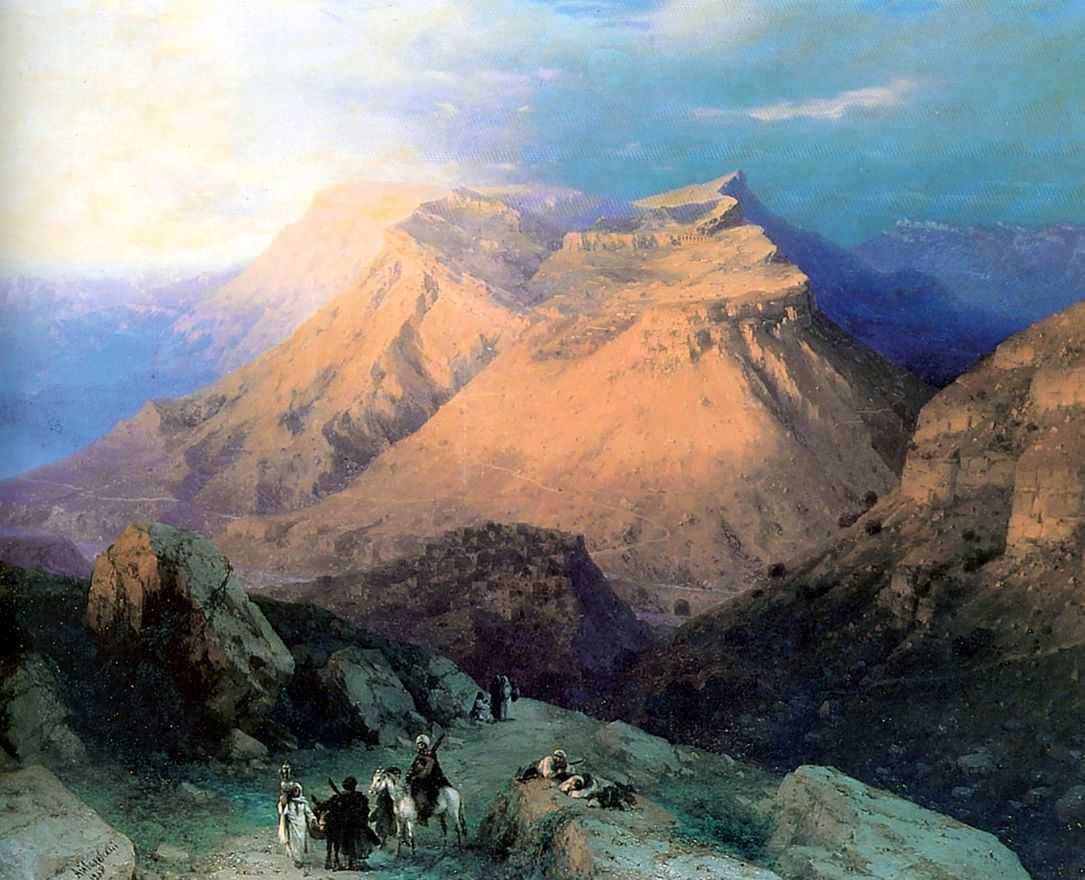
Aivazovsky was an early visitor to the mountainous wilderness of the North Caucasus, where he painted this Mountain Village Gunib in Daghestan (1869).

Later that year he travelled south to Egypt, arriving shortly after the new canal’s official opening on 17 November 1869, where he painted Suez Canal showing a convoy of ships passing through in a quite unearthly light.
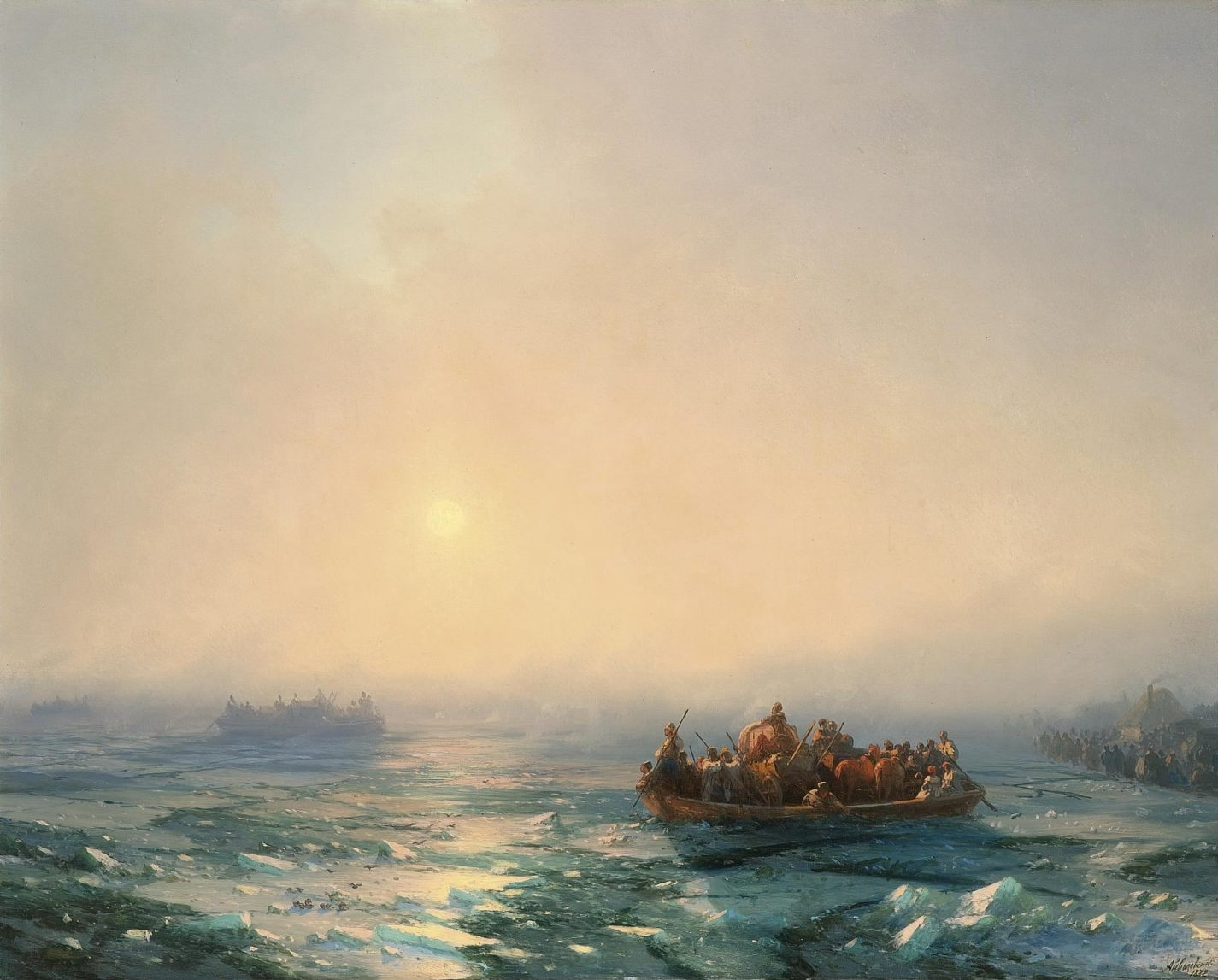
Ice on the Dnipro (1872) shows a stretch of this major river in Ukraine with crowded boats crossing its broken ice.
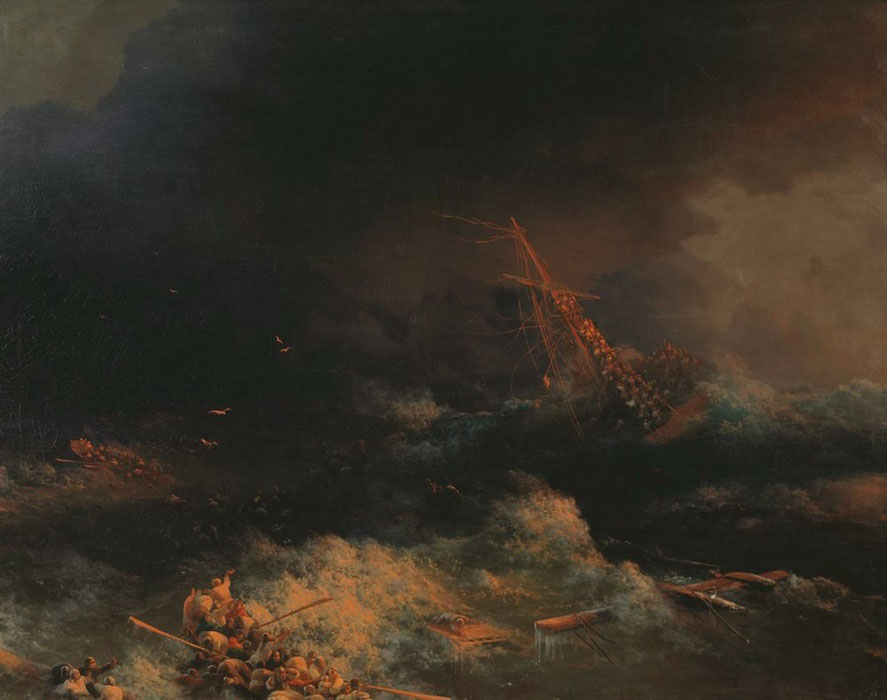
Loss of the Ship “Ingermanland” in the Skagerrak on the Night of 30 August, 1842 (1876) is a shipwreck painting comparable in content, but not style, to those of JMW Turner.
In between his travels, Aivazovsky was active in his local community in Feodosia, where he funded and led archaeological exploration. In 1880, he opened part of his house as an art gallery, and it remains one of the largest collections of his paintings. At the time, it was claimed to be the third major collection of paintings in the Russian Empire open to the public, after the Hermitage in Saint Petersburg (1852) and the Tretyakov Gallery in Moscow (1867).

The location of Sea Coast (1886) isn’t clear, but it shows a rugged coastline with a storm sea pounding at its cliffs. The sole ship has both sails and a steam engine, as was becoming increasingly common at that time.
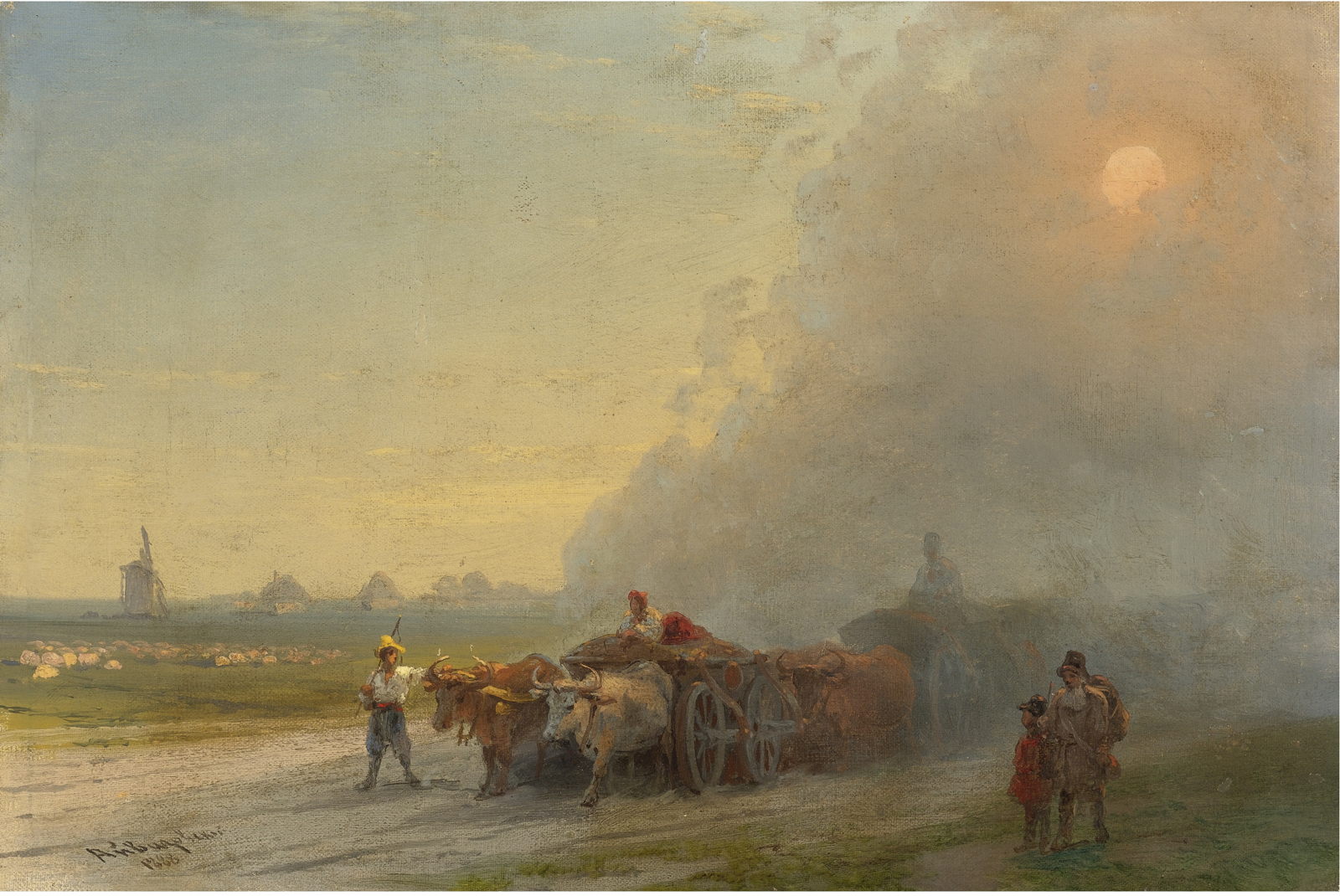
Ox-carts in the Ukrainian Steppe from 1888 may show Chumaks during their final years in Southern Ukraine, as they haul their loads past a hamlet with a windmill.
His travels in Europe continued during the 1870s, and in 1892 he visited America, where he painted the Niagara Falls, and some other landscapes. He later retired to Feodosia, where he died in 1900. He is estimated to have painted more than 6,000 works during the 60 years of his career, an average of two paintings per week.
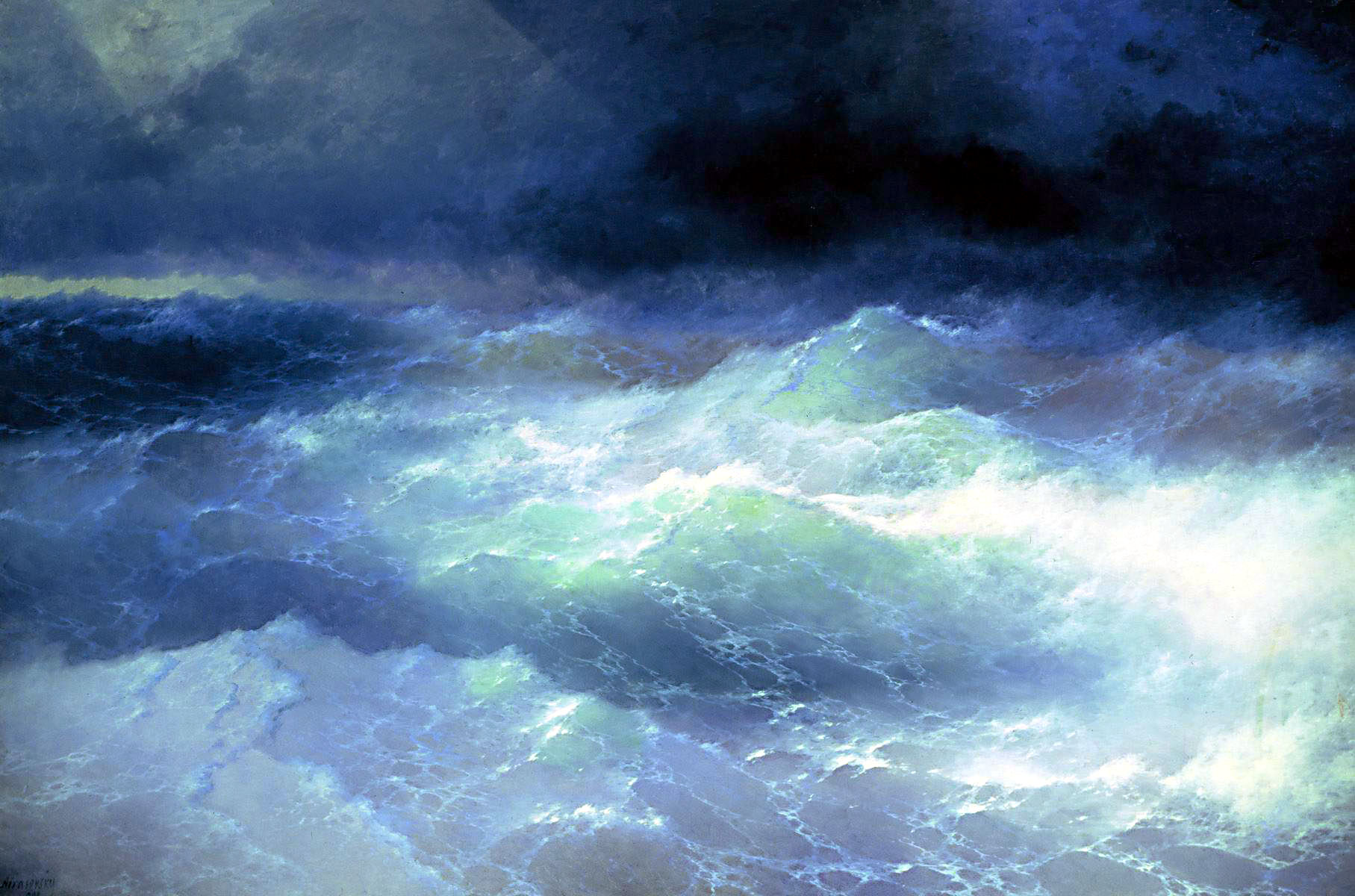
Among the Waves (1898) is a late example of Aivazovsky’s favourite subject: the storm sea.
Reference

