
One of the great resources that Eugène Delacroix (1798–1863) left us is his diary. Although he took a long break when he was occupied with the decorative paintings in the 1840s, on Tuesday 19 January 1847 he resumed writing his personal thoughts and detailing the events of each day. It so happened that on that winter’s day, he had visited the zoo and botanical gardens in Paris, the Jardin des Plantes, and that spurred him to write of his admiration for the animal paintings of Peter Paul Rubens (1577–1640).
In case you never thought of Rubens as an animal artist, around 1614-16 he painted a series of hunting scenes featuring big game, possibly with the help of the animalière Frans Snyders. Delacroix became fascinated by them, even though he probably never saw the original paintings, but had to make do with etchings of them made by Soutmans. What’s perhaps most remarkable about this series is that each has been painted purely from the artist’s imagination.
While they undoubtedly used images of the wild animals concerned, neither Rubens nor Delacroix could ever have seen any of these hunts, even if they had actually taken place. At this time, the furthest that Rubens had travelled had been to Italy, and he never visited a country in which these big cats, hippos or crocodiles lived in nature. At least it meant that no animals were harmed in the process.

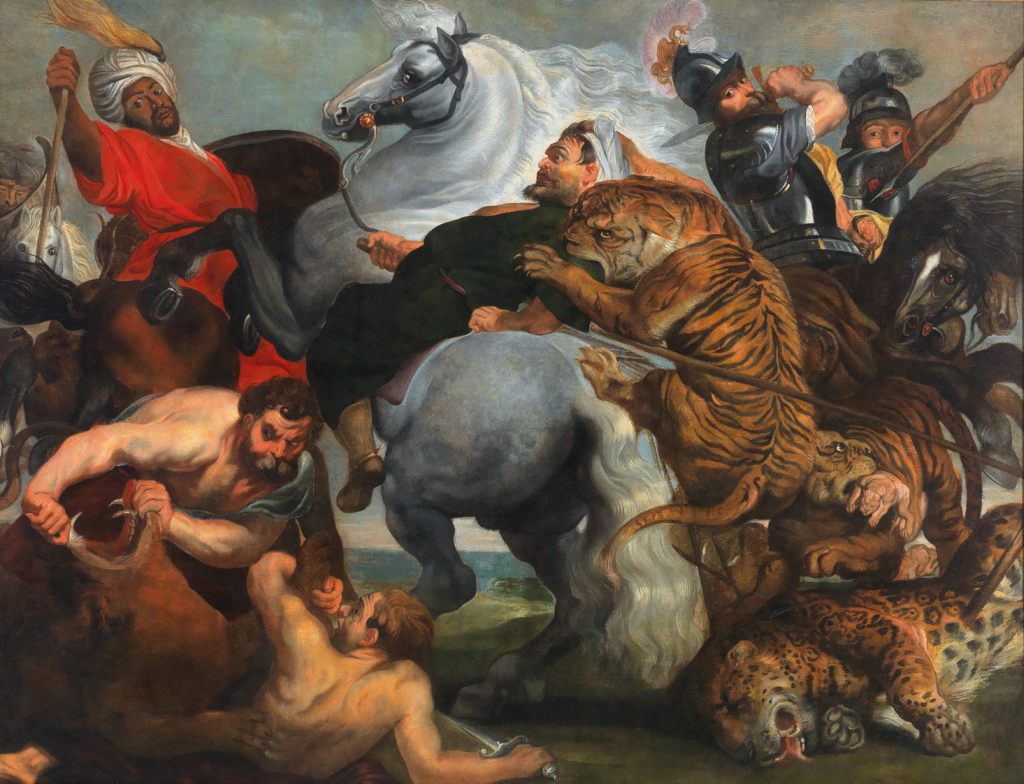
The Tiger Hunt from about 1616 packs the canvas with hunters, their horses, and a collection of big cats, including two tigers, a lion and a leopard. A Samson-like figure in the left foreground is wrestling with the lion’s jaws, as one of the tigers buries its teeth into the left shoulder of the Moorish hunter in the centre.

This version of The Lion Hunt was painted rather later, in 1621, and was Delacroix’s favourite for its confusion and fearful conflict. Although considerably less busy than The Tiger Hunt above, its diagonal is formed from the chaos of falling bodies, horses and impaled lions.
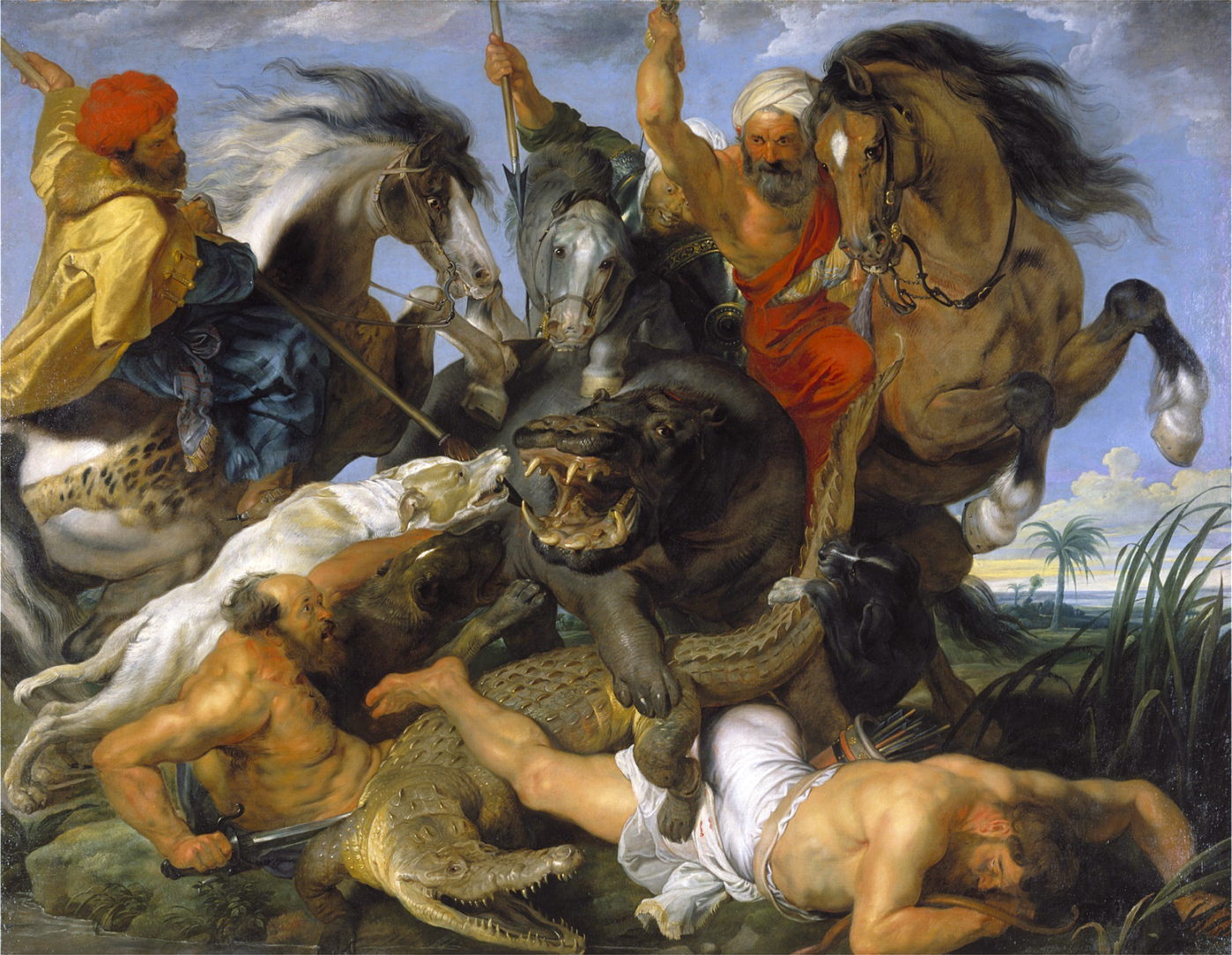
Delacroix praised this Hippopotamus and Crocodile Hunt from about 1615 for its simplicity of contrast imparting a strong sense of movement. The lower half of the painting contains a writhing group of men, crocodile and the snarling hippopotamus. Above that are the heads of three horses and two men spread across blue sky.
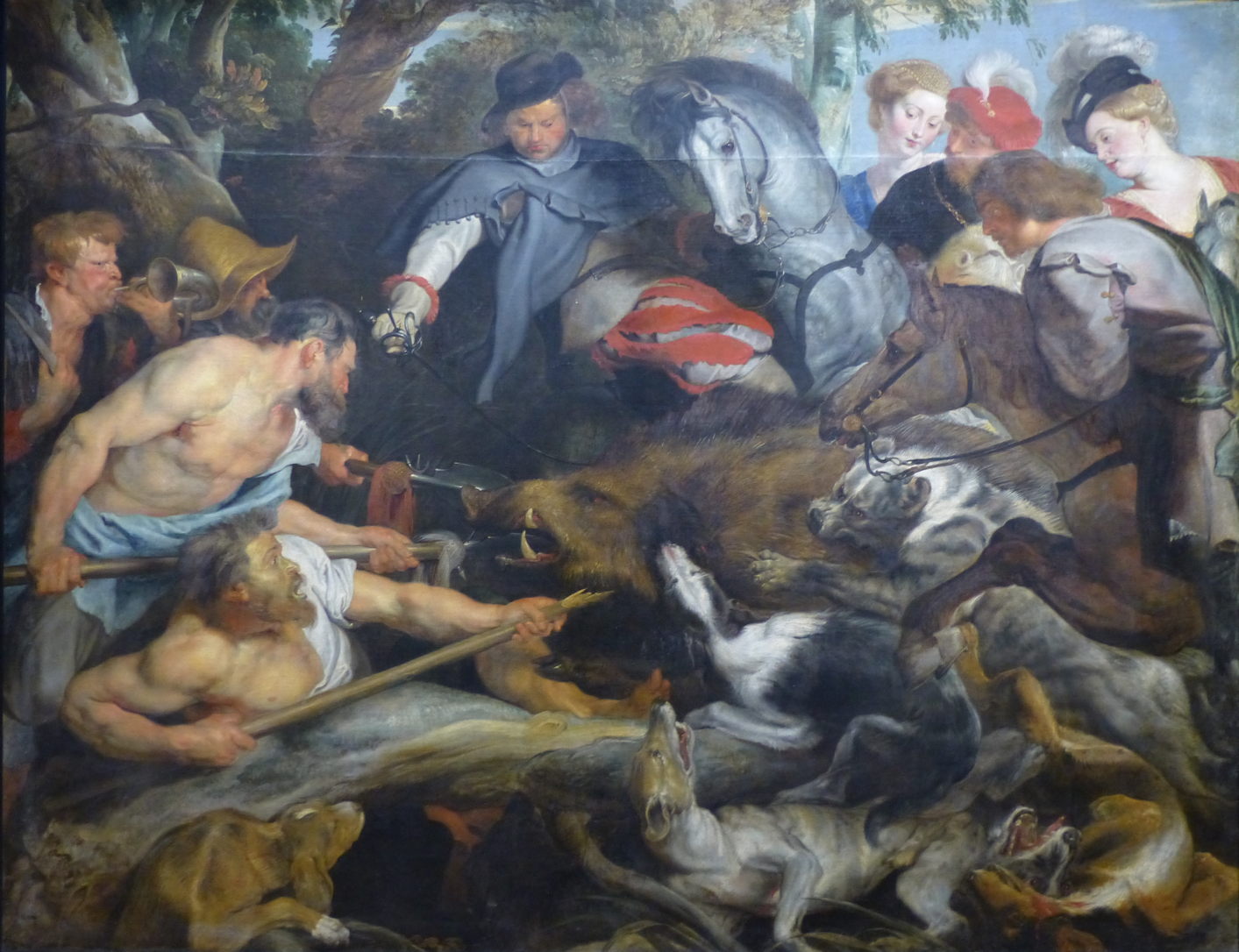
The victim in The Boar Hunt from about 1615-16 is harder to see, and this painting has stronger links to Rubens’ depictions of boar hunts in classical mythology.

Wolf and Fox Hunt from about 1616 reworks its theme for the more European viewer.
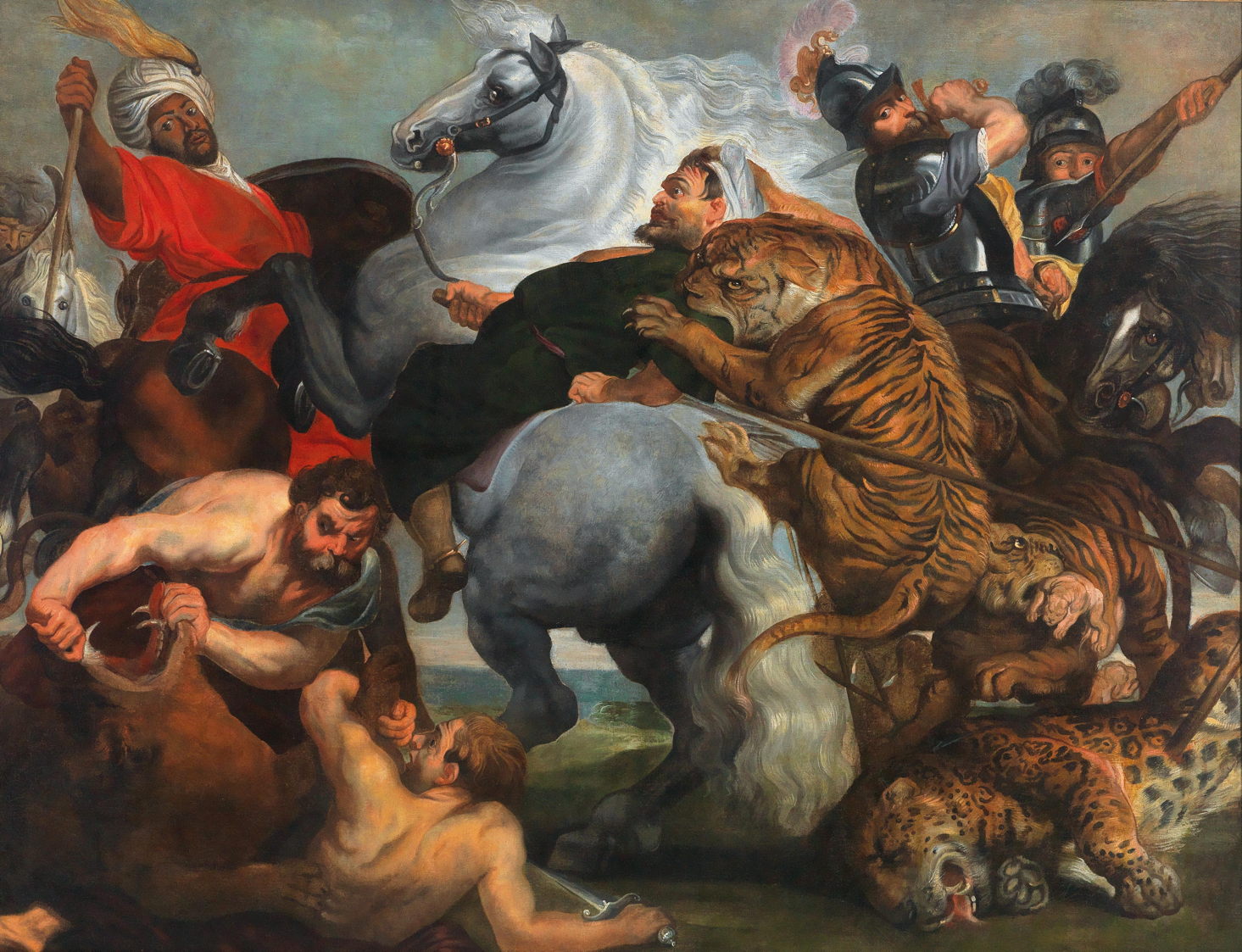
This undated version of The Tiger, Lion and Leopard Hunt is a copy made by Rubens’ workshop of The Tiger Hunt, above.
For his retrospective gallery at the 1855 Exposition Universelle, Delacroix chose to paint his major work of The Lion Hunt (1855).
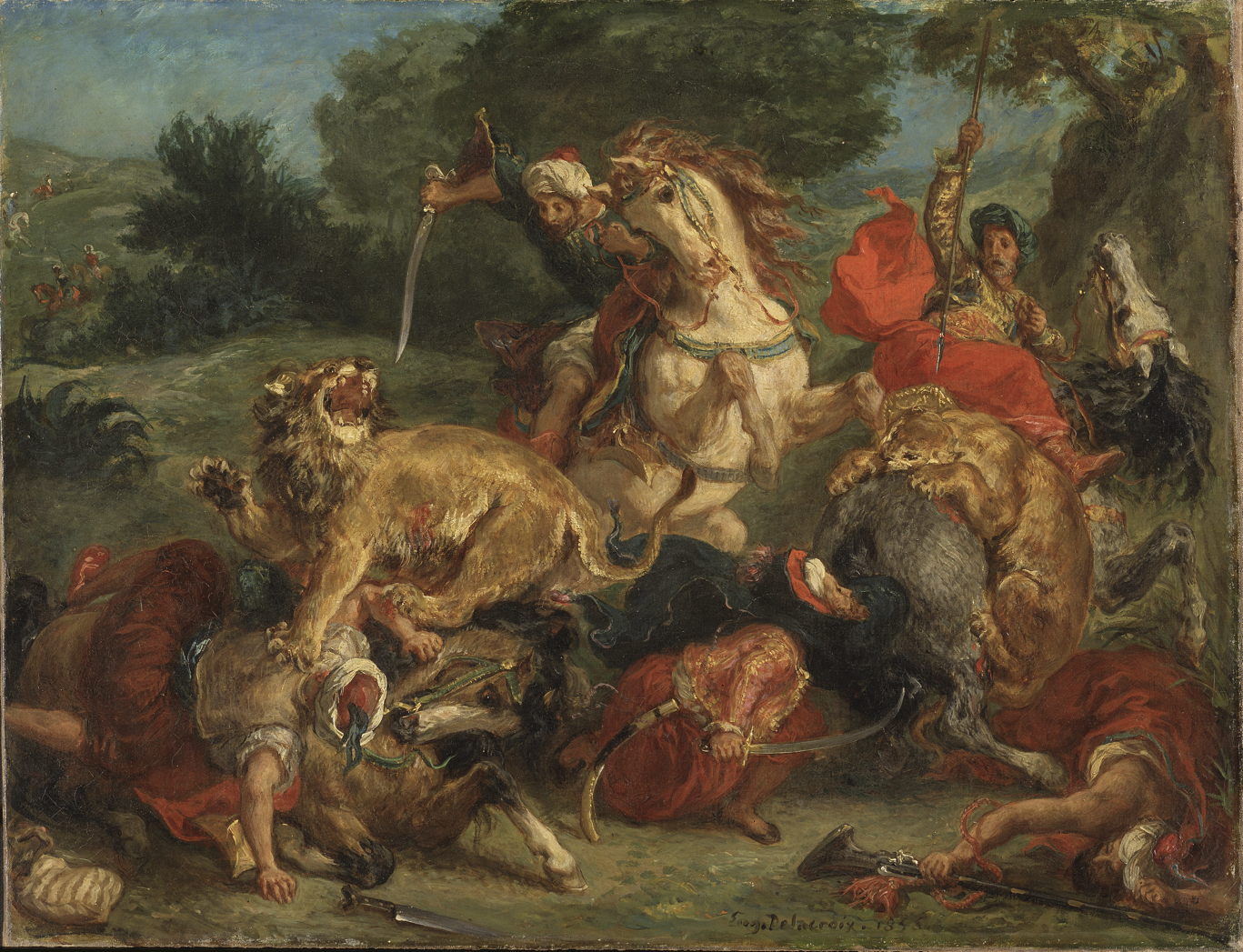
For this, he drew on his sketches made during his visit to Morocco in 1832, Rubens’ Hunts, and further studies of animals in the Jardin des Plantes, although there’s no evidence that Delacroix came any closer to witnessing such an event than Rubens.
Tragically, the full-size original was partially destroyed by fire in 1870, leading to the loss of the upper third of the canvas. The version shown above, now in Stockholm, is thought to have been painted in parallel and submitted for approval of the finished work. The influence of Rubens is clear.
Although it did attract some adverse criticism, his gallery at the Exposition was sufficiently well-received that in January 1857 he was finally elected to the Académie des Beaux-Arts.
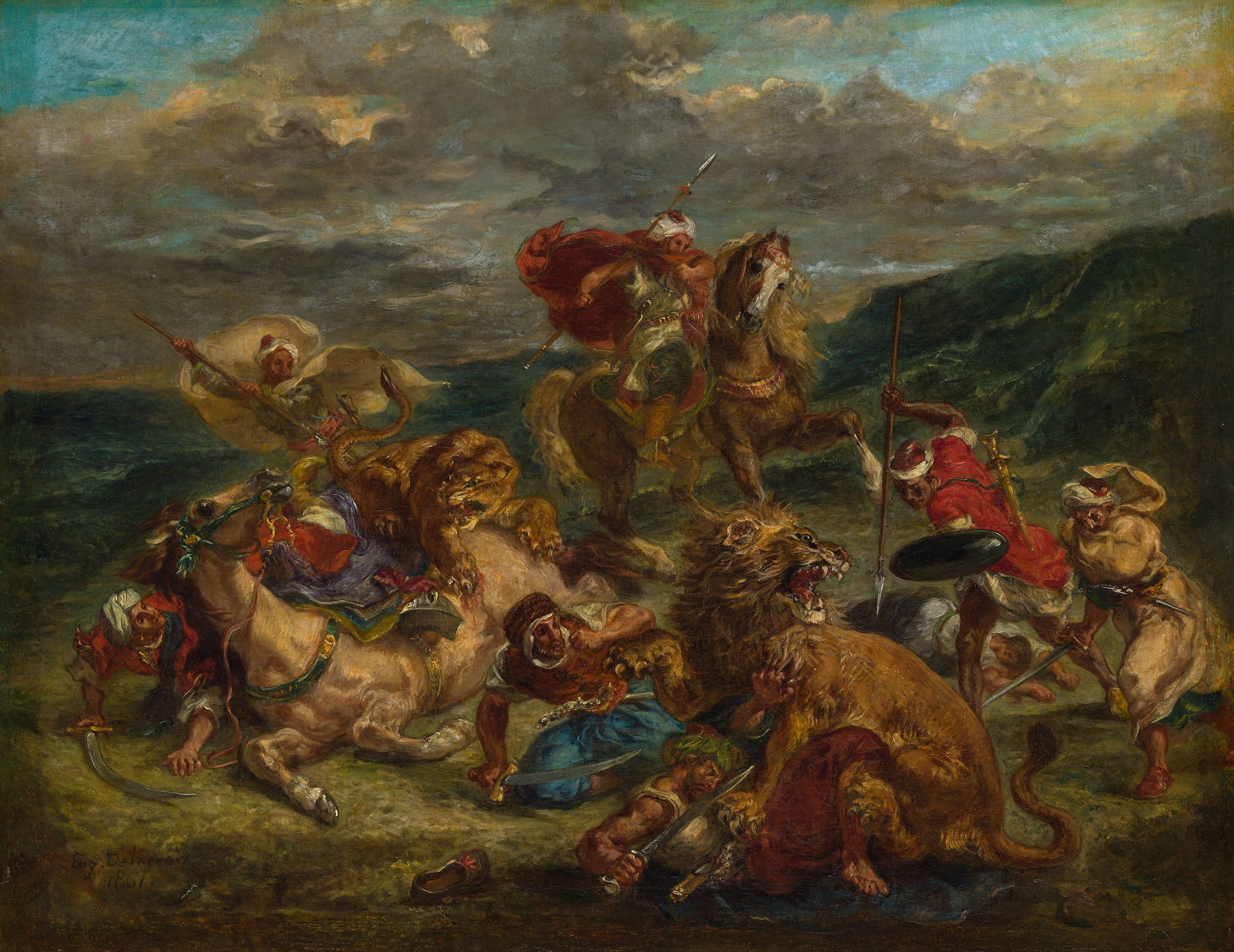
In 1860-61, he returned to rework his original version in The Lion Hunt in Morocco, now in Chicago. Below is a digitally enhanced version that reveals more of its detail, and perhaps its original brilliant colours.
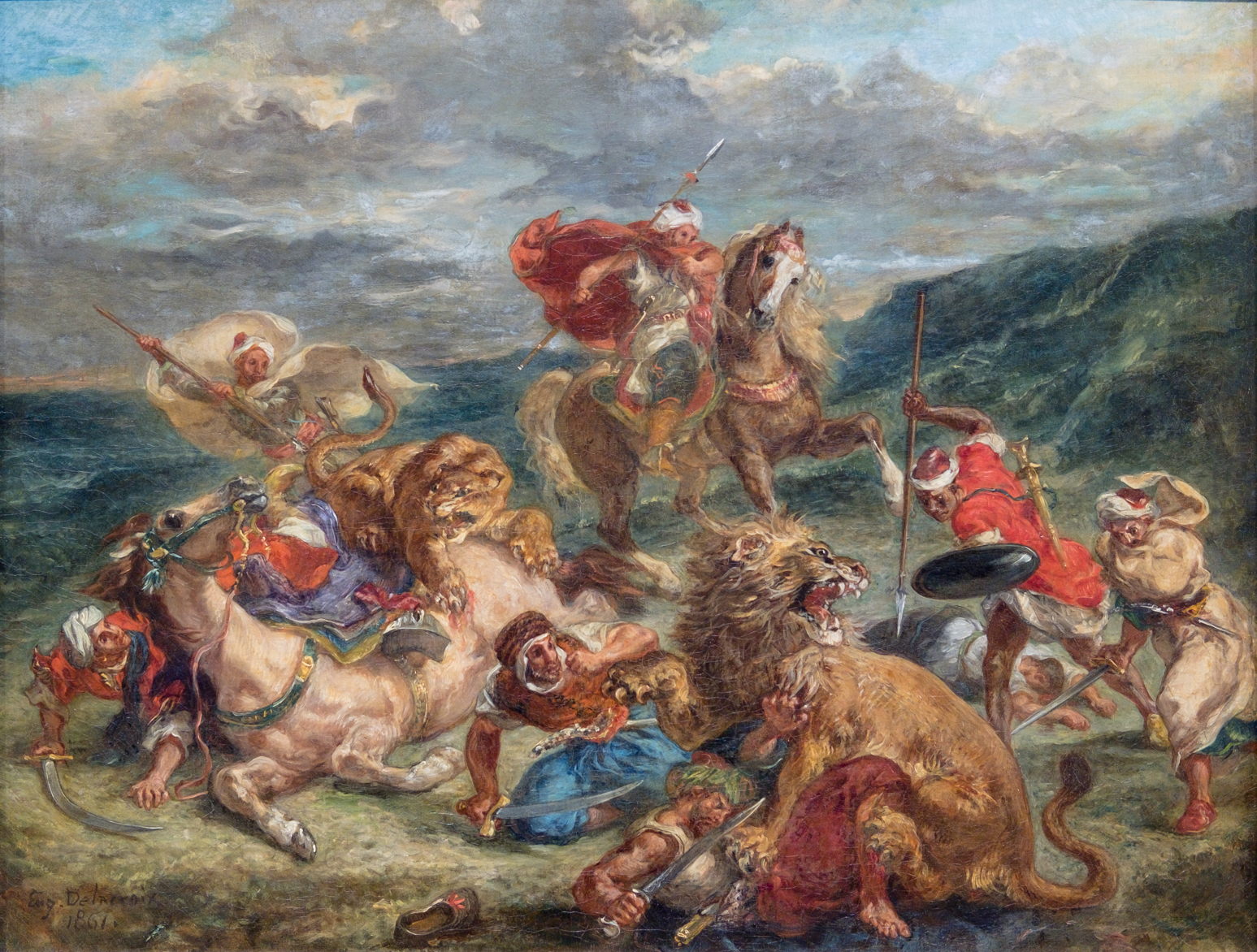
Every one of these painting is wholly imaginary.
References
Barthélémy Jobert (2018) Delacroix, new and expanded edn, Princeton UP. ISBN 978 0 691 18236 0.
Patrick Noon and Christopher Riopelle (2015) Delacroix and the Rise of Modern Art, National Gallery and Yale UP. ISBN 978 1 857 09575 3.
Lucy Norton (translator) (1995) The Journal of Eugène Delacroix, 3rd edn, Phaedon. ISBN 978 0 7148 3359 0.
Arlette Sérullaz (2004) Delacroix, Louvre Drawing Gallery, 5 Continents. ISBN 978 8 874 39105 9.
Beth S Wright (editor) (2001) The Cambridge Companion to Delacroix, Cambridge UP. ISBN 978 0 521 65077 1.
 The Eclectic Light Company