
The cornucopia is literally a horn (Latin cornu) of plenty (Latin copia), the horn of an animal overflowing with an abundance of fruit, other edible delicacies and flowers. It’s a symbol of rich fruitfulness and plenty.
There are two myths telling of its origin: one claiming that it was broken off the goat Amaltheia by the infant Zeus, the other a more elaborate story involving a wrestling match between the river god Achelous and Heracles/Hercules.
Achelous was able to change his form; both he and Heracles asked for the hand of the beautiful Deianira in marriage. Rather than the two plighting their troths verbally, Heracles rushed at Achelous and wrestled with him. With Heracles rapidly getting the better of the river god, Achelous tried changing into a snake to slither away from his opponent, but was mocked as a result. When Heracles put a stranglehold onto the snake, Achelous changed into a bull, and Heracles wrenched one of his horns off. Ever since, that horn has been held sacred by Naiads, and became the Horn of Plenty, or Cornucopia.
The most detailed and magnificent painting of this myth is modern, and was painted in 1947 for a department store in Kansas City by Thomas Hart Benton, in his Achelous and Hercules.

At the centre, Hercules, stripped to the waist and wearing denim jeans, is about to grasp Achelous’ horns. Immediately to the right, Deianira is shown in contemporary American form too, with a young woman next to her bearing a laurel crown. They’re sat on the Horn of Plenty, and Benton is one of the few painters to have included that important reference.
To the left of centre, Benton shows a second figure of Hercules holding a rope, making this multiplex narrative. That figure is part of a passage referring to ranching and cowboys, and further to the left to the grain harvest. To the right, the Horn of Plenty links into the cultivation of maize (corn), the other major crop from the area.

This collaboration between the workshop of Peter Paul Rubens and Jan Brueghel the Elder shows Nymphs Filling the Horn of Plenty (c 1615). Although it doesn’t refer to the fight between Hercules and Achelous, it shows the staff preparing the second course of Achelous’ subsequent banquet.
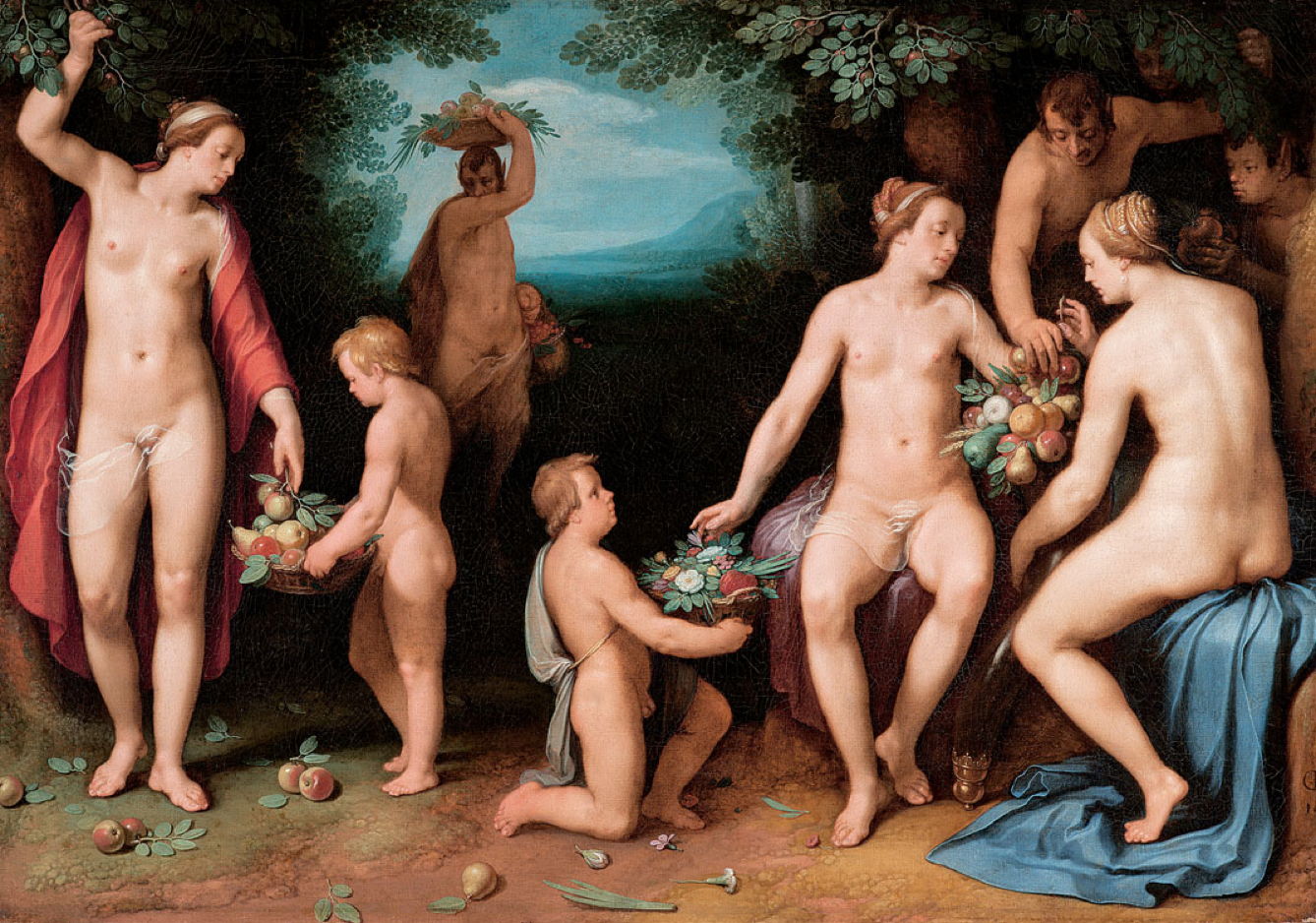
Curiously, Cornelis van Haarlem’s painting of The Hesperides Filling the Cornucopia from 1622 makes no reference to the golden apples more usually associated with their garden, but to their filling the Horn of Plenty with a wide range of fruit and other produce.
The cornucopia is frequently found in seventeenth century paintings of the four elements.

Jan Brueghel the Elder and Hendrick de Clerck’s Abundance and the Four Elements from about 1606 rolls all four into one. At the lower right and centre is earth with a cornucopia, the upper left is air and fire, and at the lower left is water.
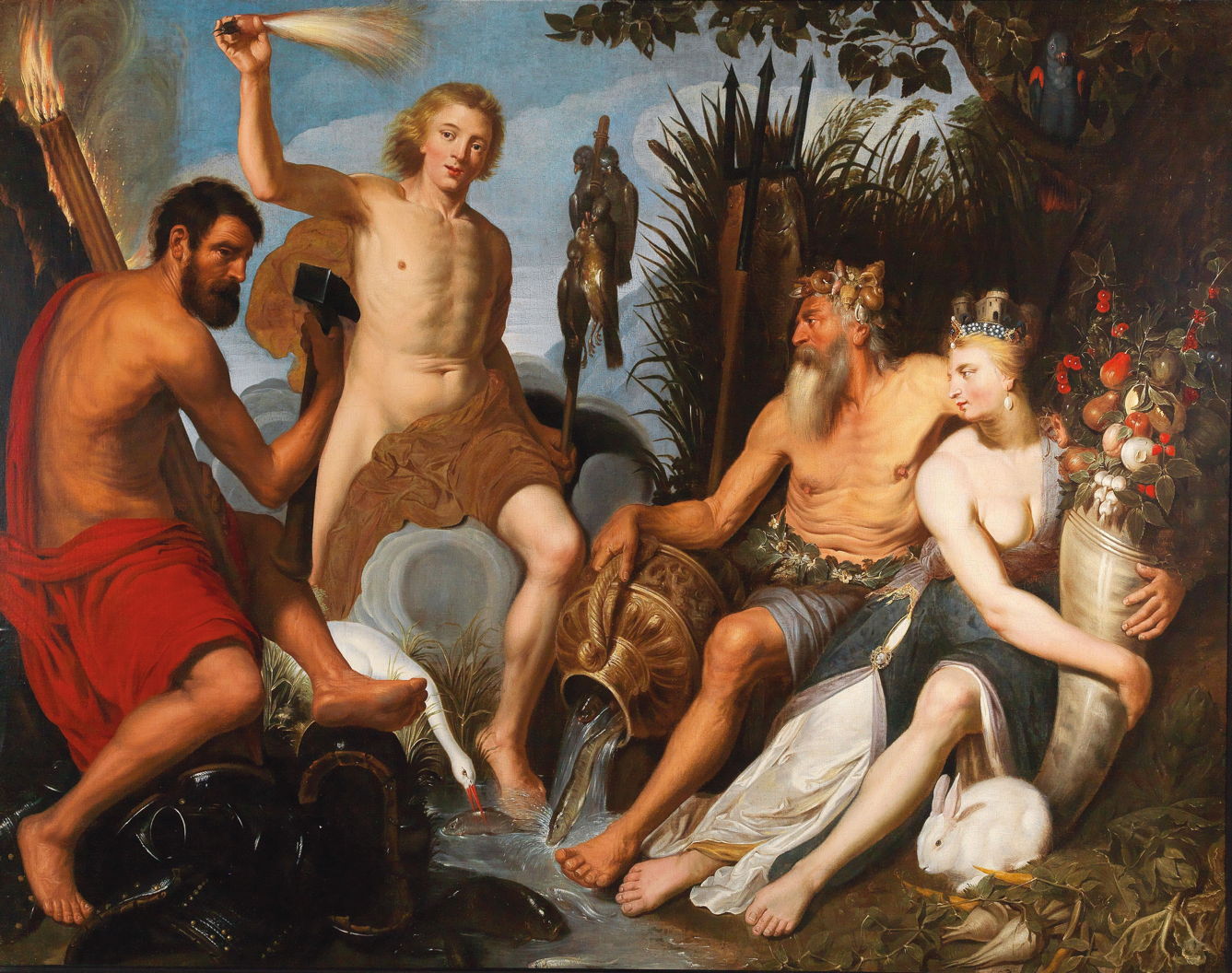
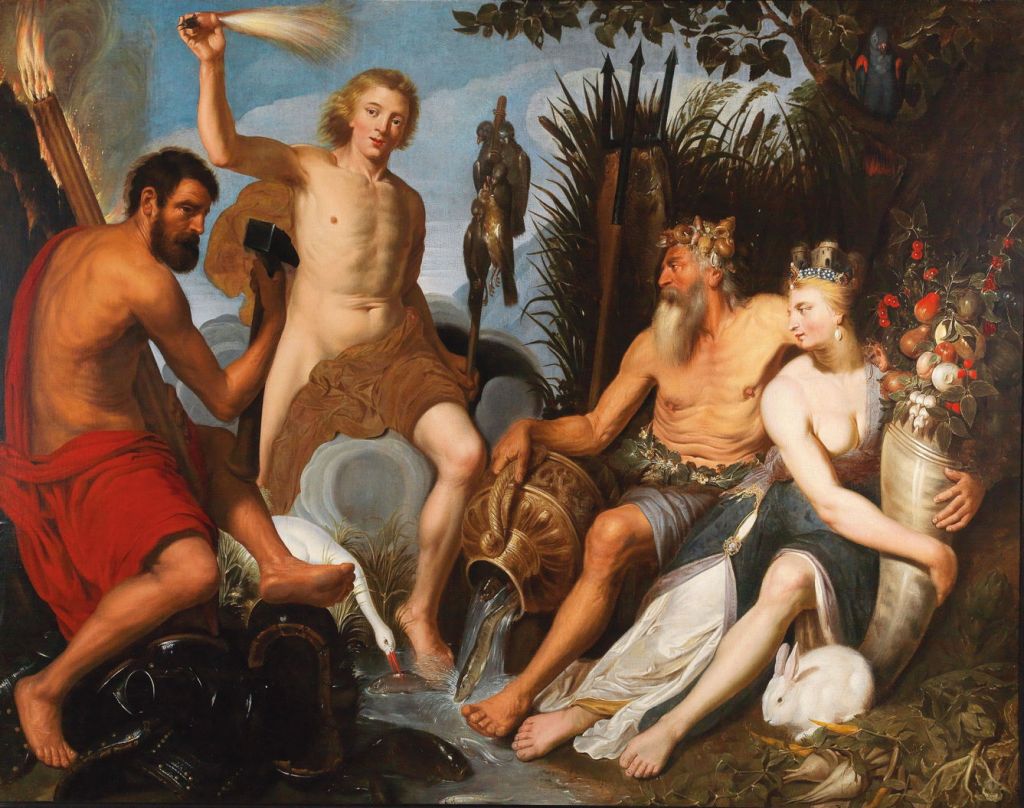
Artus Wolffort’s The Four Elements was probably painted between 1600-41, and attempts a similar composition. On the left is Vulcan, then a bird catcher who could be intended to be Apollo. On the right, a river god holding Neptune’s trident sits next to a goddess who is holding a cornucopia.
The cornucopia is often associated with the god Bacchus, as shown in Peter Paul Rubens’ late mythological masterpiece Minerva Protects Pax from Mars (Peace and War) from 1629-30.

Rubens’ painting is crowded with over a dozen figures drawn from classical myths. Until you have identified them and understood their roles and meaning, its story remains elusive. Its central figures are those of Ceres, here in the role of Pax, personification of peace, and Minerva behind her. In attendance are Mars, Hymen, Plutus, and Alecto, with sundry Bacchantes, a Satyr, putti, and the attributes of Bacchus and Mercury. It’s like an away day from Olympus, or part of an index to Ovid.
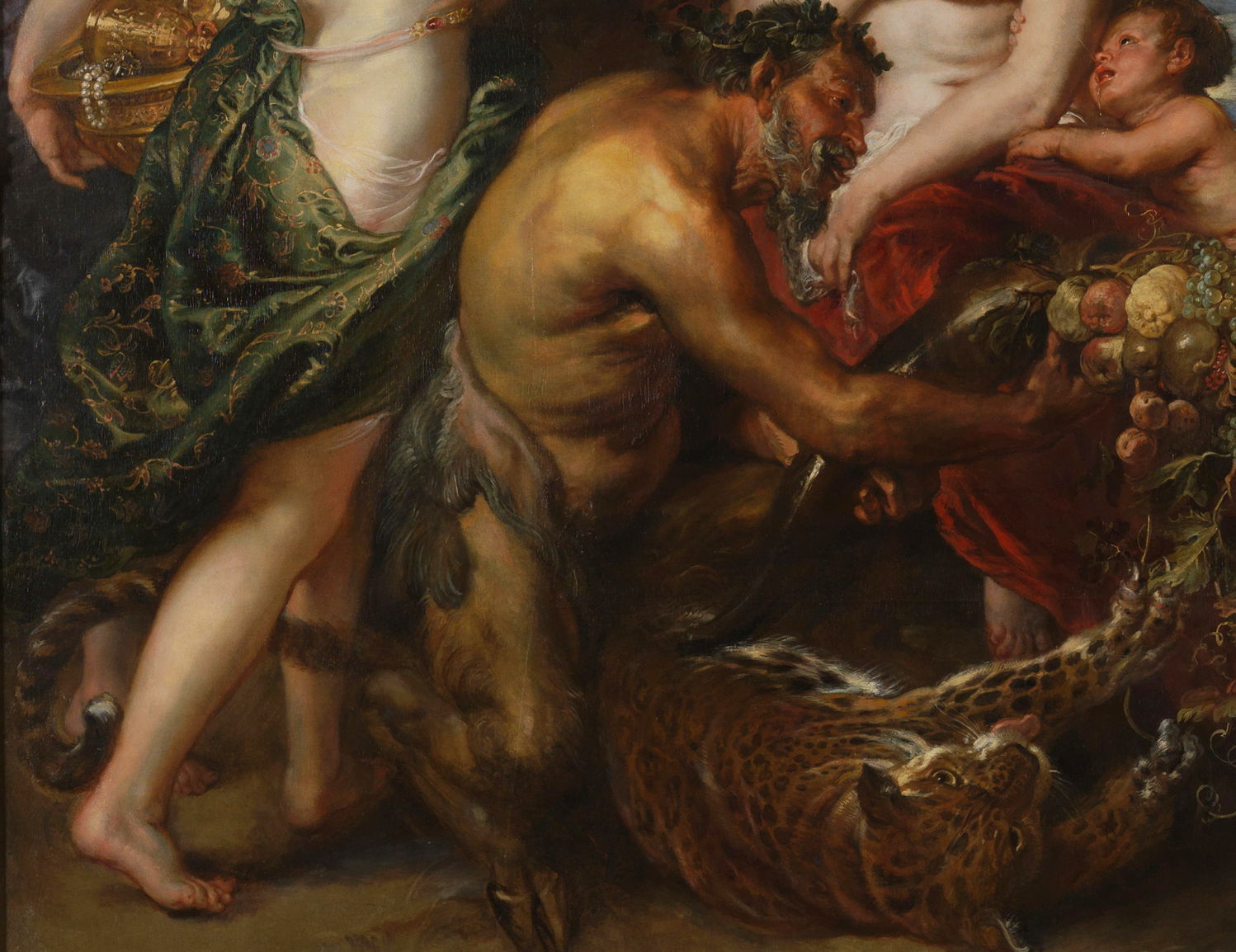
This group is associated with Bacchus. Although he isn’t present, his chariot is normally drawn by leopards or similar big cats, he’s accompanied by Bacchantes, and by a cornucopia.
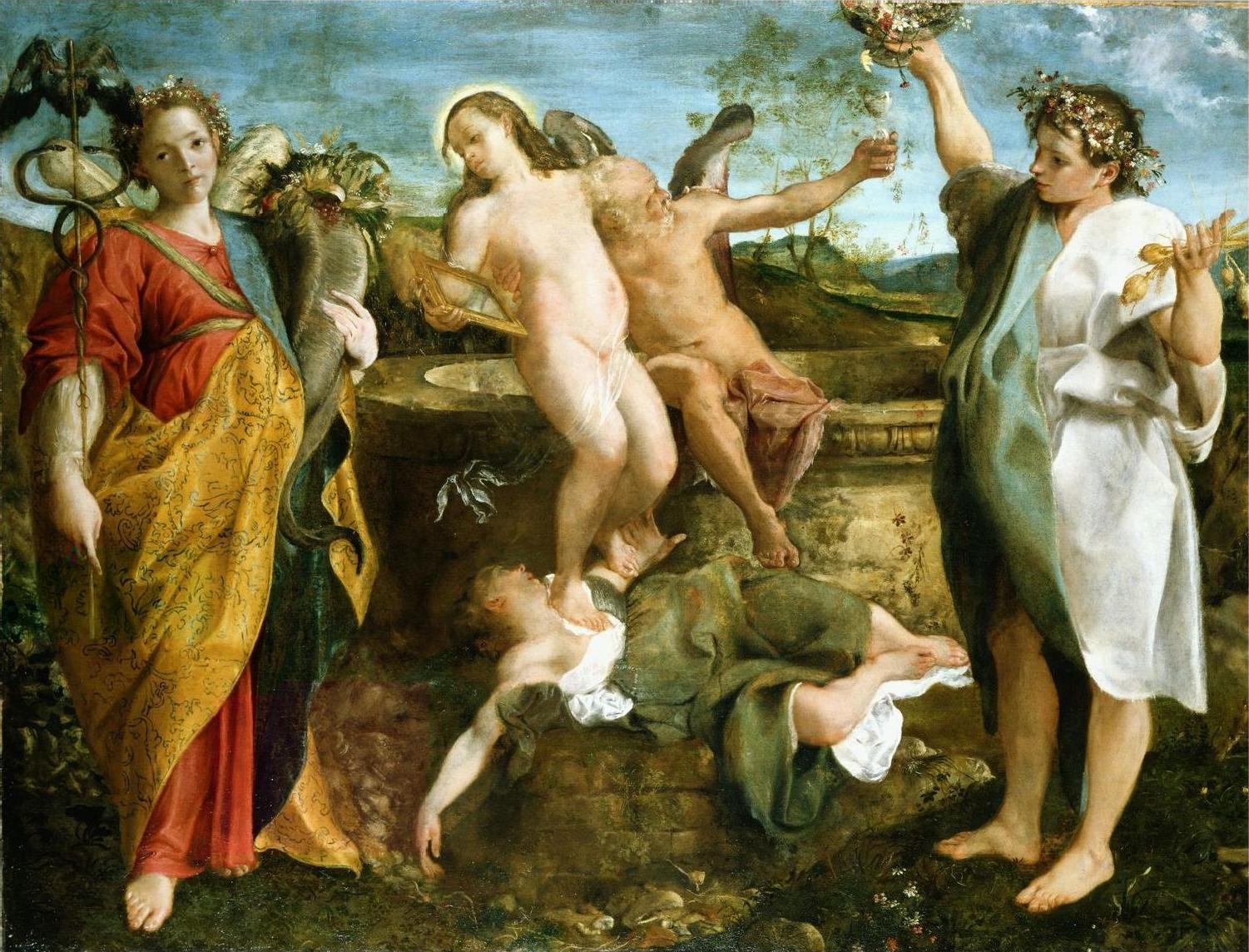
Annibale Carracci’s Allegory of Truth and Time from 1584 shows a winged Father Time without his usual scythe, putting his shoulder to Truth to raise her from a well, and she clutches a mirror in her right hand.
Trampled under the feet of Truth is the strangely chimeral two-faced figure of Deceit. The two figures framing the image are more controversial: the official identification gives them as Good Luck or Happiness on the left, and Happy Ending on the right. That on the left bears a winged caduceus and a cornucopia, an unusual combination probably alluding to good health as well as abundant food. That on the right is scattering Spring flowers, possibly relating to Flora.
 The Eclectic Light Company