

After telling of the tragic fate of Actaeon, grandson of Cadmus the founder of Thebes, Ovid describes the next disaster to strike the house of Thebes, in the bizarre myth of Cadmus’ daughter Semele. In his Metamorphoses, Ovid doesn’t detail how their relationship came about, but simply states that Semele became pregnant by Jupiter, with the implication that, for once, their relationship might even have been consensual.
Juno decided that she was going to deal with Semele in retribution, so disguised herself as Semele’s old nurse and sowed doubt in her mind about her lover’s true identity. The goddess advised Semele to ask Jupiter to reveal himself in his full divine glory, knowing how that would bring about Semele’s destruction.
When Semele put this to Jupiter, he realised that this would place his lover at grave risk: being the god of the sky and thunderstorms, she would almost certainly be killed by his thunderbolts. But she insisted, so he gathered his weakest thunderbolts and smallest storms, and revealed himself to her. Unfortunately she was immediately consumed in flames from Jupiter’s lightning, and died.

Bon Boullogne’s Semele, painted at the end of the seventeenth century, is one of the few paintings to give a close account of the climax. Semele lies on a bed beside a Roman herm (statue). Her left hand has been struck by a small thunderbolt and is already starting to burn. Above her, Jupiter is making off with a large infant while Juno, identified by her accompanying peacock, is in the distance, at the top right. The infant Bacchus is shown as being more than half the height of Semele, suggesting this might be multiplex narrative, where the upper scene with the gods takes place considerably later than the lower scene with Semele.
The next artist to attempt a painting of Ovid’s narrative was Gustave Moreau, about two centuries later.
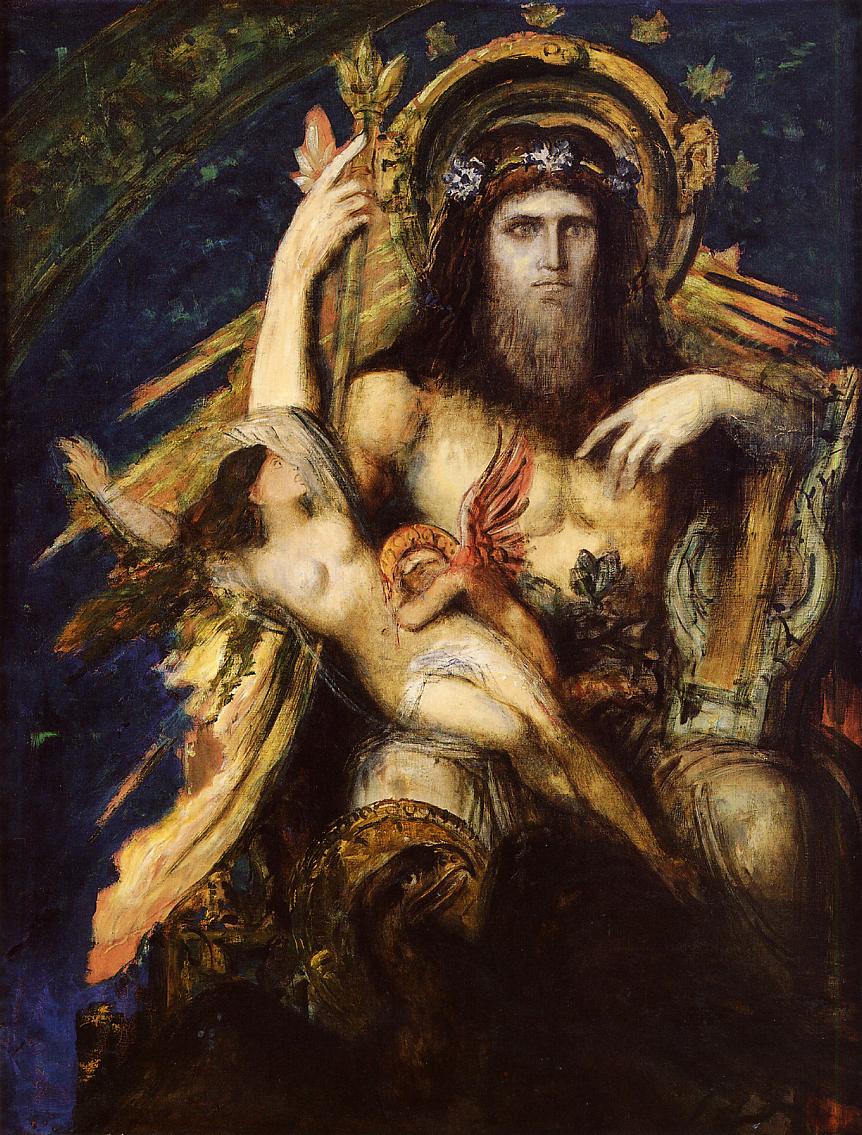
Moreau worked out the composition of the central section of his second and more ambitious painting in his earlier Jupiter and Semele, made during 1889-95. Semele has not yet been harmed by thunderbolts, but the foetal Bacchus appears to be resting against her, and Jupiter has assumed his divine form. At the foot of the painting is his eagle.
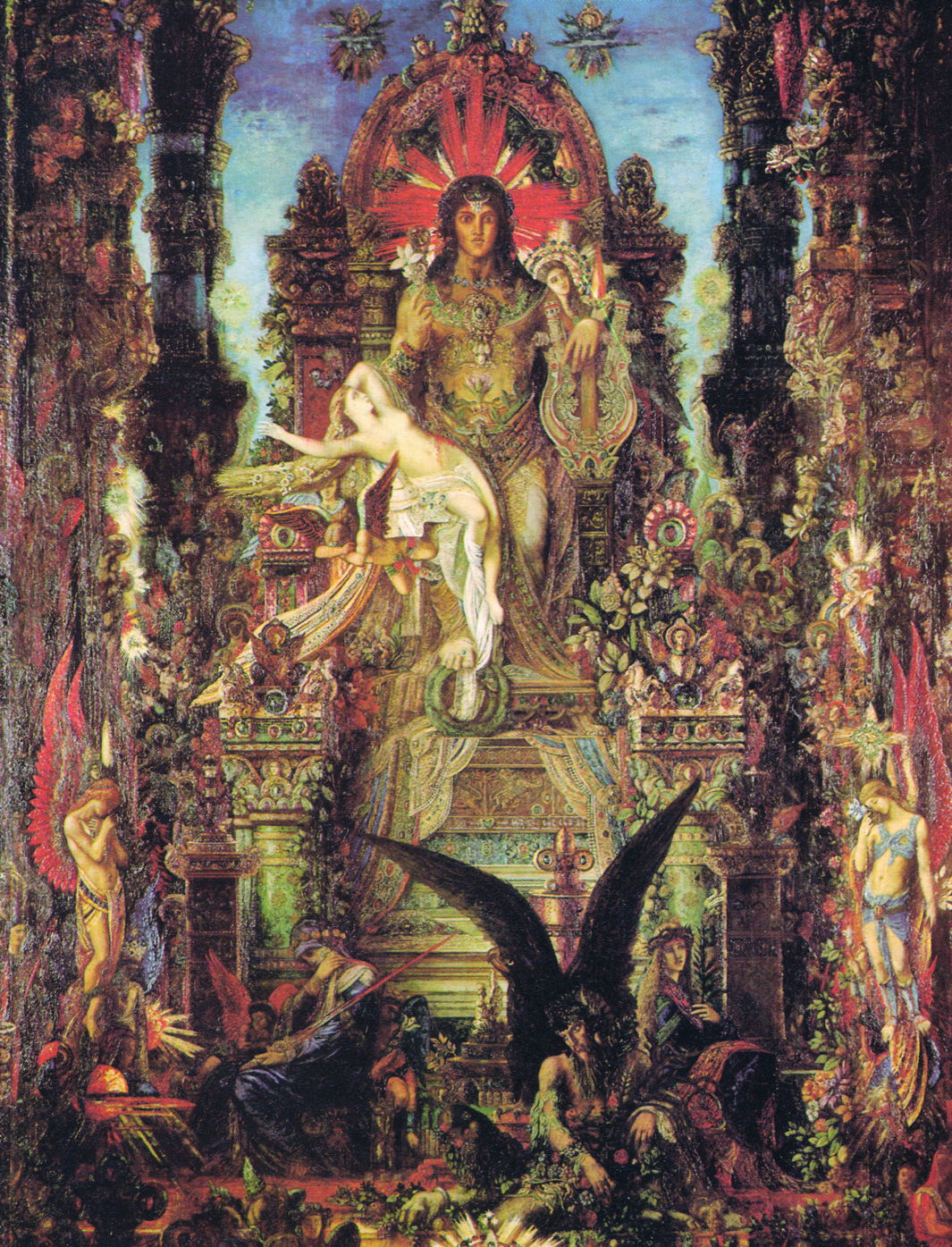
That composition then formed the centrepiece of his large finished painting, also titled Jupiter and Semele, from 1895. Jupiter now sits on a massive throne, with Semele draped over his right thigh. Surrounding the couple is one of the most iconographically rich canvases in the history of art, a dense confluence from many cultures across Europe, North Africa, the Middle East, even into India.

At its heart, Jupiter rests his left forearm on Apollo’s lyre. His right hand holds a lotus flower, and he looks straight ahead with his eyes wide open. Behind his left shoulder is the image of a female deity, perhaps Juno’s watchful and avenging eye.
Semele is statuesque, her arms cast back in shock. Her left side is covered in blood, presumably from where the foetus has been extracted, although in this painting no foetus is visible. Her hair flows off in a long, thick tress, decorated like a peacock’s feathers, reflecting her transient displacement of Juno from being Jupiter’s consort. She shows no signs of catching fire yet. Below her is a winged Cupid, its face buried in its forearms, grieving at Semele’s imminent doom.
Jupiter then seized Semele’s unborn baby, and continued the pregnancy by sewing that foetus into his thigh. When the baby was eventually born, he became the god Bacchus, who later rescued Semele from the underworld, and had her installed as a goddess on Mount Olympus.
One man scorned the gods and the blind oracle Tiresias: Pentheus, son of Echion, one of the founding Thebans born from the dragon’s teeth sown by Cadmus. Pentheus mocked Tiresias for his blindness, in return for which Tiresias warned him that he would be better off if he were blind. The seer then foretold that a new god, Bacchus, son of Semele, would soon arrive, and if Pentheus didn’t worship him, he would be torn apart, limb from limb, by his own mother and aunts.
Bacchus and his cult arrived as foretold. Although everyone else was immediately engaged in his celebration and worship, Pentheus poured scorn on the new god and those rites. Pentheus was highly critical, warning that the city of Thebes could fall to an unarmed boy while its citizens engaged in Bacchic festivities.
Pentheus ordered his men to bring him Bacchus, but they returned only with one of his followers. The captive was invited to tell his story before being put to death. Acoetes, as he called himself, described his upbringing, and career as a ship’s captain. On one journey, he put his ship in to Chios, where his crew found a young boy who seemed to be partly drunk and dazed. Against his better judgement, his crew brought the boy aboard his ship.
When the boy woke up properly, he asked to be taken to Naxos. Acoetes set course for the island, but the crew steered away from it. The ship then came to a grinding halt, in the middle of the Mediterranean, and ivy grew rapidly over the oars, sails, and rigging. The crew, apart from the captain, then leapt overboard, and were transformed into dolphins. The young Bacchus told Acoetes to sail on to Naxos, where the captain joined the god’s cult.
Pentheus then ordered Acoetes to be tortured to death, but while he awaited that fate, the doors of his cell suddenly flew open, his shackles fell away, and he escaped unharmed.
Pentheus decided to deal with this himself, and headed for Mount Cithaeron, where the Bacchic revels were taking place. He found the worshippers in a clearing on the wooded slopes. As he gazed at the forbidden sight of the ‘mysteries’, he was seen. His own mother, and her sisters, mistook him for a boar, and immediately attacked.
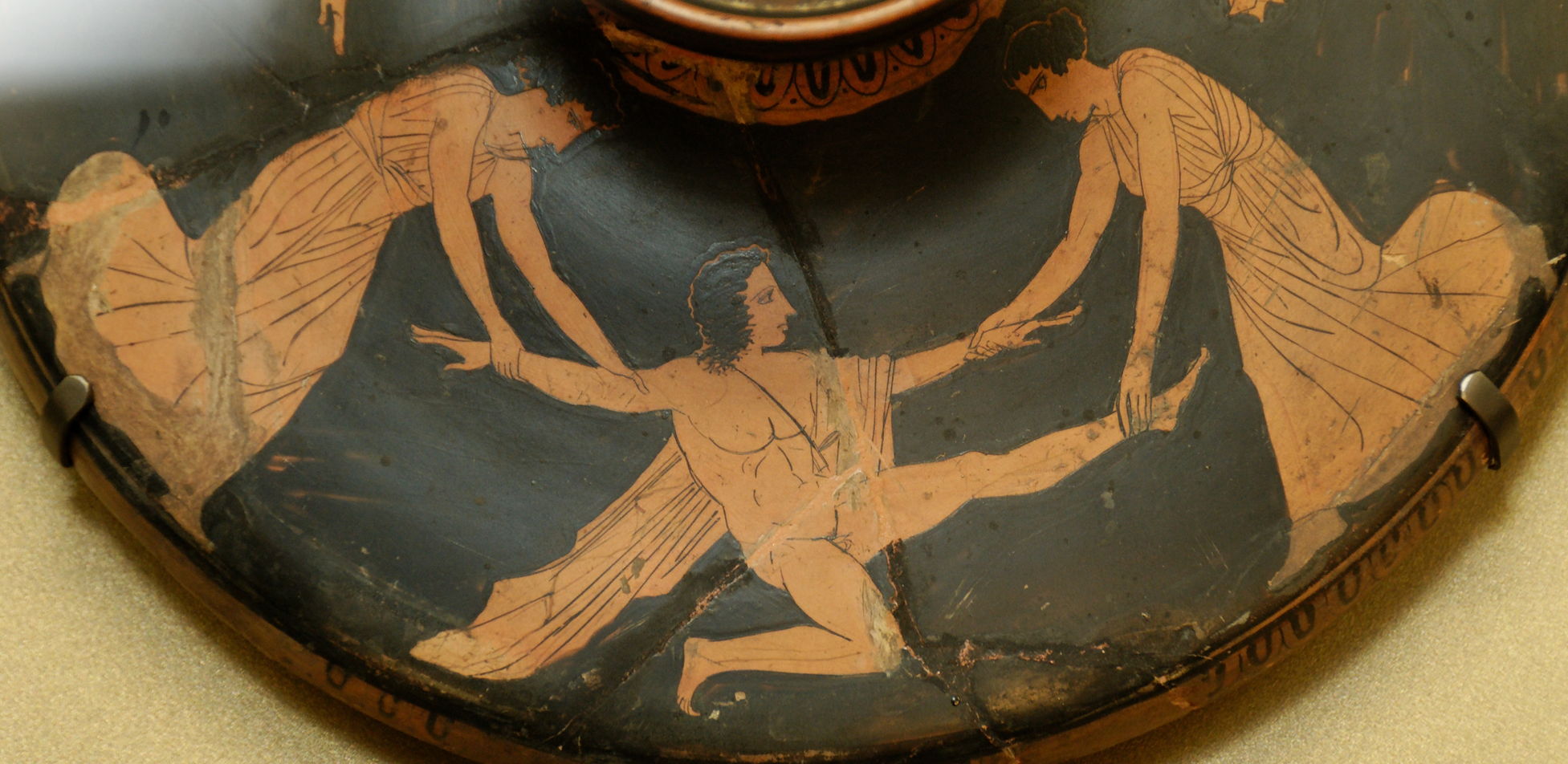
This Attic red-figure lid for a cosmetics bowl, from about 450-425 BCE, shows Pentheus about to be torn apart, limb from limb, by Agave and Ino, his mother and aunt.

This fresco found in the ruins of one of the houses in Pompeii shows a similar scene, here with his mother and an aunt preparing to rip his arms off, another woman behind him about to throw a large rock, and two others wielding their thyrsi like clubs.
Pentheus invoked the name of Actaeon in a desperate bid to stop the throng of bacchantes who attacked him, and tried to run away, but it was futile. His arms were torn off, then his head. Ovid ends the story with the lesson that the women of Thebes will honour Bacchus in those rites, and cannot be stopped.
There’s an interesting historical link, as during the history of Rome, the cult of Bacchus and its ‘mysteries’ were a source of concern to its government. Around 186 BCE (almost two centuries before Ovid’s prime), attempts were made to control or stop those practices. They don’t seem to have eliminated Bacchic cults or revels, but absorbed them better into society, perhaps the solution that Pentheus should have sought.
There are hundreds of paintings from the Renaissance onwards showing Bacchic revels and bacchantes with feasting, drinking, and free sexual activity. One of my favourite examples is Lovis Corinth’s Bacchanale (1896).

Although I’m not aware of any more recent painting of the death of Pentheus, there are at least two showing Orpheus suffering a similar fate.

Shown at the Salon in Paris in 1866, Émile Lévy’s Death of Orpheus catches the moment before the first wound is inflicted: Orpheus has just been knocked to the ground, and looks stunned. Two bacchantes kneel by his side, one clasping his neck, almost as if feeling for a carotid pulse, the other about to bring the vicious blade of her ceremonial sickle down to cleave his neck open.

Louis Bouquet’s more recent Death of Orpheus (1925-39) transports the scene to a beach, where the naked Bacchantes are almost unarmed and just starting to tear the body of Orpheus with their bare hands and teeth.
With the disposal of Athamas, Ino, and their children, the house of Cadmus, founder-king of Thebes, was finished.
Cadmus and his faithful wife Harmonia left the city and travelled until they eventually reached Illyria on the eastern side of the Adriatic Sea (roughly the former Yugoslavia), where they talked about happier times. Cadmus wondered whether the fearsome dragon that he had killed in order to found the city had in fact been sacred. He called on the gods to avenge its death, if that had been the case, by turning him into a snake.
Just before his upper body and head were transformed into the snake, and still with tears streaming down his cheeks, he embraced his wife one last time. As his transformation completed, and Harmonia found herself wrapped in his coils, she called on the gods to transform her too. And they did.

Evelyn De Morgan’s Cadmus and Harmonia was painted in 1877, after she had returned from a visit to Italy. What inspired her to paint this unique work is obscure, but it was exhibited with the following quotation from an English translation of Metamorphoses:
With lambent tongue he kissed her patient face,
Crept in her bosom as his dwelling place
Entwined her neck, and shared the loved embrace.
De Morgan was certainly very familiar with classical myths, which were a frequent source for her paintings. She was influenced by Edward Burne-Jones, taught by her uncle John Roddam Spencer Stanhope, and at the Slade by Sir Edward Poynter: all three had extensive knowledge of classical myths, and Poynter’s was deep to the point of being esoteric.
It has been suggested that Harmonia is here reminiscent of Botticelli’s Venus, a painting De Morgan knew well, as she had copied it when a student. She certainly doesn’t seem to have been influenced by any earlier image of the story, but her Harmonia isn’t the older woman that Ovid describes.
To the amazement of those around, the two snakes slithered off into a nearby wood. Having been good people, they were neither venomous nor did they bite. As a city, Thebes outlasted the house of Cadmus, to bring the tragedy of Oedipus, and was eventually destroyed by Alexander the Great.
 The Eclectic Light Company