
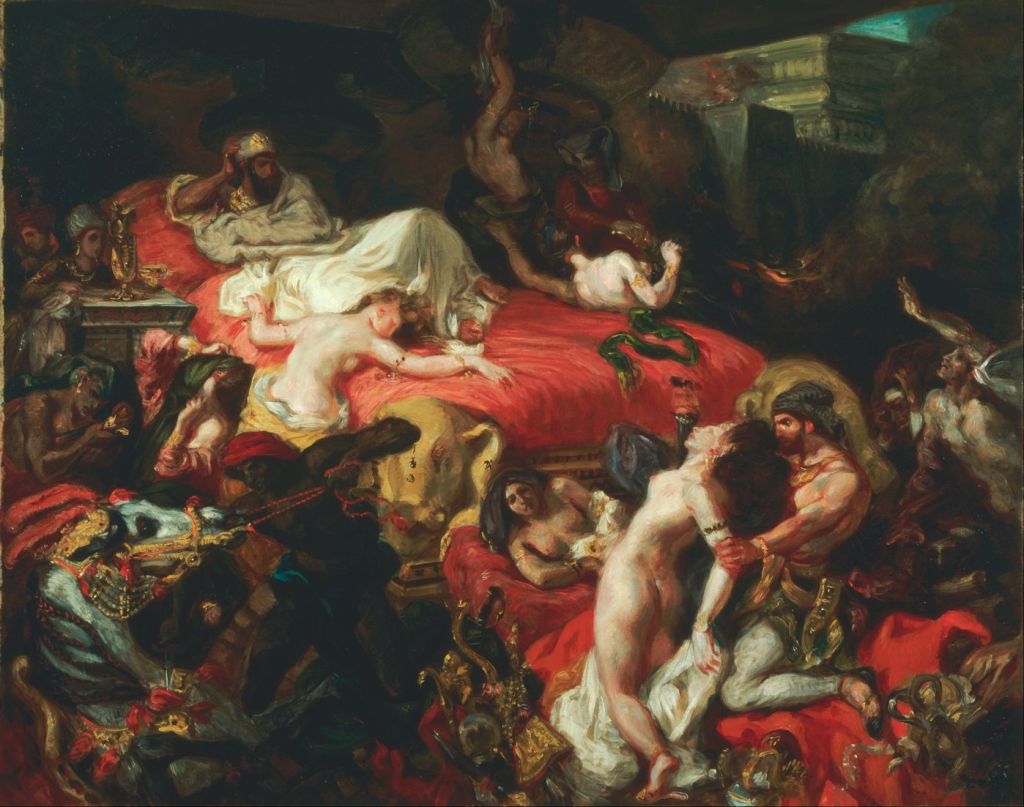
By 1824, Eugène Delacroix (1798–1863) had made his art known at two successive Salons, and thought he had secured himself the role of leader of the Romantic movement in France. The next Salon wasn’t due until 1827, giving him time to develop successors. Two in particular were sure to gain attention.
The first depicts the shocking end of one of the most colourful leaders of Venice, Marino Faliero, who was elected Doge in 1354. The following year he attempted to seize power from the ruling aristocratic elite. The plot was discovered early, and at the age of 81, Faliero pleaded guilty to all charges, and was beheaded. This was revisited by Lord Byron in his play Marino Faliero, Doge of Venice of 1821, which formed Delacroix’s literary source.
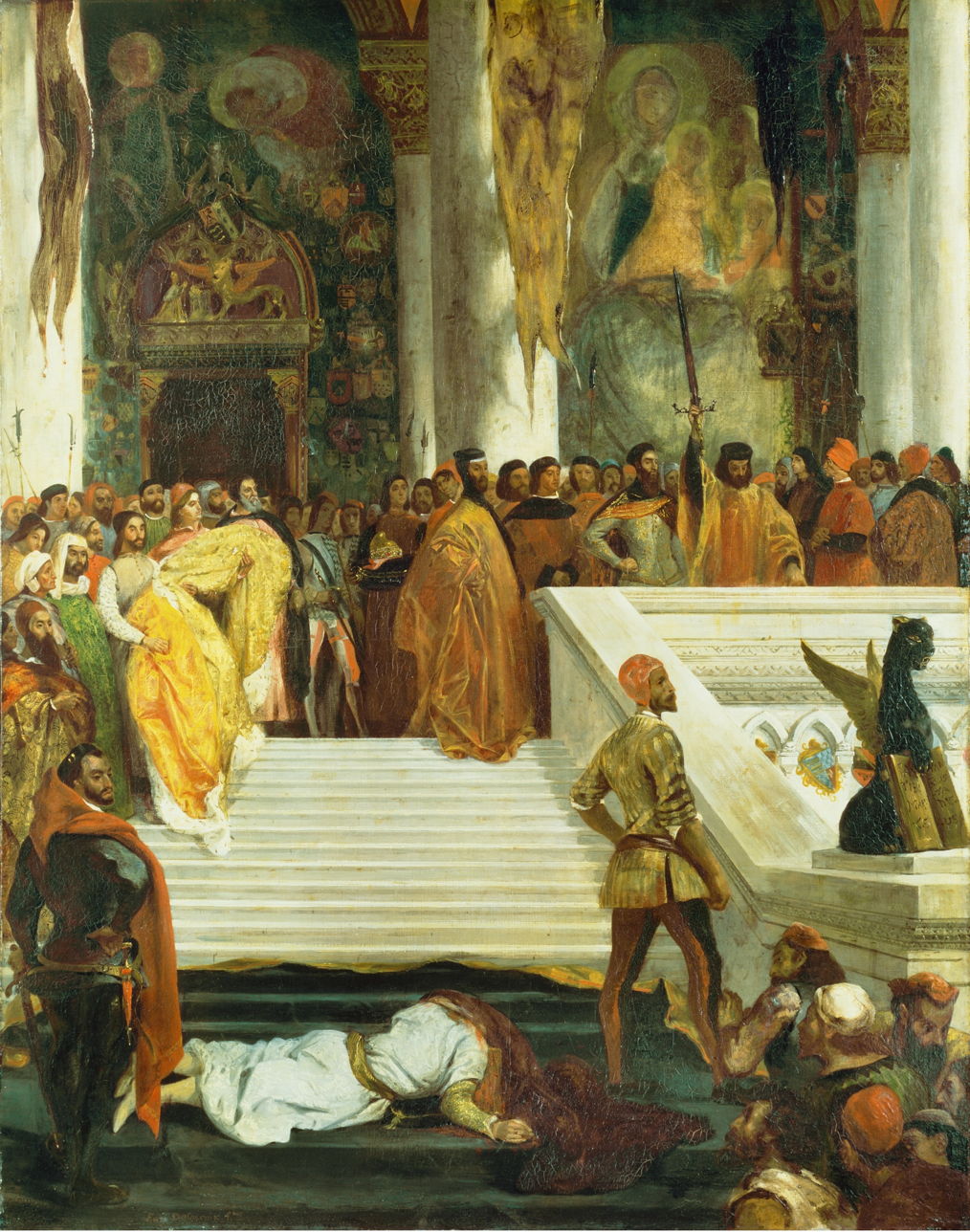
With Faliero’s corpse slumped over the lower steps, a member of the Council of Ten who condemned him to death stands at the top brandishing the huge sword still covered in blood. Although an unconventional theme and composition, it was well received, but failed to attract a buyer. The artist therefore withdrew it to send to the British Institute in London, where it got a warmer reception, but didn’t sell until 1856.
Delacroix’s centrepiece for that Salon was also drawn from the writings of Lord Byron, although this time the literary influence was more inspiration for the artist’s own imagination. In turn, Byron’s play relies on an account in the historical library of Diodorus Siculus, a Greek historian, and Mitford’s History of Greece.
In legend at least, Sardanapalus was the last of the great Assyrian monarchs, ruling a large empire from his palaces in Nineveh. However, a rebellion grew against him, and the story reaches its climax in the fifth and final act of Byron’s play.
At the time, the river Euphrates was in high flood, which had torn down part of the protective walls of the city of Nineveh. Once the river started to fall again, this left no defences against the rebels. Their leader offered to spare Sardanapalus his life if he would surrender, but he refused, asking for a cease-fire of an hour. During that period he had a funeral pyre built under his throne. He released his last faithful officer to flee for his life, and climbed the pyre. As he did so, his favourite wife Myrrha threw a lighted torch into the pyre, and climbed up after him, where they both burned to death.
As usual with these huge canvases, Delacroix worked his composition up with drawings and studies in pastel.

Here he has been working on a courtesan who has flung herself on the divan, at the feet of Sardanapalus, and a slave struggling with a horse.
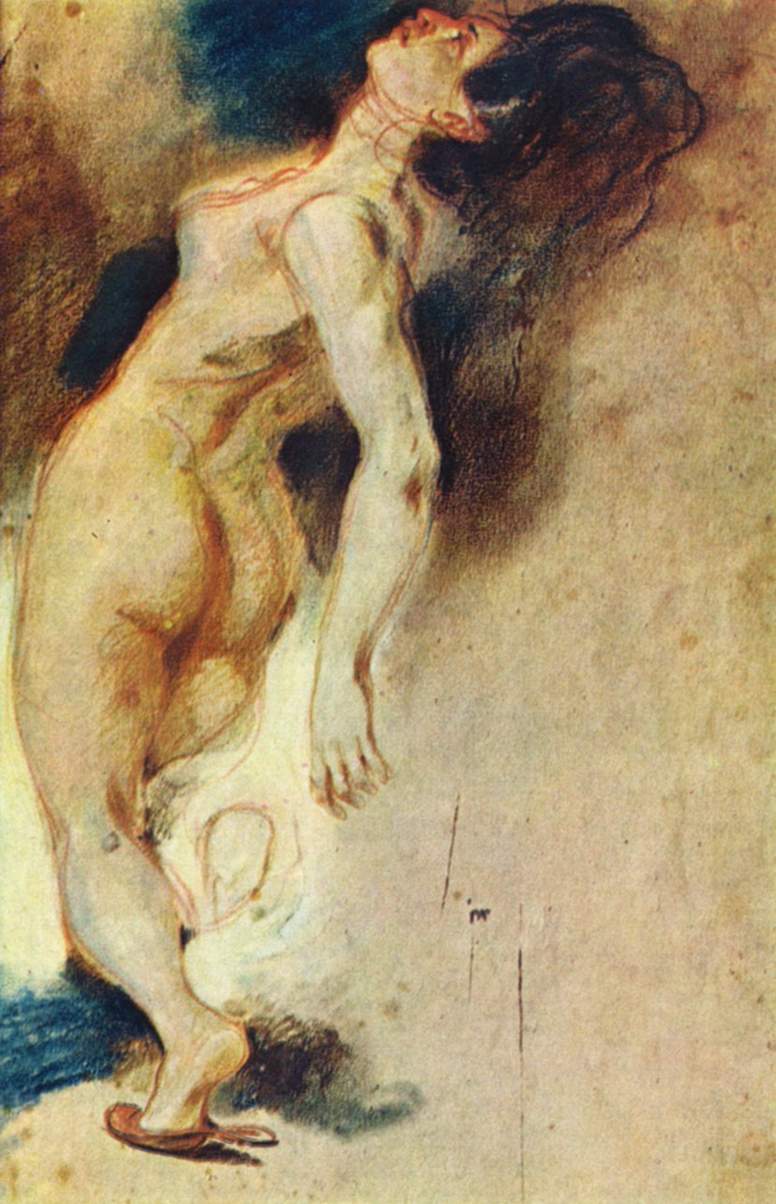
This is a study for a courtesan in the right foreground, who is just about to have her throat cut.
Delacroix painted two versions of this famous work: the huge original in 1827, now hanging in the Louvre, and a smaller more painterly replica in 1844, in the Philadelphia Museum of Art.

Delacroix departs considerably from that narrative to invite us to see Sardanapalus in a different light. In this, the original version, his brushwork is tight and the huge canvas intricately detailed.

When he painted the smaller replica seventeen years later, it wasn’t intended to please the Salon, and he was far more painterly in its facture; I use this version for detail views, as they show his brushstrokes.
Instead of showing Sardanapalus and Myrrha mounting the funeral pyre, Delacroix places the king on a huge divan, surrounded by the utter chaos and panic as his guards massacre wives and courtesans.
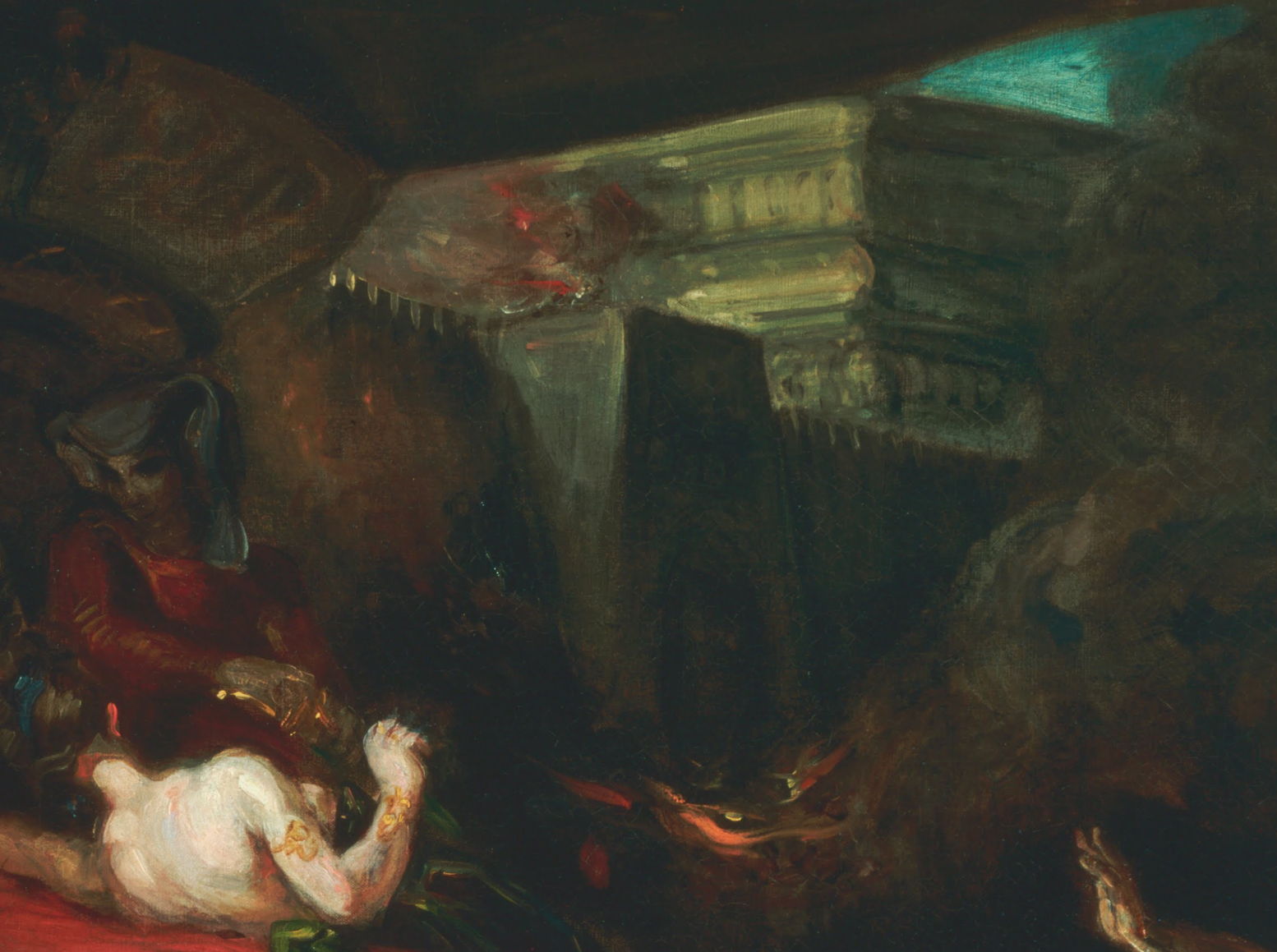
The strongest link to the original narrative is a gap opened up in the wall of the palace, showing the rebels outside, and sets the scene in the ancient city of Nineveh.

In the left foreground, a slave is struggling to bring Sardanapalus’ horse, with gold and jewels in its bridle and saddle, presumably so that it too will be killed.

But most prominent in the foreground is the horrific sight of one of his courtesans about to have her throat slit by a guard. Her face looks up to the heavens, her back is arched, forcing her body and legs into an arc, as she is tensed ready for slaughter.

With these scenes of carnage and destruction all around him, Sardanapalus rests, recumbent on his great divan. His face is mask-like, unmoved, and he stares coldly into the distance, his head propped by his right hand.
Delacroix’s critics were merciless, and no aspect of the painting survived unscathed. Even those who had previously supported his Salon paintings found reasons to disavow him. Its composition of small groups arranged about its central diagonal, its brilliant colours dominated by the red of the king’s divan, its overall effect, all were torn apart by its provocation. Underlying them all was the message that Sardanapalus had gone too far, perhaps most of all by the king’s total disinterest in the slaughter taking place around him.
Delacroix was summoned to the Minister of Fine Arts and warned to change the manner of his painting, or he would lose State commissions.
References
Barthélémy Jobert (2018) Delacroix, new and expanded edn, Princeton UP. ISBN 978 0 691 18236 0.
Patrick Noon and Christopher Riopelle (2015) Delacroix and the Rise of Modern Art, National Gallery and Yale UP. ISBN 978 1 857 09575 3.
Lucy Norton (translator) (1995) The Journal of Eugène Delacroix, 3rd edn, Phaedon. ISBN 978 0 7148 3359 0.
Arlette Sérullaz (2004) Delacroix, Louvre Drawing Gallery, 5 Continents. ISBN 978 8 874 39105 9.
Beth S Wright (editor) (2001) The Cambridge Companion to Delacroix, Cambridge UP. ISBN 978 0 521 65077 1.
 The Eclectic Light Company