
Easter Sunday is, in the Christian tradition, the day on which the Resurrection of Jesus is celebrated. This is the other, and in many ways more important, part of Easter, but has been far less extensively painted. This year I concentrate on what in several accounts is the first appearance of Jesus, to Mary Magdalene, or her and the “other Mary”, in the Gospel of Matthew 28:9-10 or John 20:11-18. The latter in particular has given rise to a common theme in Christian religious art, known by the Latin words from the Vulgate of noli me tangere.
The account given is that Mary Magdalene saw two angels sitting in the empty tomb. She was then approached by the resurrected Jesus, whom she initially mistook for a gardener. When she recognised him, he responded with ‘Don’t touch me, for I have not yet ascended to my Father’, and it’s those opening words that are the title of the many paintings of this theme.

This painting of Noli me tangere from around 1368-70 has been attributed to Jacopo di Cione, and shows Mary Magdalene kneeling with her hands outstretched towards the resurrected Christ. He is carrying an adze, most probably a reference to her mistaking him as a gardener.

In the right panel of Rogier van der Weyden’s Miraflores Altar from about 1440, the risen Christ, still bearing his stigmata, is accompanied by a background scene showing the Resurrection, with three sleepy soldiers, Christ standing beside his empty tomb, and a winged angel. In the distance are all three Marys.

In her Jesus Appears to Mary Magdalene from 1581, Lavinia Fontana re-locates the ‘noli me tangere’ encounter between Mary and Jesus, giving him the garb of a mediaeval Italian gardener. There’s no mistaking Mary here, as she’s holding her attribute of a small urn of myrrh in her left hand.

The eccentric Alessandro Magnasco has painted his Noli Me Tangere from 1705-10 over a background of ruins made by his collaborator. Christ is shown standing, holding a long-hafted implement, probably a spade, in his left hand. Mary is on her knees, a small urn of myrrh in front of her. Their clothes are rough, and Christ’s appear to be his burial linen, blowing in the wind. Several small putti are shown on the left side, apparently blowing as winds.

During Goya’s training and for much of the early part of his career, the dominant force in Spanish painting was the German painter Anton Raphael Mengs (1728–1779), who spent much of his career in Rome. Mengs’ Noli me tangere from 1769 is one of a cycle of four paintings on the Passion of Christ which Carlos III commissioned for his bedroom. Once again, Mary’s myrrh is confirmatory.

William Holman Hunt’s Christ and the Two Marys is a very early Pre-Raphaelite painting from 1847, the year before the formation of the Brethren, and a time when religious themes were popular among them. The two Marys are Mary Magdalene, accompanied by a large jar of myrrh, and “the other” Mary, while Jesus has cast off the bandages his body was wrapped in for burial, making his stigmata plainly visible.

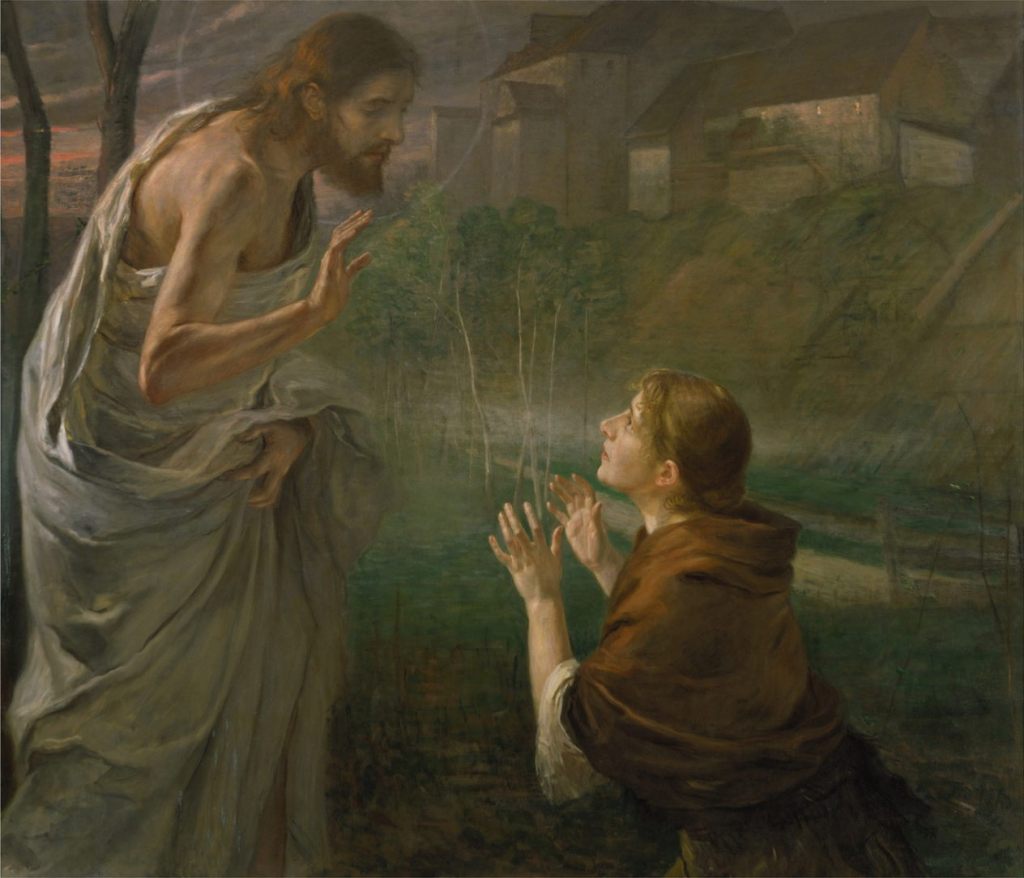
Several impossible legends grew about Mary Magdalene; here Albert Edelfelt’s Christ and Mary Magdalene, a Finnish Legend (1890) dresses her in contemporary clothing, and transports them to the lakes and forests of Finland, where the first pale leaves of Spring are on the trees.

Fritz von Uhde has a similarly modern approach in Touch me not. John 20:17 from 1894, this time outside a small town in Germany.
There’s a rich and varied tradition of celebrations held on Easter Sunday in churches to mark the Resurrection. I close with one of their most wonderful and poignant depictions, by the Ukrainian artist Mykola Pymonenko.

Waiting for the Blessing (1891) shows the scene at a country church at dawn on Easter Sunday. The local population is crowding inside, while the women gather with their Paska, traditional ornamental bread that must be blessed before it can be eaten as a brunch.
May all our Easters be peaceful, wherever we might be!
 The Eclectic Light Company