

In the middle of the night following the crusaders’ first major assault on the city of Jerusalem, Clorinda had burned their siege towers down. Tancred then mortally wounded her in a fight before realising who she was, but baptised her just before she died in his arms.
The wounded Tancred feels disgust at his killing of Clorinda, and the pair are carried back to his tent. In spite of his injuries, he makes his farewell to her corpse. She later appears to him in a dream and his emotions are reconciled following her burial.
Canto thirteen returns to the siege, and the crusaders’ need to replace their wooden towers. Ismen visits the ancient wood that’s the closest source of timber, and casts a spell to prevent any more of its trees from being felled. He then reassures Aladine that he is safe, particularly as he forecasts the weather is set to turn very hot and dry, and advises Aladine he should sit tight in the city rather than try to force an end to the siege as Argante wants.
Godfrey wants to rebuild his siege towers quickly, before the defenders of Jerusalem have had time to repair the damage to the city’s defences. He dispatches men to the woods to cut down the timber required for the new towers, but they’re now repelled by the bewitched trees. Godfrey sends troops on three successive days, but each time they’re driven out by the dire effects of Ismen’s spell.
Finally, Tancred, recovered from his wounds, plucks up courage and enters the enchanted wood. He feels no ill-effects, and makes his way to its centre, where there’s a cryptic inscription written on an ancient tree. The trees then speak to him, claiming to be the spirit of Clorinda and others, warning him not to try cutting any of them down. Tancred reports this to Godfrey, who turns to other plans.
As Ismen had forecast, the weather becomes unrelentingly hot and dry. Even the nights remain hot, and crusaders are dying as a result. The nearby stream of Siloa, which had been a major supply of water, dries up, and there are deaths from dehydration. Morale collapses, with many of the crusaders questioning Godfrey’s inaction. The remaining Greeks desert and start their journey home. Godfrey prays for divine assistance and succeeds with a torrential rainstorm and the return to more comfortable conditions at last.
Canto fourteen opens with nightfall, when at last the cooler conditions enable everyone to sleep properly again. Godfrey has a vision in which he is told to recall Rinaldo from his self-imposed exile, and to absolve him from his error. No sooner does Godfrey awake the following morning than Guelph asks him for Rinaldo’s pardon, in the hope that the knight will be brave enough to overcome Ismen’s spell and cut wood to build their siege towers.
Godfrey agrees, leaving Guelph and a team of volunteers to locate and recover the missing knight. As the group are discussing where to look, Peter the Hermit interrupts and advises them to travel to Ascalon, and to ask the man they meet there.
When they reach Ascalon, a wizard with a white beard, beech crown and wand tells them to follow him as their guide. He takes them into hidden caves beneath a stream, where they see the sources of the great rivers of the world, set in a huge cavern whose walls are speckled with jewels. The wizard tells them this is the womb of the earth. He then reveals what happened to Rinaldo after he had freed the other knights who had been made captive by Armida, and how Rinaldo’s armour came to be made to look as if the knight had been killed.
Armida had been waiting for Rinaldo at the ford on the river Orontes. When he arrived, he found a column with an inscription that enticed him to go further, leaving his esquires behind as he boarded a boat. He then came to an island that appeared deserted, so decided to rest there, and put his helmet down beside him.
A little later, he heard a sound from the river, and spied a beautiful woman emerging naked from the water. She sang a song that lulled Rinaldo to sleep, then came over intending to kill him. But when she saw him breathing gently in his sleep, her anger melted away and she fell in love with him instead. She then put garlands of flowers around his neck, arms and feet that she had bewitched to act as bonds, had him lifted into her chariot, and abducted him.
This remarkable turn of events has been a favourite among painters, and a particular challenge to depict in a single image. As a classical example of what Aristotle in his Poetics refers to as peripeteia, it has led to some superb narrative paintings.
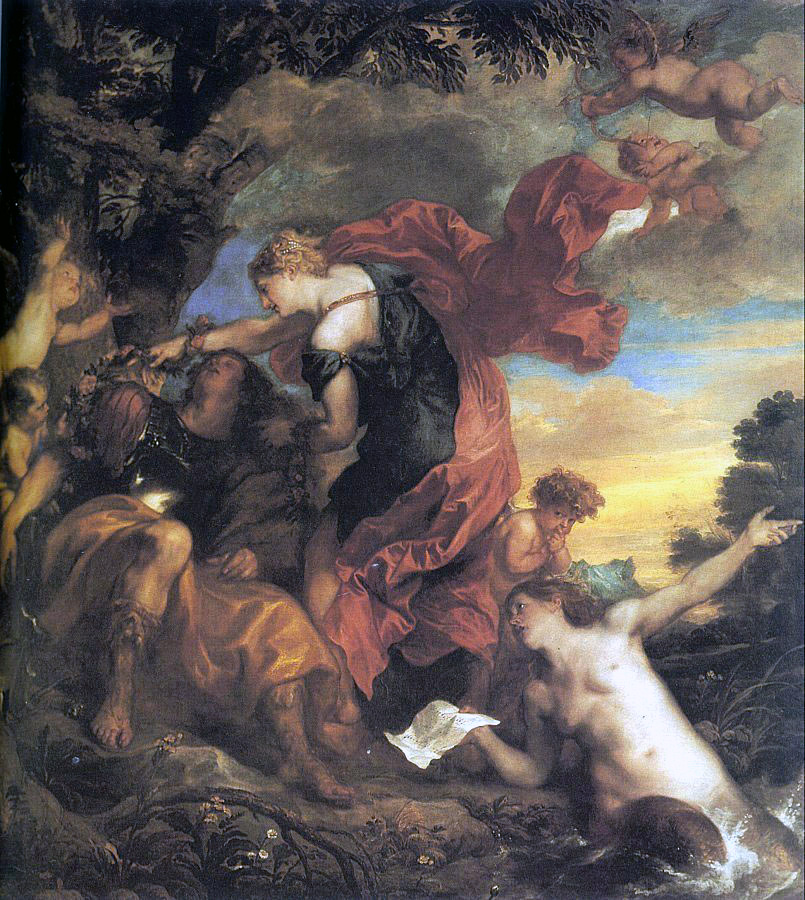
In Anthony van Dyck’s Rinaldo and Armida of 1629, the key elements of the couple and attendant symbolic amorino are enriched by a second woman with non-human legs still immersed in the river and clutching a sheet of paper, and additional amorini. Armida appears unarmed but starting to bind him with garlands, and it’s possible the letter represents her commission to murder him, which the woman in the water, perhaps a nymph, is reminding her about.

The most brilliant account to date is Nicolas Poussin’s justly famous Rinaldo and Armida from about 1630.
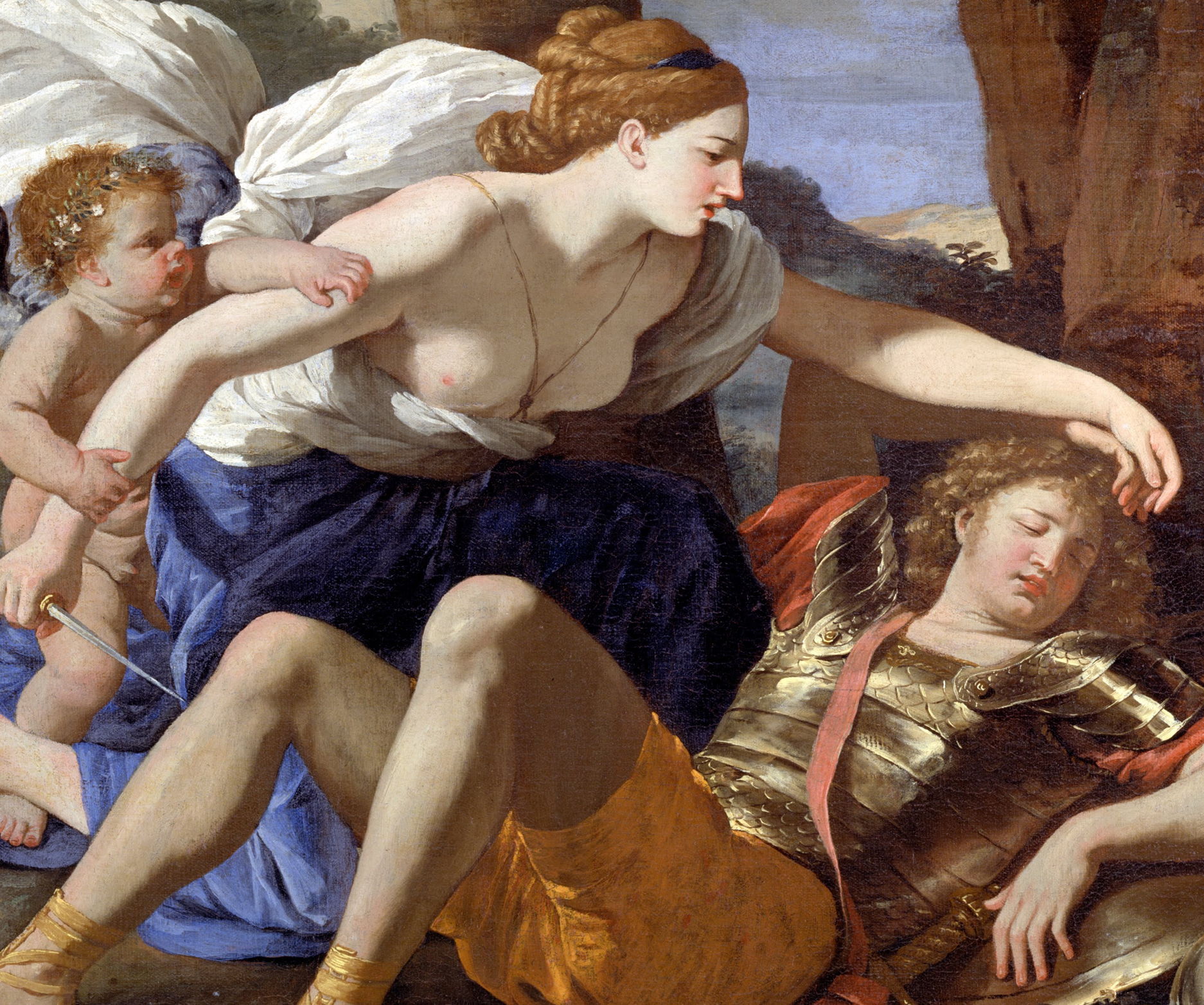
There are two distinctive elements within Poussin’s depiction, Armida’s facial expression, and her posture, particularly the conflict between her arms. Armida’s expression is key to understanding the narrative, as she is perplexed, in a quandary, unsure whether to kill or kiss the young knight. Armida’s right hand represents her original intent, to murder him with her dagger, an action the amorino is trying to stop. Her left hand, though, reaches down to touch his hand in a loving caress. Poussin manages to tell us what she had intended to do in the immediate past, and what she is going to do next in the future: three moments in time conveyed in a single image.
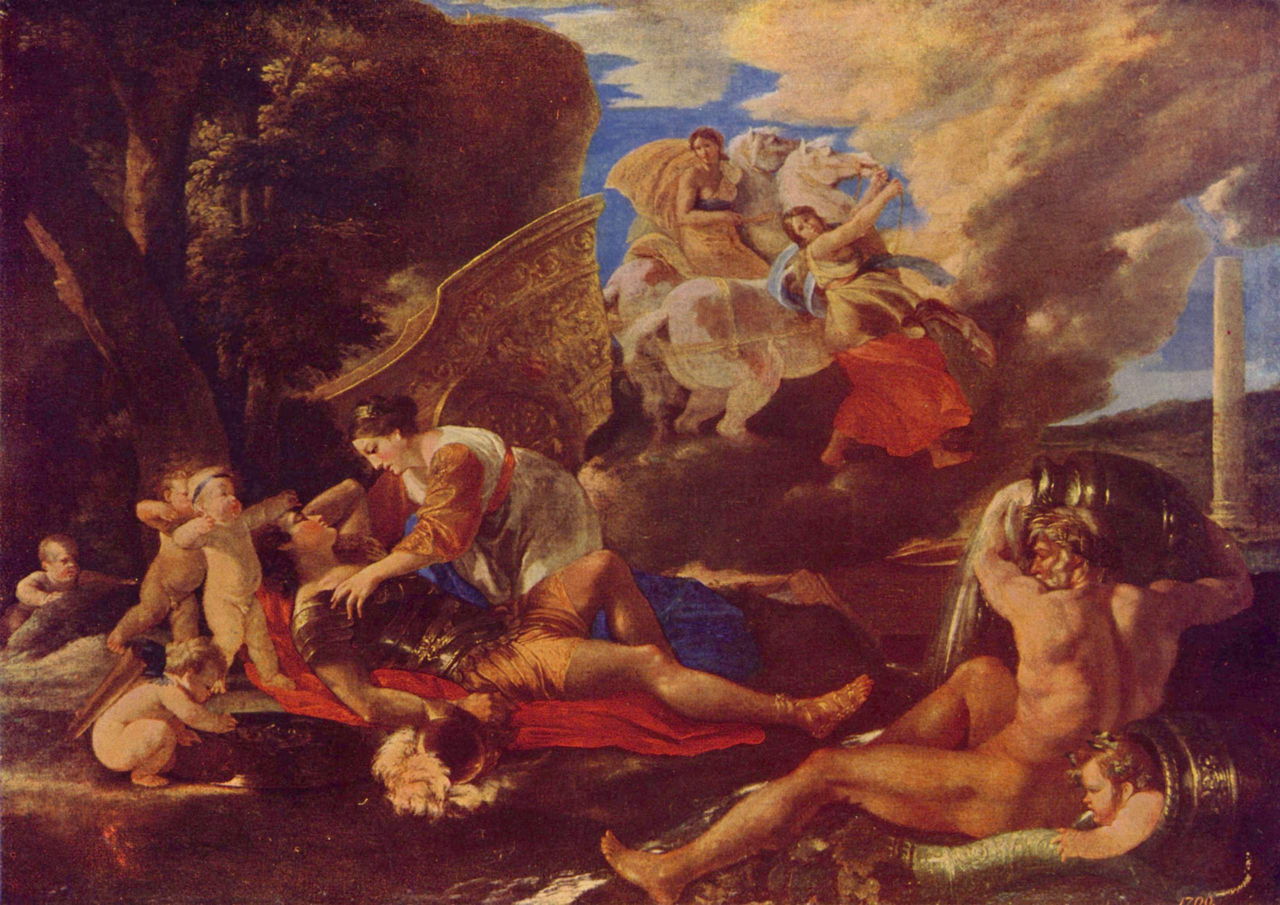
Poussin’s Rinaldo and Armida (c 1635) is a later and more explicit version of this same episode, in which Armida is falling in love with Rinaldo. There are many amorini who seem less engaged in the action. A river-god pours his river from a pitcher. In the background, Armida’s chariot is already prepared for the abduction of Rinaldo.
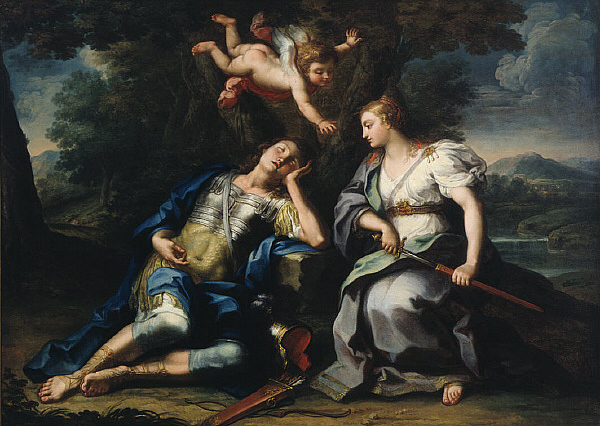
Sebastiano Conca’s Rinaldo and Armida from about 1725 is a return to simpler composition, based on a central triangle, and content. Armida is drawing her sword, and looking pensive, as the sole amorino reaches from above to intervene.
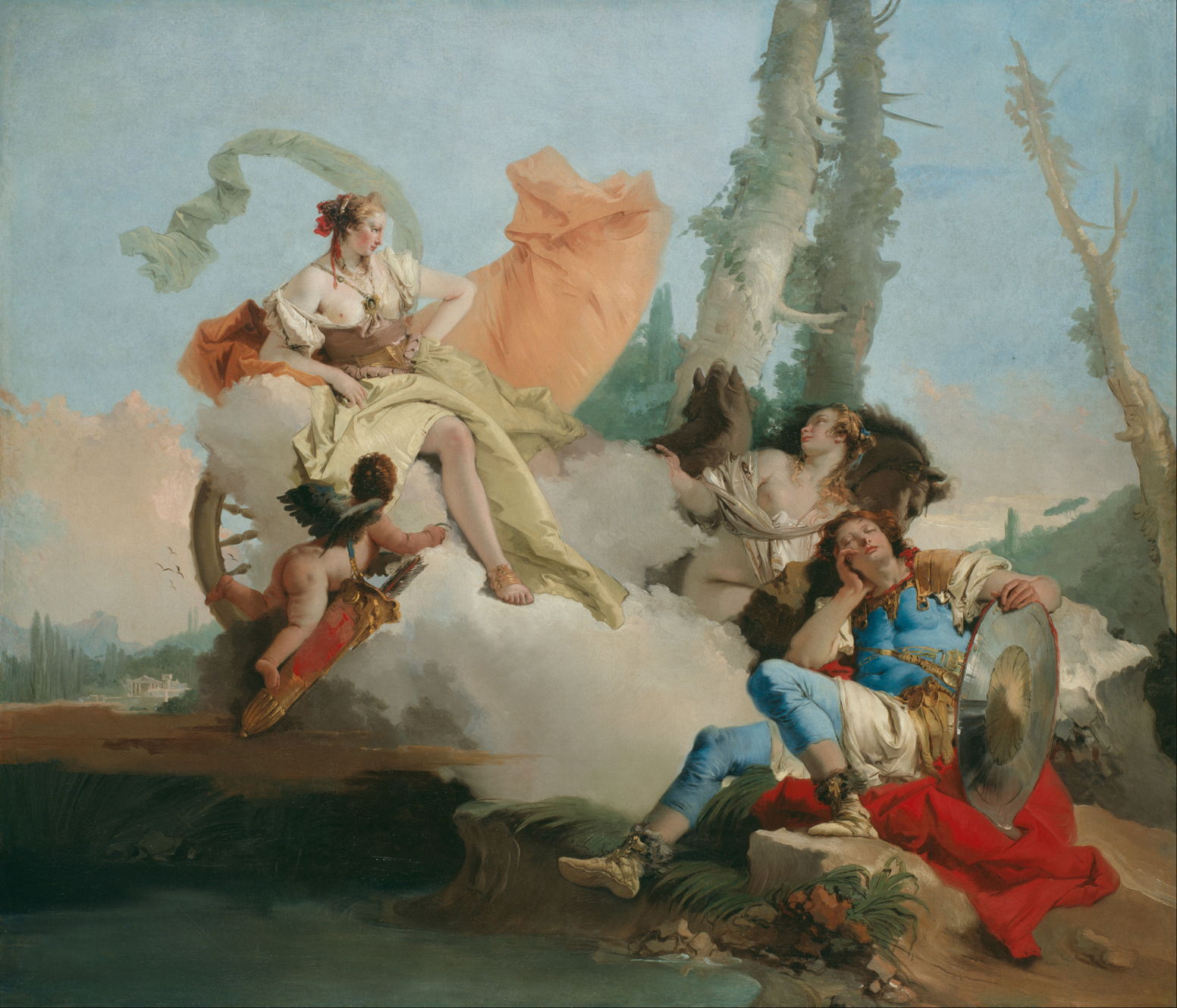
Tiepolo’s Rinaldo Enchanted by Armida (1742-45) is another permutation of the elements in Tasso’s story. Armida has already brought her enchanted flying chariot, in which there is another woman, perhaps Venus herself, with an accompanying amorino. Armida is almost undressed and unarmed, and her facial expression is more of unhappy pleading than internal conflict, while her female companion appears cold and unaffected.

Fragonard’s Rinaldo and Armida from 1760-65 is another elaborate painting with an abundance of amorini. Armida’s right hand clutches a dagger, and is restrained by two of the amorini, although it’s hard to determine her facial expression.
With Guelph’s party searching for Rinaldo, Armida now whisks him away in her chariot, still fast asleep, and unaware of what’s in store for him.
References
Wikipedia on Jerusalem Delivered.
Wikipedia on Torquato Tasso.
Project Gutenberg (free) English translation (Fairfax 1600).
Librivox audiobook of the Fairfax (1600) English translation (free).
Thomas Asbridge (2004) The First Crusade, A New History, Free Press, ISBN 978 0 7432 2084 2.
Anthony M Esolen, translator (2000) Torquato Tasso, Jerusalem Delivered, Gerusalemme Liberata, Johns Hopkins UP. ISBN 978 0 801 863233. A superb modern translation into English verse.
John France (1994) Victory in the East, a Military History of the First Crusade, Cambridge UP. ISBN 978 0 521 589871.
Joanthan Riley-Smith, ed (1995) The Oxford Illustrated History of the Crusades, Oxford UP. ISBN 978 0 192 854285.
Jonathan Riley-Smith (2014) The Crusades, A History, 3rd edn., Bloomsbury. ISBN 978 1 4725 1351 9.
Johathan Unglaub (2006) Poussin and the Poetics of Painting, Pictorial Narrative and the Legacy of Tasso, Cambridge UP. ISBN 978 0 521 833677.
 The Eclectic Light Company