
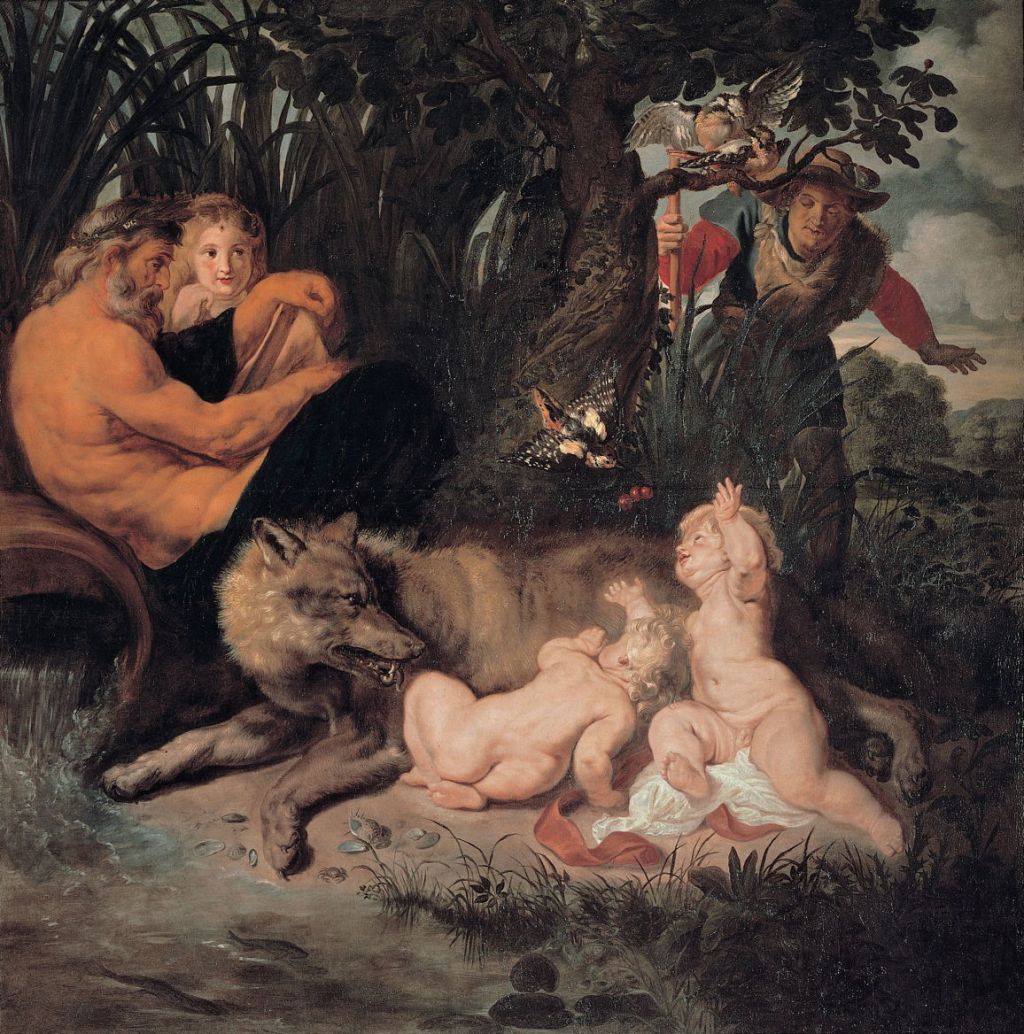
There are precious few paintings featuring European woodpeckers, but those few come with unusual stories. Of the three species that are common across the continent, it’s most likely that these refer to what’s now known as the great spotted woodpecker, responsible for the distinctive sound it makes when pecking the trunk of a tree.

When he was in Britain, the great American bird artist John James Audubon painted this fine example of a Great Spotted Woodpecker (Dendrocopos major).
The woodpecker has earned itself a place in ancient Roman legend, as one of the two guardians of the infant Romulus and Remus. They were abandoned shortly after birth, put in a trough to float down the River Tiber to their deaths. When the trough was washed up on a bank, they were adopted and fed by a she-wolf, while the woodpecker kept a close watch over the babies, until they were discovered by the swineherd Faustulus. And the rest is legendary Roman history. For its role in saving the co-founders of Rome, the woodpecker was later considered to be sacred to the god Mars.

One of the frescoes in the Palazzo Magnani, probably painted by Ludovico Carracci and/or Annibale Carracci, shows the She-Wolf Suckling Romulus and Remus (1589-92). The twins are still inside the trough in which they had survived their trip down the river, and on the opposite bank a woodpecker is keeping a close watch. At the far right, a now rather diaphanous figure may be Faustulus, one of Amulius’ swineherds who discovered the twins, and took them to his wife.

Peter Paul Rubens shows Romulus and Remus being discovered by Faustulus in this painting of 1615-16. Not only is the she-wolf taking care of the twins, but a whole family of woodpeckers are bringing worms and grubs to feed them, and there are empty shells and a small crab on the small beach as additional tasty tidbits.
Several mythical figures seem to have been transformed into woodpeckers for various reasons. The sorceress Circe was also claimed to have turned at least one of her lovers into a woodpecker, a story celebrated by Dosso Dossi.

Dossi’s Circe and her Lovers in a Landscape (c 1514-16) is a remarkably early and realistic mythological landscape, with deep rustic lanes, trees, and a distant farmhouse. Circe leans, naked, at the foot of a tree as she goes through spells on a large tablet, with a book of magic open at her feet. Around her are some of the men who she took a fancy to and transformed into wild creatures. There’s a spoonbill, a small deer, a couple of dogs, a stag, and up in the trees an owl, and a woodpecker in the upper right corner.

There’s still dispute as to whether this painting of Dossi’s shows Circe again, or the sorceress Melissa from the epic Orlando Furioso. Painted in about 1518-1531, this sorceress sits inside a magic circle, around which are inscribed cabalistic words. In the upper left corner are small homunculi apparently growing on a tree. On the left is a large dog, and perched on top of a suit of armour is another woodpecker.
Finally, the great spotted woodpecker is one of the birds that can be identified in Hieronymus Bosch’s fantastic menageries.

The right panel of Bosch’s Temptation of Saint Anthony, now in Lisbon, shows Saint Anthony seated, with a book open in front of him. He is again surrounded by strange figures and creatures from a vision of temptation. The background shows a prominent windmill and towers, behind which is a wintry landscape with snow on the ground.
Deeper into the painting, behind and to the left of the saint, is a group of figures, daemons, and objects, clustered around the hollow trunk of a dead tree. Inside the hollow, a naked woman peers out. The tree is draped with a scarlet sheet, under and on which are several daemons. At the top, an old person pours liquid from a ewer into the bowl held up by a daemon below. A woodpecker is perched on one of the upper branches.
I leave you to speculate on the significance of that woodpecker.
 The Eclectic Light Company