
It has been almost nine years since I released the first tentative version of The Time Machine Mechanic, T2M2. Over that time, Time Machine and T2M2 have transitioned from HFS+ to APFS, from backups based on directory hard links to snapshots, and Macs running Intel 2-core processors to those with M5 chips. This article explains how T2M2 analyses those backups in macOS Sequoia and Tahoe, and is based largely on automatic backups being made hourly to local storage.
T2M2 offers three features to see what’s happening with Time Machine and backups:
- Check Time Machine button, to analyse backups made over the last few hours.
- Speed button, to view progress reports in the log during a long backup.
- Browse log button, to show filtered log extracts in fullest detail.
These are each detailed in its Help book. Here I’ll concentrate on the first and last, and defer speed checks to the Help book.
Check Time Machine summary
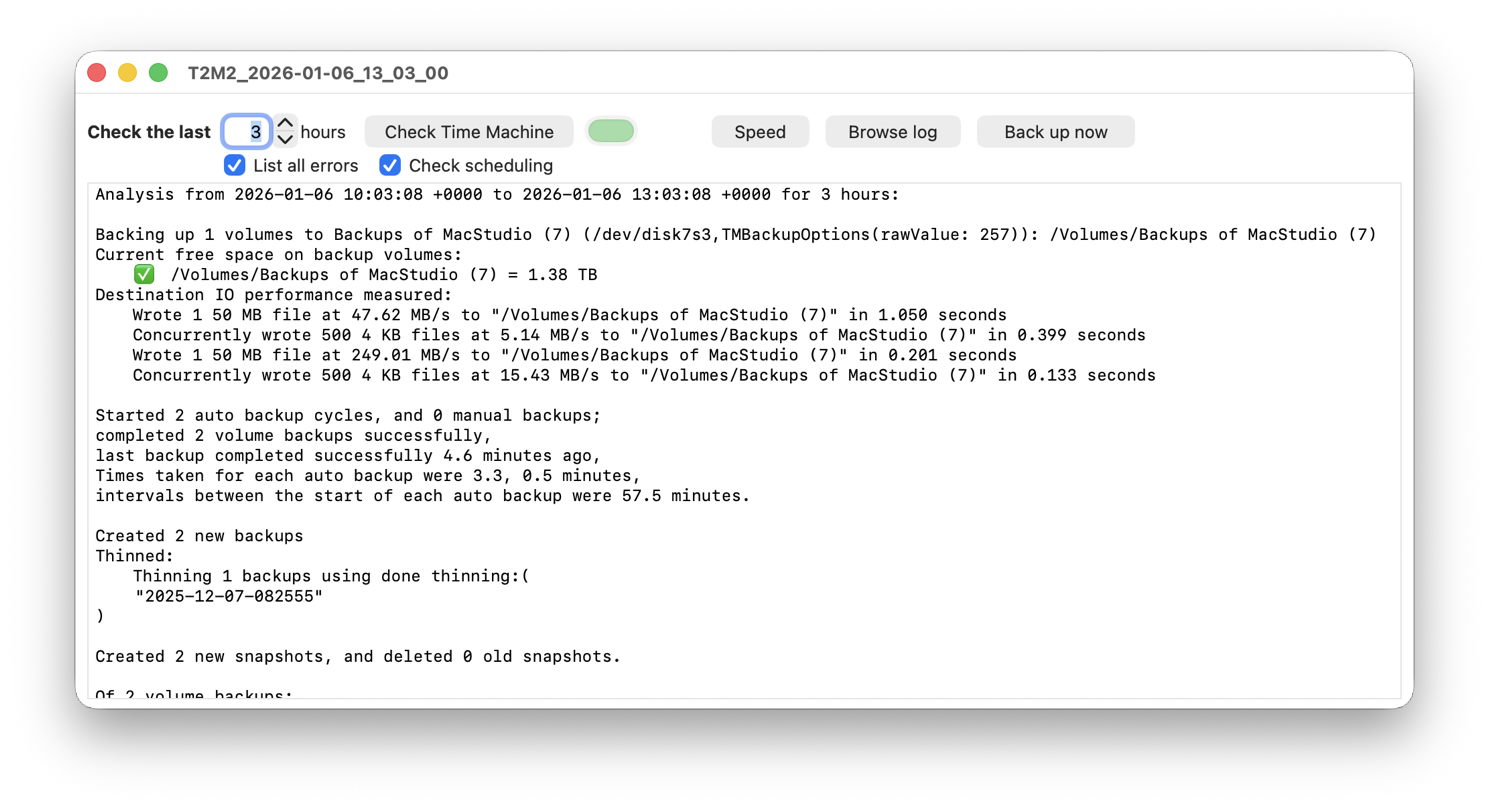
T2M2 analyses log entries made by Time Machine to produce a summary of how Time Machine has performed over the last few hours. That is broken down into sections as follows.
Backup destination
This is given with the free space currently available on that volume, followed by the results of write speed measurements made before each backup starts.
Backing up 1 volumes to Backups of MacStudio (7) (/dev/disk7s3,TMBackupOptions(rawValue: 257)): /Volumes/Backups of MacStudio (7)

Current free space on backup volumes:

✅	/Volumes/Backups of MacStudio (7) = 1.38 TB

Destination IO performance measured:

Wrote 1 50 MB file at 47.62 MB/s to "/Volumes/Backups of MacStudio (7)" in 1.050 seconds

Concurrently wrote 500 4 KB files at 5.14 MB/s to "/Volumes/Backups of MacStudio (7)" in 0.399 seconds

Wrote 1 50 MB file at 249.01 MB/s to "/Volumes/Backups of MacStudio (7)" in 0.201 seconds

Concurrently wrote 500 4 KB files at 15.43 MB/s to "/Volumes/Backups of MacStudio (7)" in 0.133 seconds
Backup summary
This should be self-evident.
Started 2 auto backup cycles, and 0 manual backups;

completed 2 volume backups successfully,

last backup completed successfully 4.6 minutes ago,

Times taken for each auto backup were 3.3, 0.5 minutes,

intervals between the start of each auto backup were 57.5 minutes.
Backups created and thinned (deleted)
Created 2 new backups

Thinned:

Thinning 1 backups using done thinning:(

"2025-12-07-082555"

)
Local snapshots created and deleted
Created 2 new snapshots, and deleted 0 old snapshots.
Note those snapshots are made on the volumes being backed up, not those created in backup storage.
How items to be backed up were determined
This shows which methods Time Machine used to work out which items needed to backed up, and should normally be FSEvents, once a first full backup has been made.
Of 2 volume backups:

0 were full first backups,

0 were deep scans,

2 used FSEvents,

0 used snapshot diffs,

0 used consistency scans,

0 used cached events..
Backup results
This gives Time Machine’s detailed report on how many items were added, and their size, for each completed backup. Note that backups in Tahoe may be performed in two passes, the first with the device unlocked, and secondly with it locked. When that occurs, each phase reports its own results, so you can expect to see two sets of results for each backup completed.
Finished copying from volume "Data"

3168 Total Items Added (l: 611.5 MB p: 662.3 MB)

9699 Total Items Propagated (shallow) (l: Zero KB p: Zero KB)

910579 Total Items Propagated (recursive) (l: 213.45 GB p: 208.82 GB)

913747 Total Items in Backup (l: 214.07 GB p: 209.48 GB)

1578 Files Copied (l: 188.9 MB p: 209 MB)

970 Directories Copied (l: Zero KB p: Zero KB)

432 Symlinks Copied (l: 11 KB p: Zero KB)

5485 Files Move Skipped (l: Zero KB p: Zero KB) | 5485 items propagated (l: 4.89 GB p: 3.86 GB)

4214 Directories Move Skipped (l: Zero KB p: Zero KB) | 895395 items propagated (l: 208.56 GB p: 204.96 GB)

119 Files Cloned (l: 279 KB p: 487 KB)

69 Files Delta Copied (l: 422.4 MB p: 452.8 MB)
Error messages
✅ No error messages found.
iCloud Drive and pinning
Backing up the contents of iCloud Drive is a longstanding problem for Time Machine when Optimise Mac Storage is enabled. Those files in iCloud Drive that are stored locally will be backed up, but any that have been evicted from local storage could only be included if they were to be downloaded prior to the backup starting. Sequoia and Tahoe let you ‘pin’ individual files and whole folders so they aren’t evicted, and will always be included in Time Machine backups. This is explained here.
Discrepancies and glitches
T2M2 tries to make sense from log entries that don’t always behave as expected. As backups can be complex, there are situations when T2M2 may report something that doesn’t quite add up. This most commonly occurs when there have been manual backups, or a third-party app has been used to control the scheduling and dispatch of backups. If you do see figures that don’t appear quite right, don’t assume that there’s something wrong with Time Machine or your backups. Generally, these glitches disappear from later automatic backups, so you might like to leave it for a few hours before checking Time Machine again to see if the problem has persisted.
Browse log
In practice, you’re most likely to view T2M2’s analysis using the Check Time Machine button first, but here I’ll walk through the greater detail available in log extracts, to aid understanding of the sequence of events in each automatic backup.

To help you see which subsystems are involved in each stage, T2M2 displays their entries in different colours, and you can show or hide each of those.
Automatic backups are called off by the DAS-CTS dispatching mechanism, whose entries are shown in red (DAS) and blue (CTS). They schedule backups so they don’t occur when the Mac is heavily loaded with other tasks, and call a chain of services to start the backup itself. Dispatching is reliable over long time periods, but can be delayed or become irregular in some situations. Inspecting those DAS-CTS entries usually reveals the cause.
From there on, most informative log entries are made by Time Machine itself.
Preparations are to:
- Check the Power State is good to make a backup.
- Find each destination backup storage, decide whether any rotation scheme applies, so determine the destination for this backup.
- Check write performance to the backup destination.
- Find the machine store on the destination.
- Determine any sticky exclusions using Spotlight.
- Determine which local snapshots should be removed, and delete them.
- Create local snapshot(s) as ‘stable’ snapshot(s), and mount them.
- Mount previous local snapshot(s) as ‘reference’ snapshot(s).
- Determine how to compute what needs to be backed up from each source. This should normally use FSEvents to build the EventDatabase.
- Scan the volumes to be backed up to determine what needs to be backed up.
- Estimate the total size of the new backup to be created.
This may be performed as a first pass with the device unlocked. Once backing up starts, entries cover:
- Copying designated items to the destination.
- Posting periodic progress reports during longer backups.
Those may be followed by a second backup pass with the device locked, opening access to a few more items for backup. When that’s complete, closing stages are to:
- Report details of the backup just completed.
- Set local snapshots ready for the next backup, with the ‘stable’ snapshot(s) marked as ‘reference’, and unmount local snapshots.
- Delete working folder used during the previous backup as ‘incomplete’.
- Create the destination backup snapshot.
- List the number and frequency of backups in backup storage.
- Delete any old backups due for removal.
- Report backup success or other outcome, and the interval to the next scheduled backup.
They’re summarised in this diagram. Although derived from Sonoma, Sequoia and Tahoe bring no substantial change, apart from Tahoe’s two-pass backup sequence.

Further reading
Where should you back up to?
How big a backup store do you need?
What performance should you get from different types of storage?
Is it worth storing Time Machine backups on a faster drive?
Snapshots aren’t backups
Exclude or include items in backup, search, iCloud Drive and QuickLook preview
Watch your background: automatic Time Machine backups
Migrating to a new Mac, and claiming Time Machine backups
Planning complex Time Machine backups for efficiency
How Time Machine backs up iCloud Drive in Sonoma
Time Machine backing up different file systems
Which extended attributes does macOS Tahoe preserve?
A brief history of Time Machine
 The Eclectic Light Company