
Wherever you go in the world, the feast of Christmas is now associated with decorated trees, a relatively modern tradition outside Germany, where they originated and became popular as recently as the nineteenth century. That compares with Nativity scenes, plays and cribs that had originated in the fourteenth century and had quickly spread across Europe.
In the early nineteenth century, following marriages between German royalty and those of other European nations, Christmas trees spread across Europe. They reached Britain by 1800, Denmark a few years later, and Austria in 1816. They became more generally popular as a result of Queen Victoria’s fondness for them, and from the 1840s swept the rest of Europe, followed by North America.

Nordic countries had a plentiful supply of suitable trees. Hans Andersen Brendekilde’s finely detailed Cutting Christmas Trees from 1885 shows the men and boys of Danish families preparing some for their homes.

Those who couldn’t go off to the woods to cut their own Christmas trees bought them in one of the seasonal markets that set up in most towns, as shown in Carl Wenzel Zajicek’s watercolour of the Christmas Market in Am Hof Vienna from 1908. This is the largest square in the centre of Vienna, and still hosts a large seasonal market.

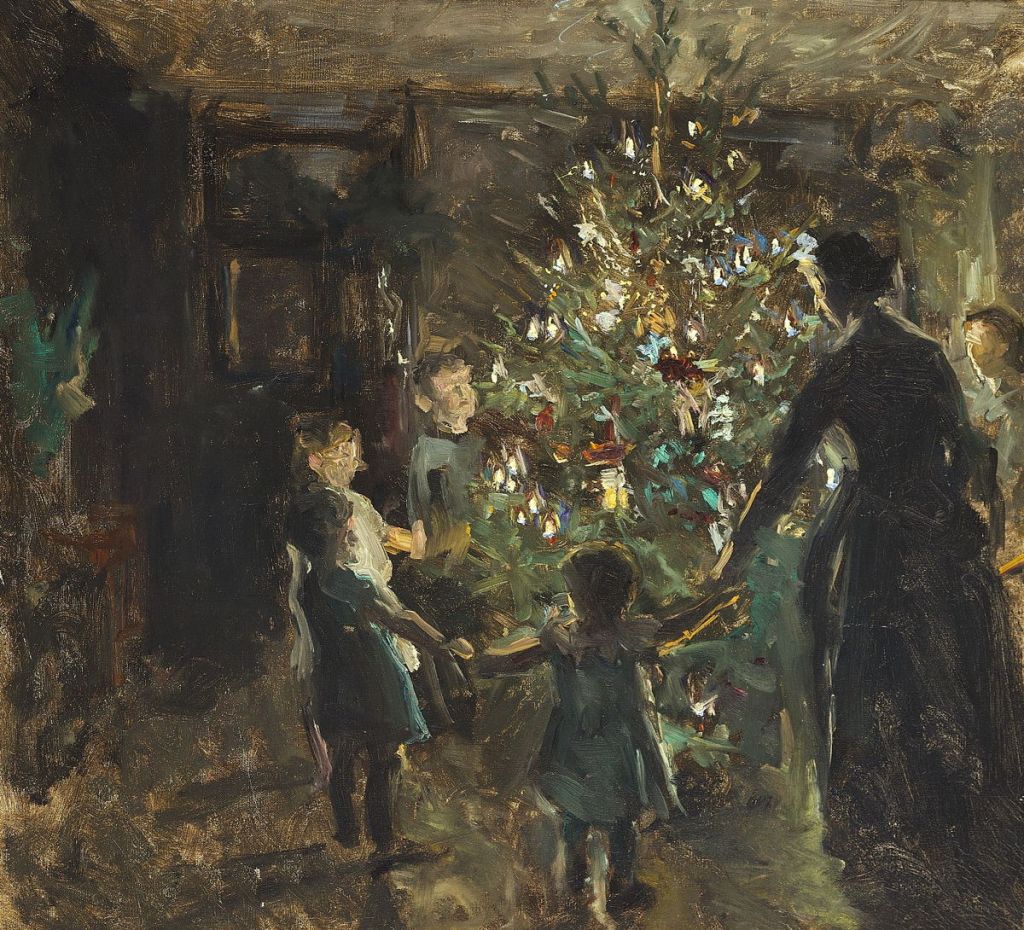
A Danish artist and member of the Skagen group of Impressionists, Viggo Johansen painted this wonderfully loose study for a finished painting of Christmas Eve in 1891.
Because of an earlier family tragedy, Johansen had been banned from dancing around the family Christmas tree when he was a child. When he came to have his own family, he went out of his way to ensure that his six children weren’t so deprived. That year he bought one of the largest Christmas trees in Copenhagen, and painted his family celebrating around it. That took him about four months, while the tree shed most of its needles, and his family had to keep attaching freshly cut branches to maintain its appearance.

The younger Carl Oesterley captured history in his painting of Queen Marie of Hanover Giving Presents to the Poor and Needy (1908). Princess Marie of Saxe-Altenburg, as she’s more properly known, lived between 1818-1907. The artist’s father, Carl Oesterley senior, had been court painter to her family, but in 1866 her father’s kingdom was annexed by Prussia. The Princess married King George V of England, and her family never relinquished the throne. Princess Marie is shown as a saintly figure, bathed in light as the poor and needy, including a sick boy in the bed behind her, worship her grace.

Leopold Graf von Kalckreuth brings together what has since become a cliché of Christmas cards in his sentimental group of Children by the Christmas Tree from about 1912.

On Christmas Eve at the end of 1913, Lovis Corinth painted this delightful scene of their two young children enjoying their Christmas Decorations. Charlotte, the artist’s wife, is seen at the left edge dressed as Father Christmas. Their son Thomas stands with his back to the viewer in front of a nativity scene close to his mother. Daughter Wilhelmine is at the right edge, inspecting one of the presents. Corinth uses high chroma traditionally associated with Christmas to enrich the scene.

In Nikolai Astrup’s woodcut print of his family’s Christmas Eve at Sandalstrand from 1918, his wife and young son have fallen asleep exhausted, amid traditional Norwegian decorations, including their well-decked tree.
 The Eclectic Light Company