

By happy coincidence, while I’m exploring paintings of the Dutch Golden Age, one of its outstanding artists celebrates the four hundredth anniversary of his infant baptism on 20 November 1625: Paulus Potter, who died tragically young in early 1654, but in that short period established himself as a founding father of animal painting.
He was born in Enkhuizen, a busy port in the north of the Dutch Republic, but moved to Leiden and then Amsterdam while still a child. His father was a painter, and young Paulus learned and worked as an apprentice in the family workshop.

He painted God Appearing to Abraham at Sichem in the middle of his apprenticeship, in 1642, making it one of his earliest surviving works. The human figures at the left have some odd proportions indicating his inexperience, but the most striking feature is the magnificent pair of cows stealing the centre. How these cattle came to dominate this painting is a mystery: it’s as if he was told to paint the Biblical story, but lacked interest and decided to liven it up according to his desires.
Once he had completed his apprenticeship he moved to Delft, where he became a member of the Guild of Saint Luke (the painters’ guild) in 1646.

Peasant Family with Animals (1646) appears to be another example of a hijacked motif, of a peasant family with a curiously grotesque young daughter, their cottage, and some wizened trees. Potter has added to that an extensive collection of farm animals, including two cows (one being milked), a calf, and sundry sheep, lambs, and a goat, in a sampler of farm animals.

His Figures with Horses by a Stable from 1647 shows his maturing composition. The farmer and his wife, who is feeding a child at her breast, still have a slight awkwardness about them, but the horses, chickens, dog, and distant cattle are finely painted, as is the magnificent tree in the centre. The sky contains several birds, another consistent feature of his mature works.

He completed his development in his Driving the Cattle to Pasture in the Morning (1647) with a superb dawn sky, providing the warm backlighting to the cattle and barren trees. The farmer’s child has grown, but is still feeding at the breast, as was common at the time. At the far left a pair of pigs are shown in repose.
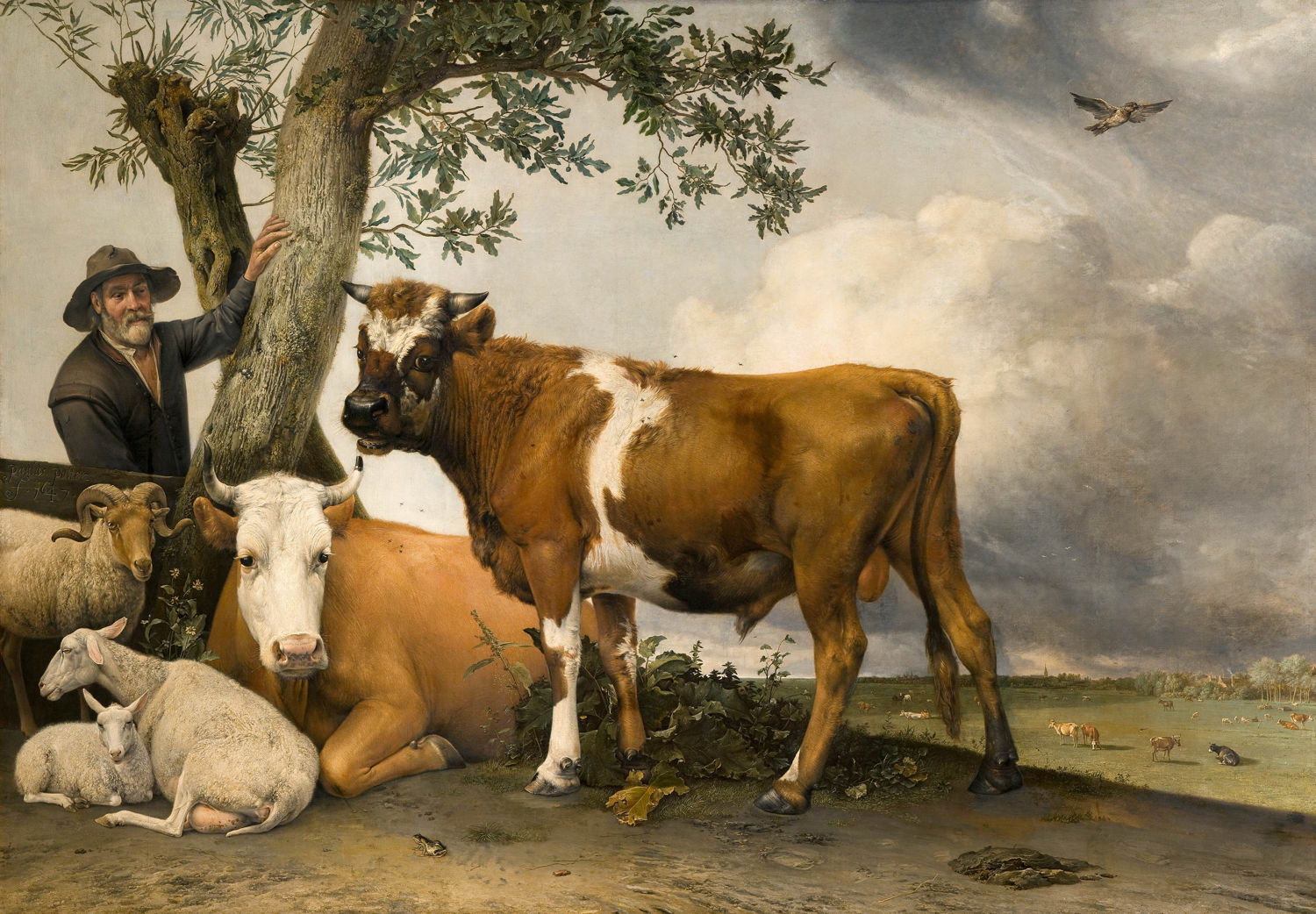
His first masterpiece, for the next couple of centuries ranked alongside Rembrandt’s finest, is The Bull (also widely known as The Young Bull) (1647), which is almost life-sized, and vivid in its surface details. Originally intended just to be a portrait of the central bull, Potter enlarged the canvas to accommodate (from the left) a ram, lamb, ewe, herdsman, cow, and above them a bird of prey, possibly a buzzard. Beyond them are more cattle in the meadows receding to the church of Rijswijk, between Delft and The Hague. There are also many finer details including a frog in the foreground, textured bark and lichen on the tree, and several flies on the cattle.

A Husbandman with His Herd (1648) is a variation on a similar theme, this time with a lifelike cow-pat in the centre foreground.
In 1649, Potter moved to The Hague, where he married, and worked until 1652. His wife’s family were well-connected and provided entry to the upper class. At this time he apparently painted a work showing a cow pissing that was bought with glee by Amalia of Solms-Braunfels, Princess of Orange by marriage.
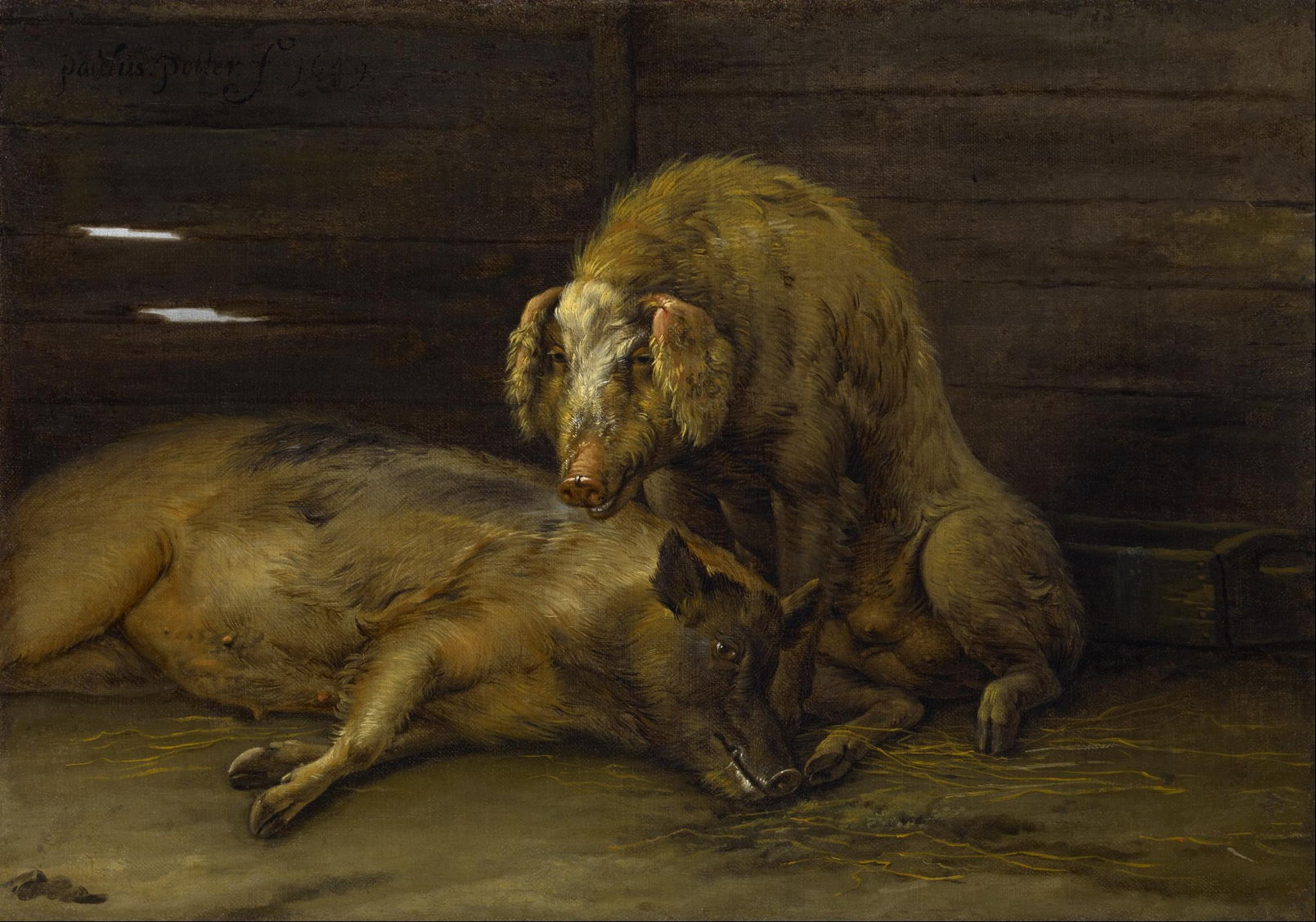
His Two Pigs in a Sty (1649) shows two hairy pigs at rest inside. Many of the older breeds of pig were hairier than modern varieties, and Potter has painted their coats realistically, as well as skilfully lighting the face of the sow sat on her haunches.

Two Horses near a Gate in the Meadow (1649) shows that Potter still had some room for improvement in his equine works: the head of the horse in the centre has some slightly peculiar proportions.

The Bear Hunt (1649) is another large canvas, showing a swarthy man armed with a scimitar, his hounds, and others attacking two Eurasian brown bears. Although the bear had become extinct through hunting in the British Isles by about 1000 CE, it may still have been rarely encountered in the Netherlands in Potter’s day. His first-hand knowledge of the animal appears limited, though, as their body proportions are quite different to those shown here.

Orpheus and Animals (1650) is one of Potter’s most unusual paintings, showing a wide range of different species, some of which weren’t well-known then, and one of which (the unicorn) didn’t even exist. They include a Bactrian camel (two humps), donkey, cattle, ox, wild pig, sheep, dog, goat, rabbit, lions, dromedary (one hump), horse, elephant, snake, deer, unicorn, lizard, wolf, and monkey.
In 1652, Potter moved to Amsterdam.

Cattle in the Meadow (1652) develops the effects of light together with the early autumn season almost to the point of being impressionist in its use of colour. In addition to the cattle, the painting is enhanced with a sow and her piglets in the right foreground, and exuberant lichen growth on the split tree-trunk by them.

Resting Herd (1652) shows another variation of his standard composition for cattle.
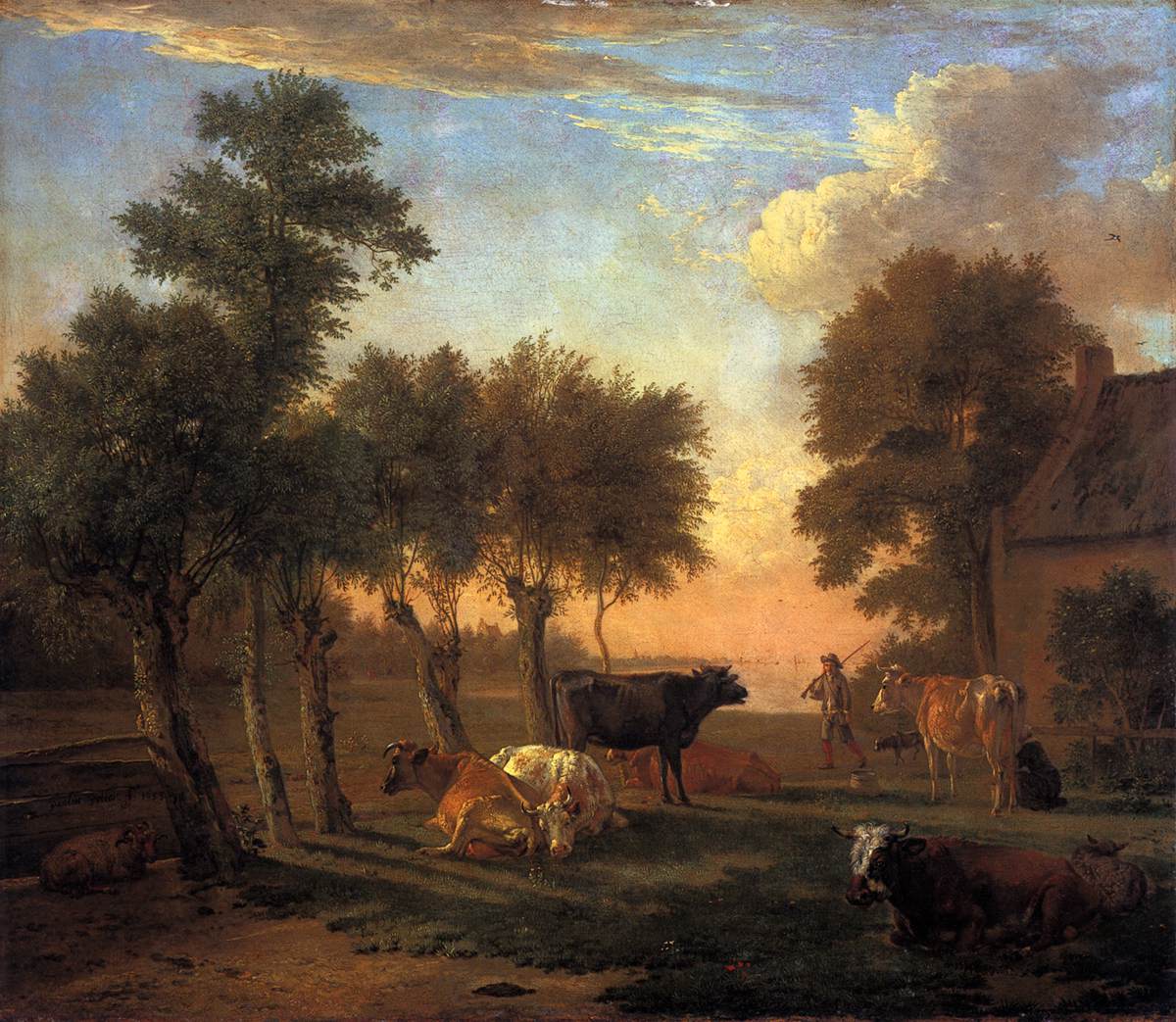
His Cows Grazing at a Farm (1653) was one of his last paintings, and apart from its meticulous detail, its rich lighting effects might have been more typical of Corot two hundred years later.
In 1654, when Paulus Potter was still in Amsterdam, he died from tuberculosis at the age of only 28. In his tragically brief career, he had painted over a hundred oil paintings, most of which survive today. His faithful depictions of farm animals set the standard for art for the next couple of centuries, and were inspiration to Constant Troyon and others who painted animals.
 The Eclectic Light Company