
With the Paris Commune crushed in 1871, and order being restored to France under the new Republic, the Pissarros returned to live a more settled life in Louveciennes again, after the shock of discovering that most of his 1500 or so paintings had been damaged or destroyed by occupying Prussian soldiers. There Pissarro lived close to Alfred Sisley, and the two often painted in company. Renoir’s mother also lived in the village, enabling the three painters to meet frequently.
Among Pissarro’s favourite motifs in this post-war period were numerous views of the Route de Saint-Germain and other roads around Louveciennes, and the River Seine at Bougival.

Less known are his watercolours, such as this view of Louveciennes, Route de Saint-Germain from 1871, and are reminiscent of the paintings of Johan Jongkind.

Pissarro painted this woodland view of an Avenue in the Parc de Marly in the autumn of 1871. It looks towards the village of Marly-le-Roi from the Port du Phare, inside the grounds of the Château de Marly. His skilful use of staffage draws the eye towards the far end of the avenue. The artist seems to have sold this painting quite quickly to an unknown buyer, from whom Durand-Ruel bought it in early 1873.

Alfred Sisley also painted here en plein air, as seen in The Seine at Bougival from 1872. The water surface is mirror-smooth, and Sisley has been careful to paint the reflection of the buildings with optical precision.

This is Pissarro’s wintry scene of The Post-House, the Route de Versailles, Louveciennes, Effect of Snow from 1872. This looks from the ‘Royal Gate’ of the Château de Marly towards the post-house, a landmark featured in several of his works from this period. This painting was bought that Spring by Durand-Ruel, who sold it a year later to Jean-Baptiste Faure, the opera singer, Pissarro’s first collector and Sisley’s enduring patron.

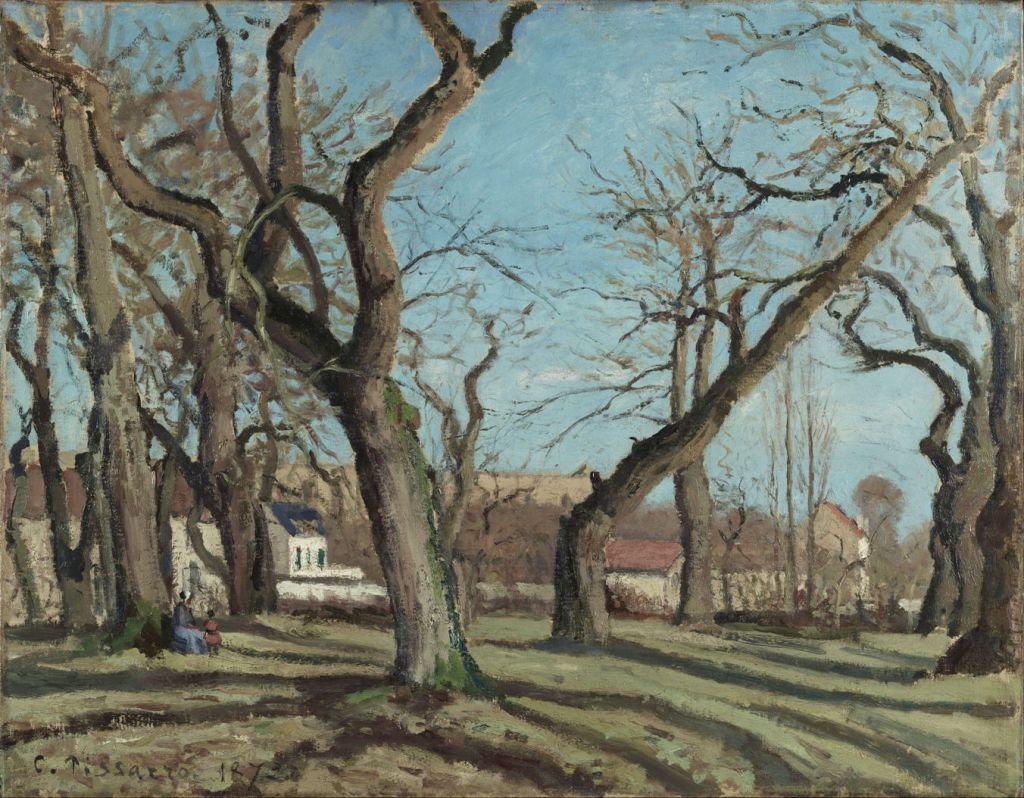
Pissarro must have taken delight in the weird forms of the trees in this Chestnut Grove at Louveciennes, painted in 1872. In the far distance is the massive warm cream stone of Marly Aqueduct.
Although the Pissarros were able to live on the money generated by Camille’s painting, they must have got by in relative poverty. However, in 1872, he sold four stretched canvas overdoor panels depicting the seasons to the banker Achille Arosa for 100 Francs each. Pissarro tried to buy them back when they came up for auction in 1891, but despite appealing to Vincent van Gogh’s brother Theo, they were sold for just over a thousand Francs to the Bernheim-Jeune Gallery, and have remained in private collections since.
In April 1872, the Pissarros moved from Louveciennes to Pontoise, where they rented a house and Camille established his studio.

Sisley wasn’t as prolific as Pissarro in either ‘road’ or snow scenes. His Snow on the Road, Louveciennes (1874) clearly comes from the same school, but his trees and buildings remain distinctive.

Sisley’s Aqueduct at Marly (1874) shows the massive form of this aqueduct which appeared in the distance in Pissarro’s Chestnut Grove at Louveciennes above. This and the nearby Machine de Marly, which Sisley also painted, were part of a monumental hydraulic network built in the 1680s for Louis XIV, to supply water to the Château de Marly and the royal gardens of the Palace at Versailles. The stone tower at the right end of the aqueduct is the Tour de Levant, used by Prussian troops as a vantage point for observing the besieged city of Paris, a point that won’t have escaped Sisley’s attention.

Sisley’s Forge at Marly-le-Roi from 1875 shows the village blacksmiths at work.

In 1876, Félicien Rops must have visited one of the popular bathing resorts nearby, to paint his Sunday in Bougival. This shows a lecherous old man watching two young women preparing to bathe there, a mere 15 km (10 miles) from the heart of Paris.
By this time, the Impressionists had moved away from Louveciennes, and were painting elsewhere.

Although Sisley was now living near Sèvres, he must have returned in about 1879 for one last painting in front of the motif, on The Road from Versailles to Louveciennes. This is an example of his more sketchy plein air paintings from his time at Sèvres, and a more traditional perspective view of a road of the time. This section of the road is close to Louveciennes, on the main route between Versailles and Saint-Germain-en-Laye.
At that point, the Impressionists finally left Élisabeth Louise Vigée Le Brun to rest in peace.
 The Eclectic Light Company