

When the prolific portraitist in pastels Élisabeth Louise Vigée Le Brun retired to live near Paris, she chose a small hamlet to the west of the city, between the palace at Versailles and Saint-Germain-en-Laye, Louveciennes. She died there in 1842, and is buried in the graveyard not far from her house.
Twenty-seven years later it became the focus for a group of friends, who went on to become the core of the French Impressionists. For the next few years Louveciennes and the adjacent villages of Bougival and Marly-le-Roi were to appear in well over a hundred of their paintings, a few of which I show this weekend.
Just beyond Chatou, the River Seine sweeps to the right in a bend with a series of long islands with popular bathing houses, among them the famous La Grenouillère. In the summer of 1869, Auguste Renoir was living at his parents’ house in Louveciennes, just to the south of this bend, where Camille Pissarro and his family were renting a house. He visited Claude Monet and his family, who were living near Bougival, also on that bend, and they often painted together.
Some of the formative moments in Impressionism if not European art occurred when Monet and Renoir visited La Grenouillère.

Renoir painted at least three different views of La Grenouillère that summer: that above is now in Stockholm, and that below, which is most similar to Monet’s, is in the Oskar Reinhart Collection in Switzerland; the third (not shown here) is in the Pushkin Museum in Moscow. Originally conceived as plein air sketches preparatory to more finished paintings for submission to the Salon the following year, they came to define these brilliant shimmering images formed from high chroma brushstrokes as Impressionist style.

If Impressionism has to have a single moment of birth, it’s surely in the summer of 1869 at La Grenouillère.

Monet’s Bathers at la Grenouillère is his early statement of his Impressionist agenda. The pair realised that Impressionism was about these sketched instants. This also reveals Monet’s preference for modern pigments, as most of the brighter mid-blues here use cobalt blue, introduced earlier in the nineteenth century.

In addition to Renoir, Pissarro and Monet, Alfred Sisley maintained a studio nearer the river in Bougival, where the four artists painted, starved and fought off despair together.

Pissarro painted a succession of views of the roads around the village. His Road to Versailles at Louveciennes (Snow Effect) (1869) is typical of his earlier ‘road’ paintings, showing an avenue of tall, bare-branched trees, brushed in coarsely.

The following winter his paintings concentrated on road scenes around Louveciennes, a theme which continued for many years, spanning the seasons.
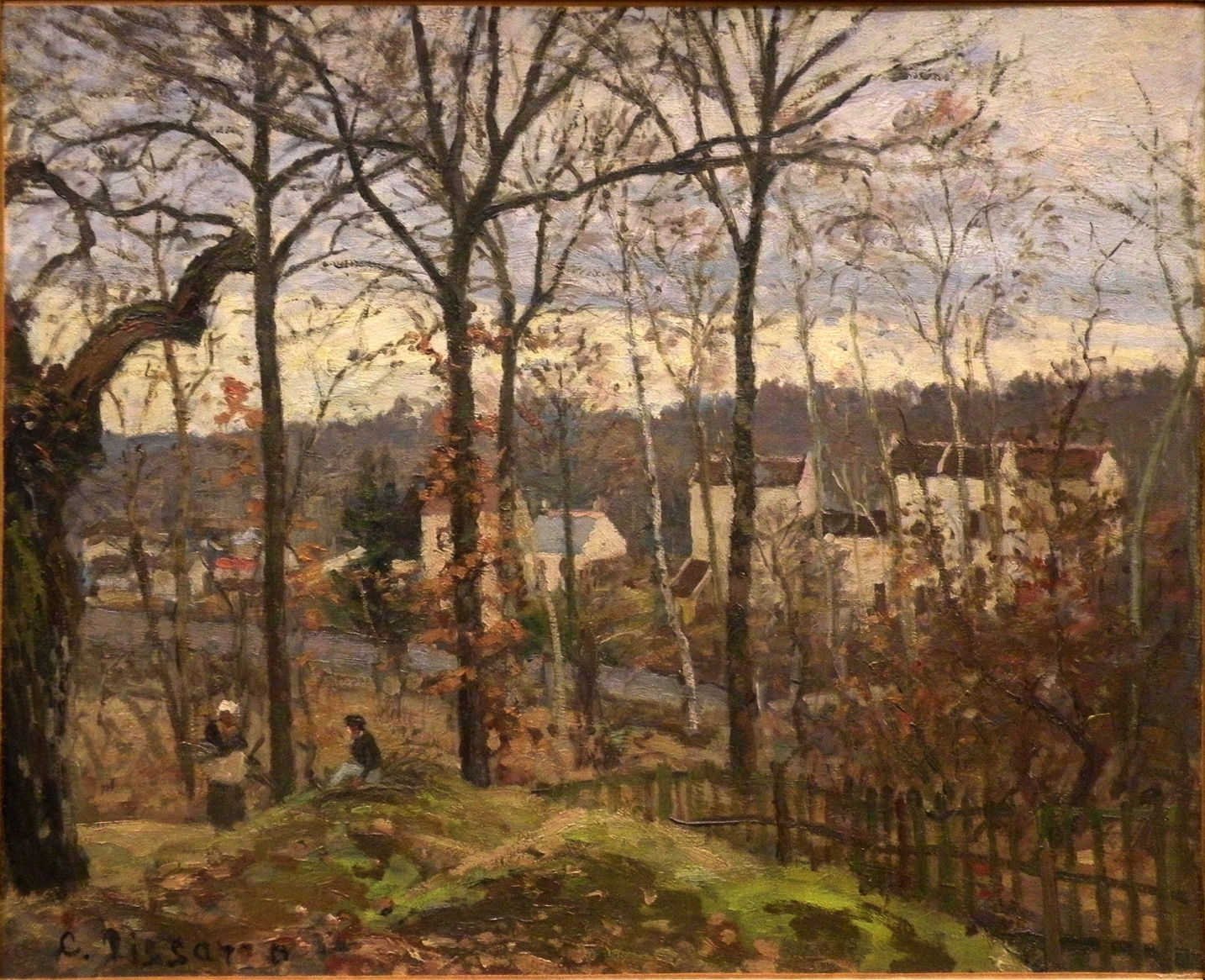
As many artists before him, Pissarro used trees to frame his motifs in repoussouir, but during the late 1860s they started to invade more central areas of the canvas. In about 1869, in his Winter Landscape at Louveciennes for the first time tree trunks and branches spread across his canvas, breaking up the motif behind into small sections.

Pissarro’s Houses at Bougival, Autumn is clearly dated 1870, although by that time he had moved from Louveciennes. It is also thought to have been exhibited at the Salon that year, suggesting it may have been started in late 1869.

Like Pissarro, Sisley started depicting the streets of suburbs, including Early Snow in Louveciennes. This has been dated to 1870, although it appears more likely that it was painted en plein air late the previous year.
Following the outbreak of the Franco-Prussian War, in September 1870 the Pissarros’ house in Louveciennes was requisitioned by the invading Prussians. The family fled first to their friends in Montfoucault, then in December travelled on to England, where they settled in Norwood, at that time an outer suburb of London. When in England, Pissarro met Paul Durand-Ruel, who became his dealer, and Claude Monet, who had also fled to London.
Bougival was also overrun by Prussian soldiers, who commandeered Sisley’s studio; many of his early works were lost, as Pissarro’s were in Louveciennes, just over a mile away. The Sisleys were forced into the city of Paris, and despite Alfred’s British nationality, they remained trapped through the siege of the city into the following year. Worse still, the Sisley family business collapsed and his parents were in no position to support the artist.
 The Eclectic Light Company