

The name of the French department Finistère means the end of the earth, an apt description for the extreme west of the Brittany peninsula as it reaches out into the North Atlantic Ocean. This weekend, weather permitting, I look at a selection of paintings of this often wild part of France. Just over a month ago, Storm Ciarán made landfall here, with winds gusting to 129 mph (207 km/h) and mountainous seas.
This part of France is renowned for its pardons, religious festivals in which the faithful are given indulgences for their sins.
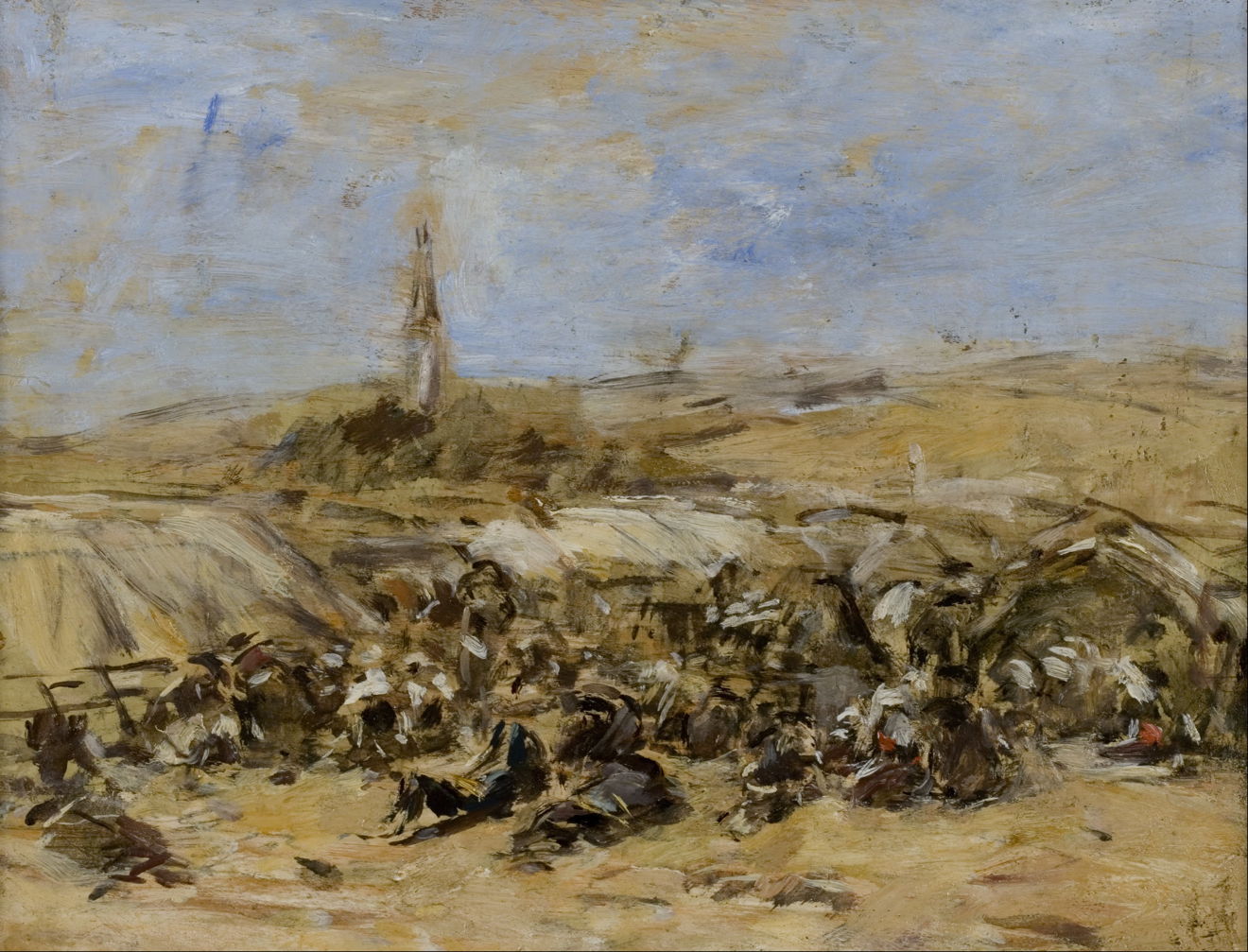
On the last weekend in August, 1857, Eugène Boudin visited the Finistère region’s largest religious celebration, and made sketches in oils, including this The Pardon of Sainte-Anne-La-Palud (study) (1858). These he used to paint a more traditionally finished oil painting, shown in the Paris Salon the following year, where it was praised by Baudelaire.
Boudin also painted landscapes in the west of Brittany, including at least three views of the rugged coast at Camaret.
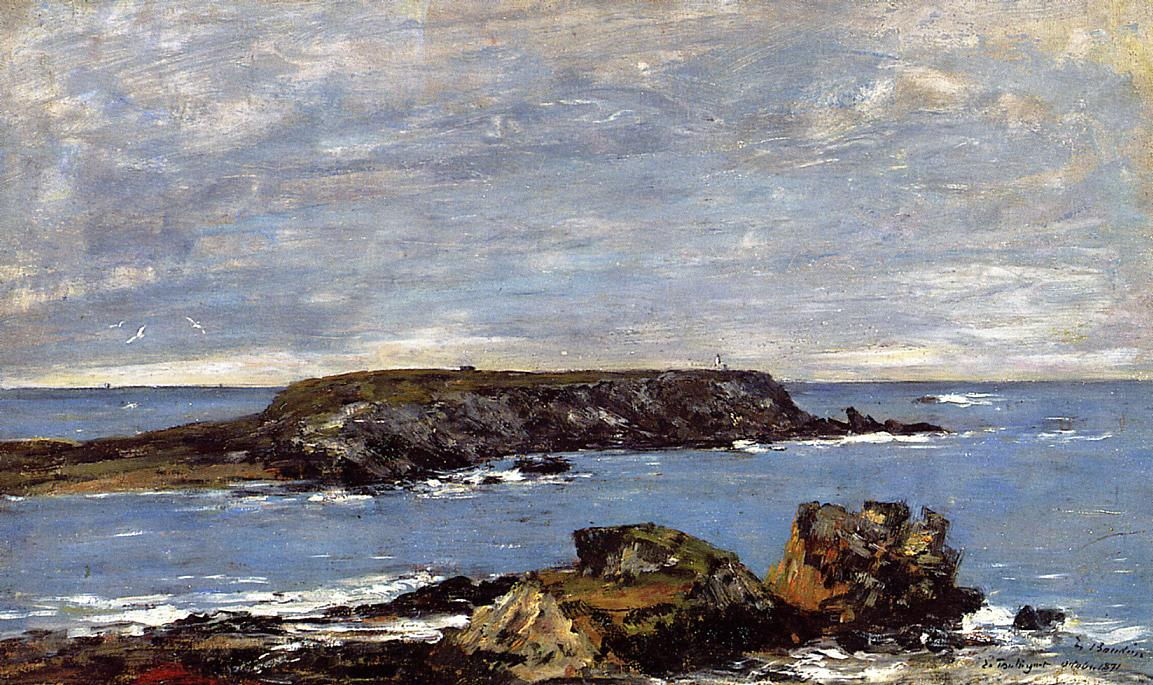
The first two, both known as Camaret, Le Toulinguet (c 1871) and showing almost identical views, include the version above in a private collection, and another now in the Philadelphia Museum of Art (not shown). Boudin painted at Camaret, in Brittany, each year between 1870 and 1873.
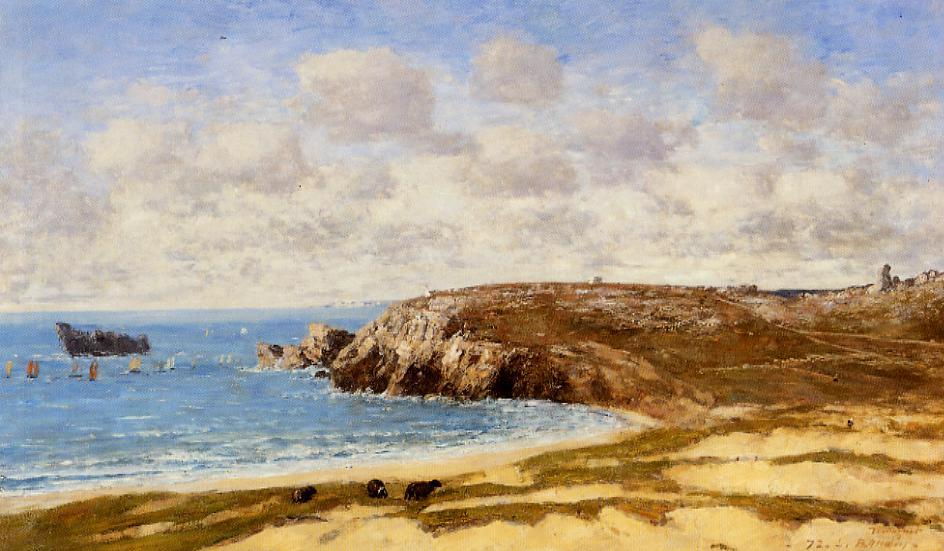
The third is this, Camaret, Le Toulinguet (1872), now in a private collection.
Each summer, Jules Breton and his family travelled west from their home in the north of France, to holiday in the far west of Brittany.

In 1871, the Breton family spent much of the summer and autumn in their now-customary haunts in Brittany. It was probably in the previous year that he started making a series of studies which evolved into Élodie with a Sunshade, Baie de Douarnenez (1871). This shows Breton’s wife Élodie reading, with the magnificent view over the Bay of Douarnenez to the low hill of Ménez-Hom in the far distance. Ménez-Hom is reputed to have been a sacred place in neolithic times, and is the subject of many local legends.
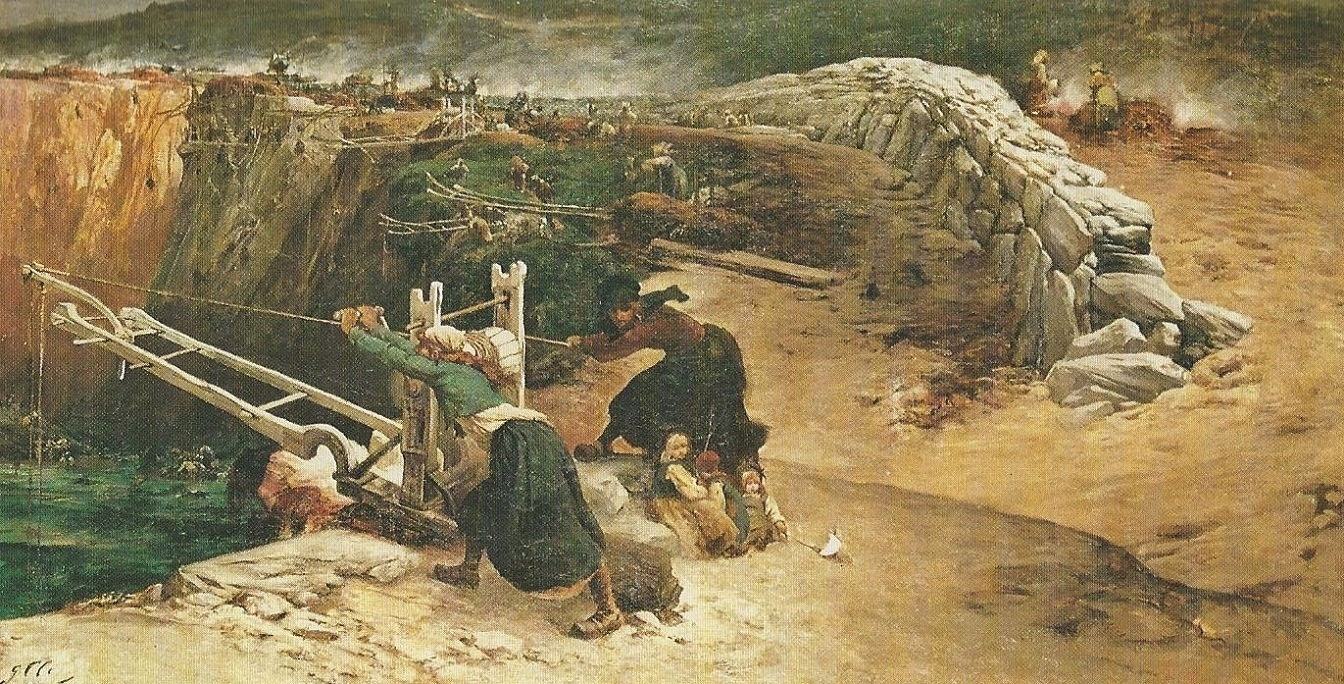
As artists started to flock to Brittany in the late nineteenth century, they saw the seaweed harvesting and processing industries at first hand. When Georges Clairin visited the extreme western promontory of the peninsula, he painted Kelp-burning at the Pointe du Raz (1882).
Teams, largely of women, descended the cliffs when the tide was low, to gather seaweed onto the narrow beach (left). They loaded the seaweed into baskets which were then raised using winches at the top of the cliffs (centre), and the harvest taken behind a massive dry-stone wall for burning (right and in the distance). The ashes were then gathered up and taken off in carts, for sale.

Pierre-Auguste Renoir visited this area in about 1883, and caught it in its summer disguise, in his Sunset at Douarnenez.
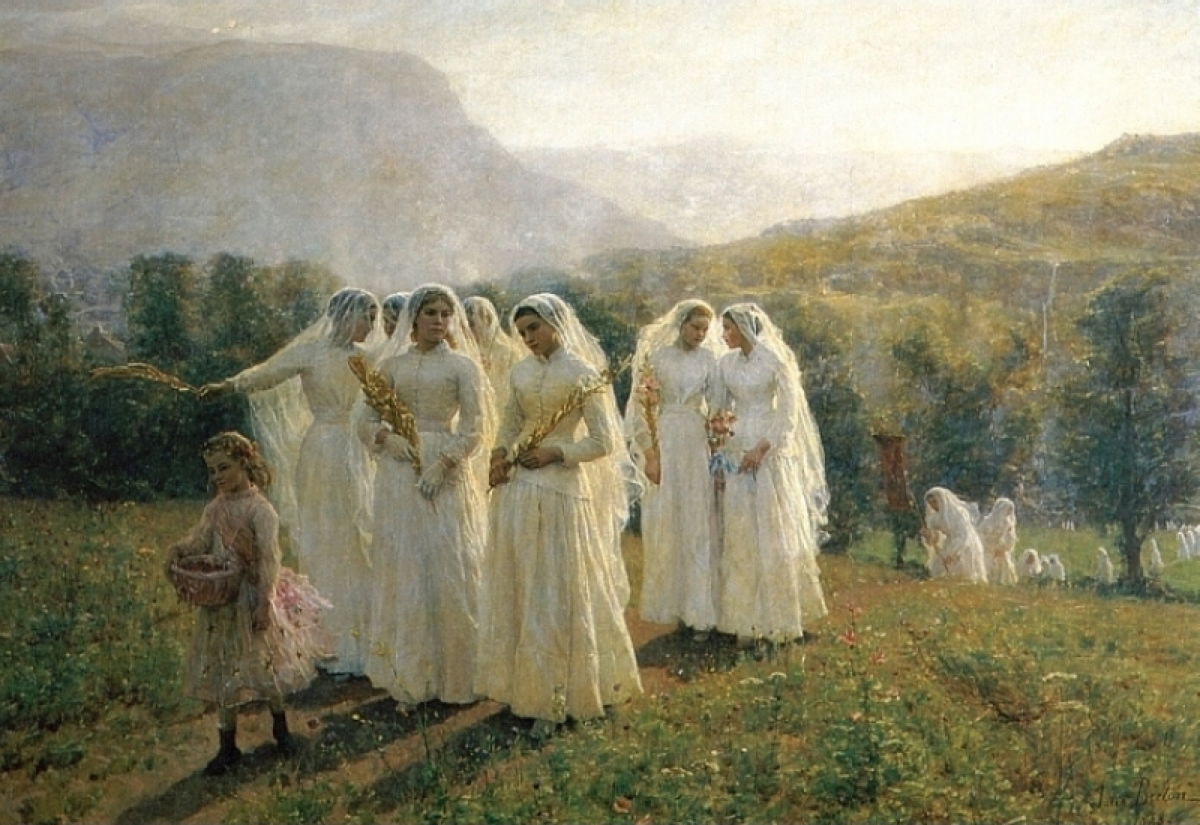
Jules Breton’s last working period in Douarnenez was in 1890, when he most probably painted his visionary Young Women Going to a Procession (c 1890). A long trail of young women, dressed in virginal white, are making their way through the rolling coastal countryside. Clutching golden fronds (probably of ripe wheat), they are led along the path by a young girl. Further back is a woman bearing a church banner.
The distant hills and cliffs are wreathed in mist, and the whole scene is backlit, casting halos around the veiled heads of the young women. This probably shows a ceremonial procession in association with the rite of First Communion.
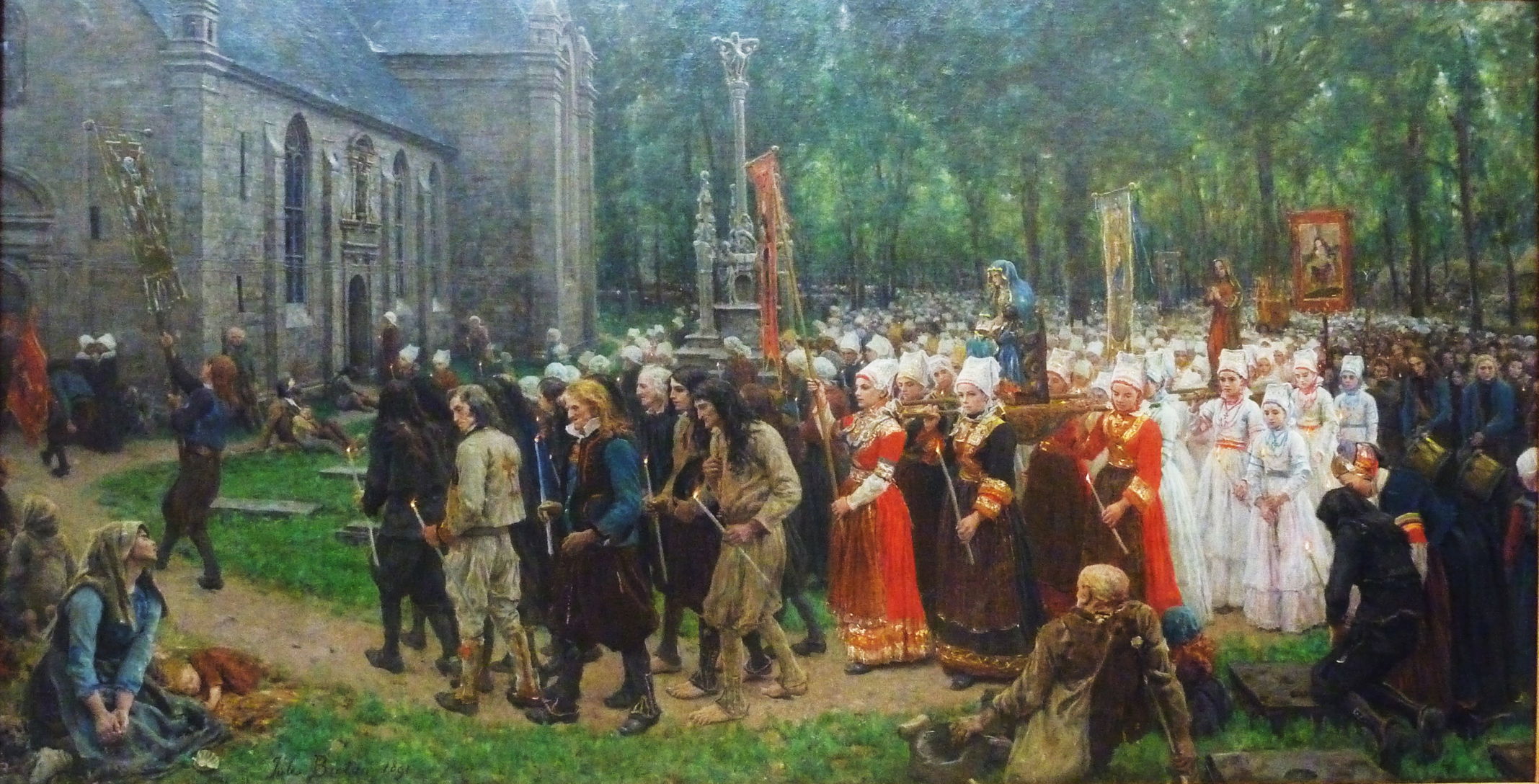
Breton’s last great painting of the crowds at a pardon was The Pardon of Kergoat in Quéménéven in 1891. He had accumulated numerous studies, sketches, and probably photographs too showing the masses who attended this small inland village near Quimper in Brittany, on the third Sunday in August, 1891. They came to ask the ‘Virgin of Pity’ and ‘Christ in Agony’ to cure their ailments.
During the 1890s the Nabi painter and sculptor Georges Lacombe discovered the area.
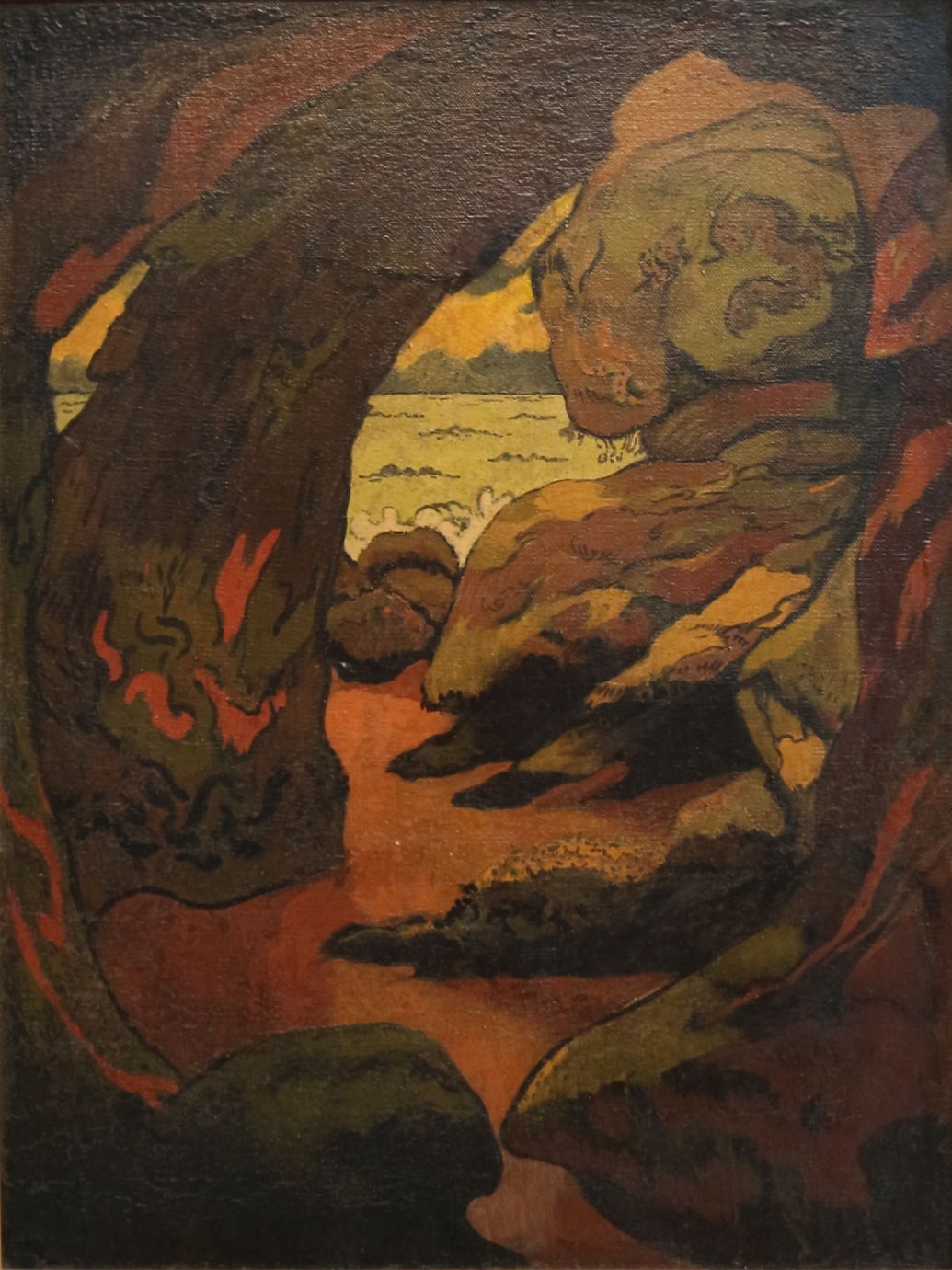
Lacombe’s Cave in Camaret from the period 1890-97 shows a sea cave at the end of the Crozon peninsula in the far west of Brittany, not far from Cape Finistère.
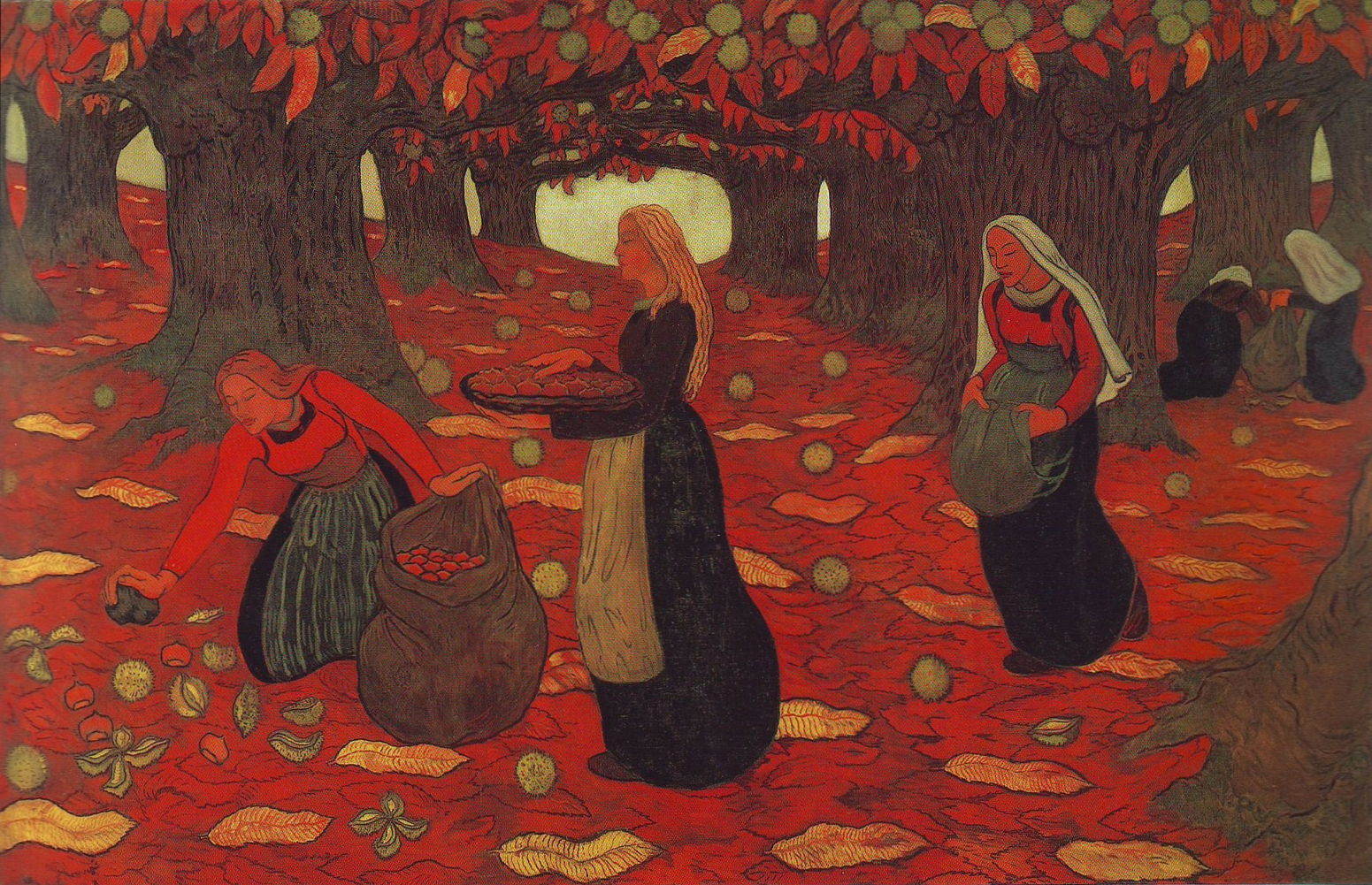
Like Paul Sérusier, Lacombe was fascinated by goings-on in the woods in Brittany. This painting of Chestnut Gatherers from 1893-94 combines the Nabi flattened decorative look with a rich red more typical of the early twentieth century.
 The Eclectic Light Company